
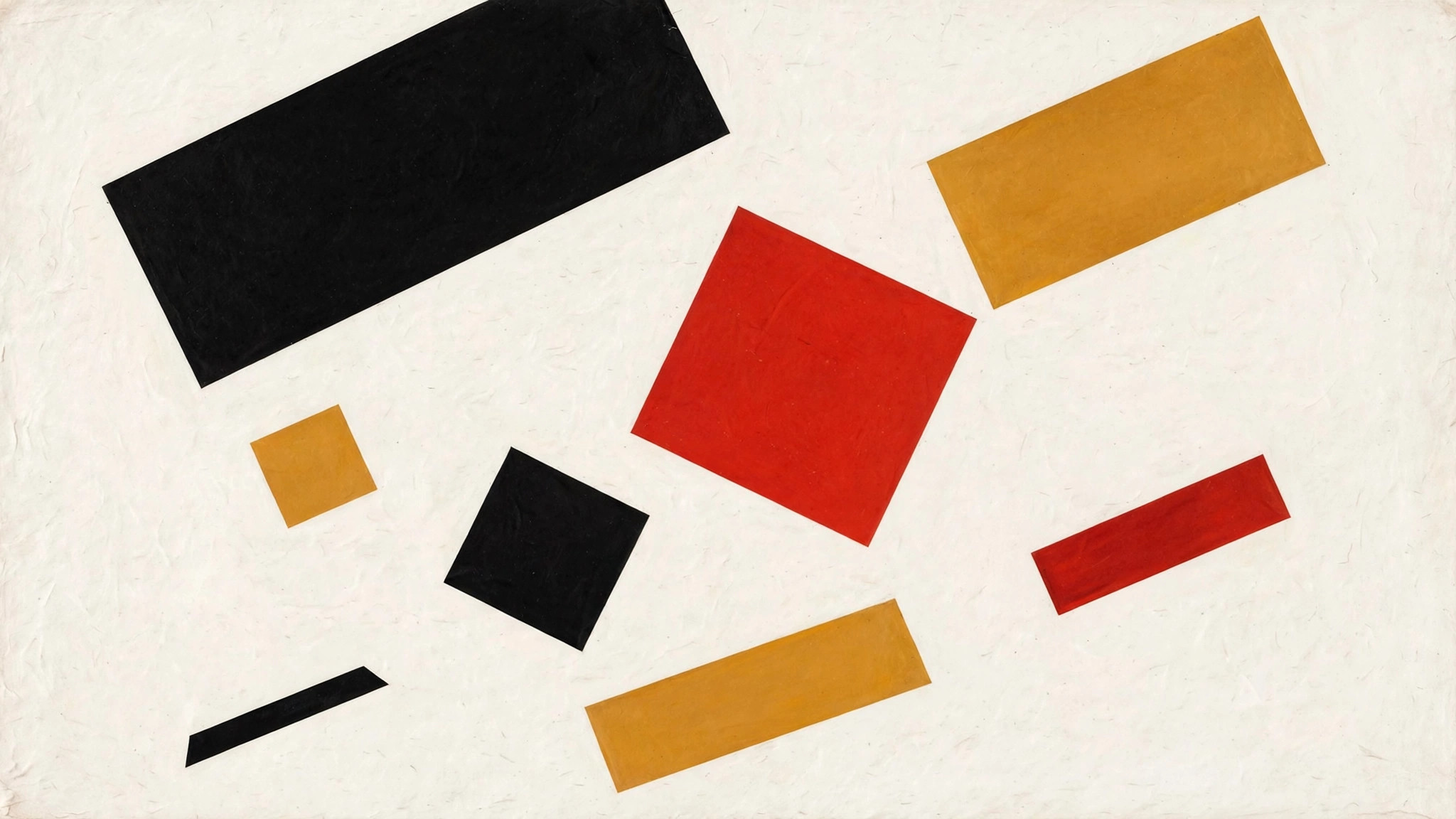
In 1915, Kazimir Malevich hung a black square in the corner of a gallery — the corner traditionally reserved for religious icons — and declared the zero point of painting. Suprematism was born: art reduced to pure geometric feeling, rectangles and circles floating in white voids, nothing depicted, everything felt. A Suprematist abstract wallpaper brings that radical purity to your screen: bold shapes in cosmic space, the avant-garde as background.
Suprematism’s power is its absolute conviction. Malevich believed geometric forms could convey pure spiritual feeling, unmediated by representation — that a red square could mean more than any landscape. Whether or not you share the mysticism, the visual result is undeniable: compositions of startling clarity and confidence. Where guides to geometric abstract art wallpaper catalog geometry’s varieties, Suprematism is its manifesto — geometry with a mission.
The Zero Point
Malevich’s Black Square was not a joke but a reset: painting, he argued, had exhausted representation, and only by starting from zero — from the simplest possible form — could it find a new purpose. Suprematism (“the supremacy of pure feeling”) was that purpose: art as direct transmission of sensation, the shape bypassing the mind to strike the spirit.
As wallpaper, this philosophy creates backgrounds of unusual intensity. The geometric red texture design tradition explores red’s energy; Suprematism deploys it — the red rectangle not as decoration but as event, a pure hit of feeling.
Floating in the Void
Suprematist compositions typically float their shapes in white (or light) voids — the forms unanchored, drifting in infinite space. This weightlessness is the style’s signature: the shapes seem to hover, to exist in a cosmic rather than terrestrial space. As wallpaper, the floating creates a sense of openness — the screen becomes a window onto the infinite, the shapes its only inhabitants.
Composing the Absolute
Suprematist wallpapers are composed around the shapes’ relationships — each arrangement a different pure feeling. The main arrangements are:
- Dynamic diagonals — shapes tilted and thrusting, full of implied motion
- Static icons — shapes at rest, the square centered and the circle calm
- Complex constellations — multiple shapes in dynamic relation across the void
Dynamic Diagonals
Shapes tilted, thrusting, in motion — the Suprematist diagonal suggests energy, flight, the cosmic in motion. These are the most dynamic Suprematist wallpapers: the rectangles seem to travel, the composition humming with implied movement. They suit energetic setups and users who want their minimalism with momentum.
Static Icons
Shapes at rest — the square centered, the circle calm, the composition icon-like. These are the most meditative Suprematist wallpapers: pure form, perfectly placed, radiating stillness. They suit contemplative work and pair beautifully with an abstract dark geometric wallpaper‘s love of essential form.
Complex Constellations
Multiple shapes in dynamic relation — Malevich’s later, more complex compositions, the void populated with geometric life. These are the richest Suprematist wallpapers: the pure feelings multiplied, the composition becoming a society of shapes. They suit larger screens, where the constellation has room to develop its relationships.
The Suprematist Palette
Suprematism’s palette is famously limited — and the limits are expressive.
Black, Red, and White
The classic triad: black for gravity, red for energy, white for infinity. These wallpapers have the stark power of manifestos — the colors of revolution, of urgency, of absolute conviction. They suit bold tastes and statement roles: the wallpaper as declaration.
Earth and Ochre
Malevich’s later palette warmed: ochres, browns, muted reds — the cosmic made terrestrial. These feel more human, more approachable: pure feeling with a heartbeat. The history of neon signs reminds us that even the boldest aesthetics have warm chapters; Suprematism’s ochre period is its most livable.
Styling Radical Purity
On desktops, Suprematist wallpapers create workspaces with philosophical character — the floating shapes seem to ask what matters, the void suggesting that the answer is: less. They are superb for deep work: the wallpaper that embodies focus through its own radical simplification.
On phones, a Suprematist lock screen is a small manifesto: pure form in your pocket, the avant-garde as daily companion. And as a design touchstone, these wallpapers are unmatched — a century-old reminder that the boldest move is often the simplest one, executed with total conviction.
Malevich and the Black Square
Suprematism began with a scandal: December 1915, Petrograd, the “Last Futurist Exhibition,” where Kazimir Malevich hung thirty-nine abstract paintings — and in the corner, the place of honor traditionally reserved for religious icons, placed his Black Square. A black quadrilateral on white ground, nothing else. The statement was total: painting freed from depicting, the icon replaced by the void, the corner’s holiness transferred to pure form. Audiences were baffled; art history was redirected.
Malevich’s theory matched the audacity: suprematism — the supremacy of pure feeling in creative art — held that the artist’s sensation, not the world’s appearance, was the true subject. The geometric forms were feeling made visible: the square as the ultimate expression, the “zero of form,” the point where painting began again from nothing. His later compositions — the floating rectangles, the tilted crosses, the limited palettes — were explorations of that zero, the void given structure.
The movement’s influence radiated far beyond its brief life: the Bauhaus absorbed its geometry, De Stijl its purity, minimalism its reduction, the entire twentieth century its permission to begin from nothing. Every flat-color abstract, every geometric wallpaper, every designer who ever placed a single shape on an empty field is working in Malevich’s shadow — the Black Square’s long shadow, cast from that Petrograd corner across a century of screens.
The Feeling Remains Supreme
What survives of suprematism is not the theory but the sensation: the peculiar lift of pure geometry, the feeling the shapes give without depicting anything. Stand before a suprematist composition — or set one as wallpaper — and the effect is immediate and hard to explain: the forms feel significant, though they signify nothing. That is the supremacy Malevich meant: feeling, needing no object.
Your screen’s bold geometry carries that century-old conviction quietly: that pure form can move, that the square and the rectangle are enough, that feeling doesn’t need a subject. The Black Square hung in a corner in 1915 and changed what painting could be. The suprematist wallpaper hangs on your screen and changes, slightly, what the day feels like. The supremacy of feeling, indeed — over depiction, over decoration, over everything except the pure, floating, undeniable form.
Malevich promised that pure form could convey pure feeling — and a century later, his rectangles still deliver. A Suprematist wallpaper is not decoration but transmission: shape to spirit, without intermediaries.
Keep it for the essential days. Let its floating blocks remind you that beneath the complexity — the notifications, the noise, the everything — there are simple forms, pure feelings, waiting.
The square is still black. The feeling is still pure. The zero point holds.
Related posts:
Abstract work rewards a second look — browse more of geometric-art when you are ready for a new backdrop.
Share this page with a fellow art lover looking for their next wallpaper.

