
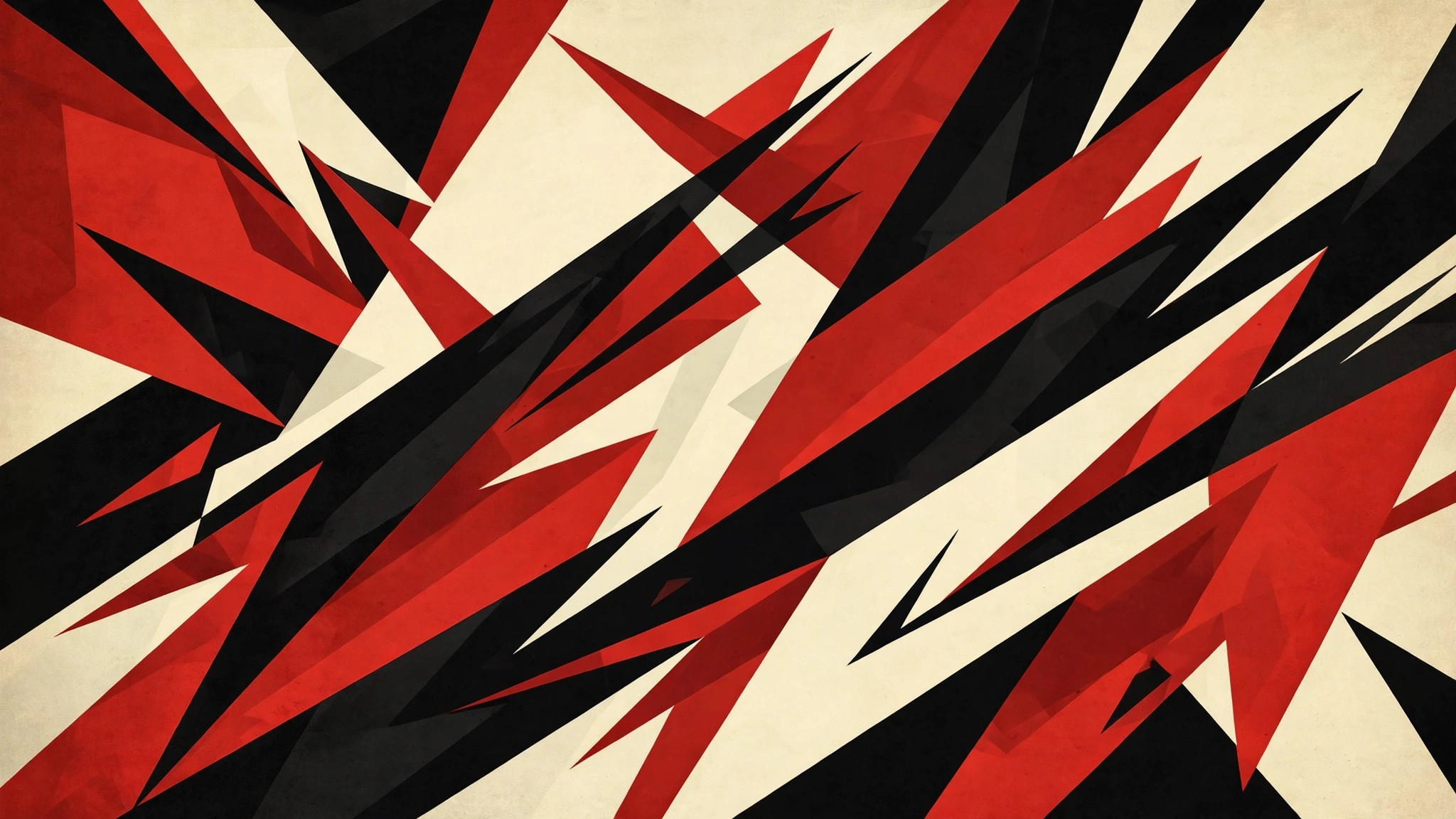
In the years after the Russian Revolution, a group of artists decided art should not decorate life but construct it — and Constructivism was born: angular, dynamic, unapologetically bold, art as engineering for a new world. A Constructivist abstract wallpaper brings that revolutionary energy to your screen: diagonal planes colliding, bold color blocks in red and black, composition as construction.
Constructivism’s power is its forward momentum. Every diagonal thrusts, every plane collides, the whole composition seeming to build itself before your eyes. It is the opposite of contemplative abstraction — this is art with a deadline, design with a purpose. Where a geometric red texture design explores red’s energy, Constructivism weaponizes it — red as the color of action, of building, of now.
Art as Construction
The Constructivists — Rodchenko, Stepanova, El Lissitzky, Tatlin — rejected “art for art’s sake” as bourgeois indulgence. Art, they argued, should serve society: design posters, buildings, textiles, books — construct the new world visually. Their aesthetic followed their ethics: no ornament without function, no curve without reason, every element earning its place through work.
As wallpaper, that work ethic translates to unusual vigor. Where geometric abstract mural UI design often treats geometry as decoration, Constructivism treats it as labor — the shapes are working, building, doing. The screen feels industrious by association.
The Diagonal Imperative
Constructivism’s signature is the diagonal: the dynamic thrust that breaks the rectangle’s calm. Diagonals suggest motion, progress, the future arriving — everything the movement stood for. As wallpaper, diagonals energize: the composition never rests, the eye always moving along the thrust lines. It is the most kinetic abstract style — the wallpaper as engine.
Composing the Revolution
Constructivist wallpapers are composed around collision and construction — each arrangement a different act of building. The main arrangements are:
- Colliding planes — angular planes crashing into each other, red into black
- Architectural assemblies — planes assembled into structure, reading as building or machine
- Typographic echoes — bold bars and letter-like forms recalling the poster heritage
Colliding Planes
Angular planes crashing into each other — red into black, black into cream, the impacts creating the composition’s energy. These are the most dramatic Constructivist wallpapers: the collisions generating visual sparks, the screen seeming to build and unbuild itself. They suit energetic setups and users who want their backgrounds to work as hard as they do.
Architectural Assemblies
Planes assembled into structure — the composition reading as building, as machine, as constructed thing. These feel more stable than the collisions: the energy channeled into form, the dynamism given purpose. They suit professional setups, the wallpaper suggesting competence and drive. A Cubism black abstract drawing pursues geometric mastery in monochrome; Constructivism assembles — and the assembly is the art.
Typographic Echoes
Many Constructivist wallpapers echo the movement’s poster heritage: bold bars, dynamic letter-like forms (abstracted, never literal text), the composition reading as announcement. These have a communicative urgency: the screen seems to be saying something important, even in pure abstraction. They suit statement roles — the wallpaper as proclamation.
The Constructivist Palette
Constructivism’s palette is famously disciplined — and the discipline is expressive.
Red, Black, and Cream
The classic triad: red for energy, black for gravity, cream for clarity. These wallpapers have the punch of posters — the colors of urgency, of importance, of now. They suit bold tastes and high-energy contexts: the screen as rallying cry. The neon abstract art in red registers shares this voltage; Constructivism grounds it in history.
Industrial Greys
Later Constructivist-inspired designs cool the palette: greys, steels, the occasional red accent — the factory aesthetic, art as industry. These feel more contemporary and more wearable: the revolutionary energy tempered into professional drive. They suit modern workspaces, the wallpaper suggesting competence without shouting.
Styling Revolutionary Energy
On desktops, Constructivist wallpapers create workspaces with unmistakable drive — the diagonal energy seeming to push the work forward. They are superb for deadline periods and ambitious projects: the wallpaper that refuses to let you coast.
On phones, a Constructivist lock screen is a daily rallying cry: the bold planes framing the interface like a poster for your own day. And as a motivational choice, these wallpapers are unmatched — a century-old movement’s energy, still building, still urging forward, in your pocket.
The Constructivist Afterlife
Constructivism as a movement was short-lived — roughly a decade in revolutionary Russia — but its afterlife is one of design history’s longest. The angular graphics, the diagonal compositions, the limited palettes of red, black, and cream: this visual language escaped its origins and colonized the century. When you see a bold poster with tilted typography and geometric force, you’re seeing Constructivism’s ghost — the revolution’s graphics, still working.
Swiss typography absorbed it first: the International Typographic Style took Constructivism’s grid, its asymmetry, its conviction that design should be structural — and made it the global language of corporate modernism. The journey from Rodchenko’s posters to the modernist annual report is direct: the same belief that the page is architecture, that typography builds. Then came the punk era’s photocopied inheritors, the rave flyer’s digital descendants, the startup landing page’s bold geometry — each generation rediscovering the angular power.
Soviet propaganda gave the style its most famous applications: the posters urging literacy, industrialization, collectivization — the whole utopian program rendered in striking graphics. There’s an irony the style can’t quite shake: the most liberating visual language, in service of the century’s most controlling state. But the forms outlived the politics, as forms do — the diagonal freed from the doctrine, the geometry available to anyone.
Building Still
The constructivist wallpaper is that afterlife’s quietest chapter: the revolutionary graphics retired to background duty, the angles still building but now building atmosphere. It suits the screen precisely because the style was always about structure — and the screen is a structure, the desktop a small architecture of work.
Let the angles keep building, then — the composition constructing its quiet order behind your windows, the century-old revolution still finding things to make. Rodchenko wanted art to build the new world. The wallpaper builds a smaller one: the ordered screen, the intentional desktop, the day given structure by geometry. The revolution continues — one angular background at a time.
Constructivism promised that art could build a new world — and while history complicated that promise, the energy remains: the diagonals still thrust, the planes still collide, the red still demands.
Keep Constructivism for the building days. Let its angular energy remind you that screens are for making, not just viewing — that the planes are colliding toward something, and that something is the work. The revolution, as the posters said, is now. Your wallpaper agrees.
Related posts:

Pieces in geometric-art talk to each other across pages — follow the thread with Suprematist Abstract Wallpapers: Bold Geometric Purity.
Share this page with a fellow art lover looking for their next wallpaper.

