
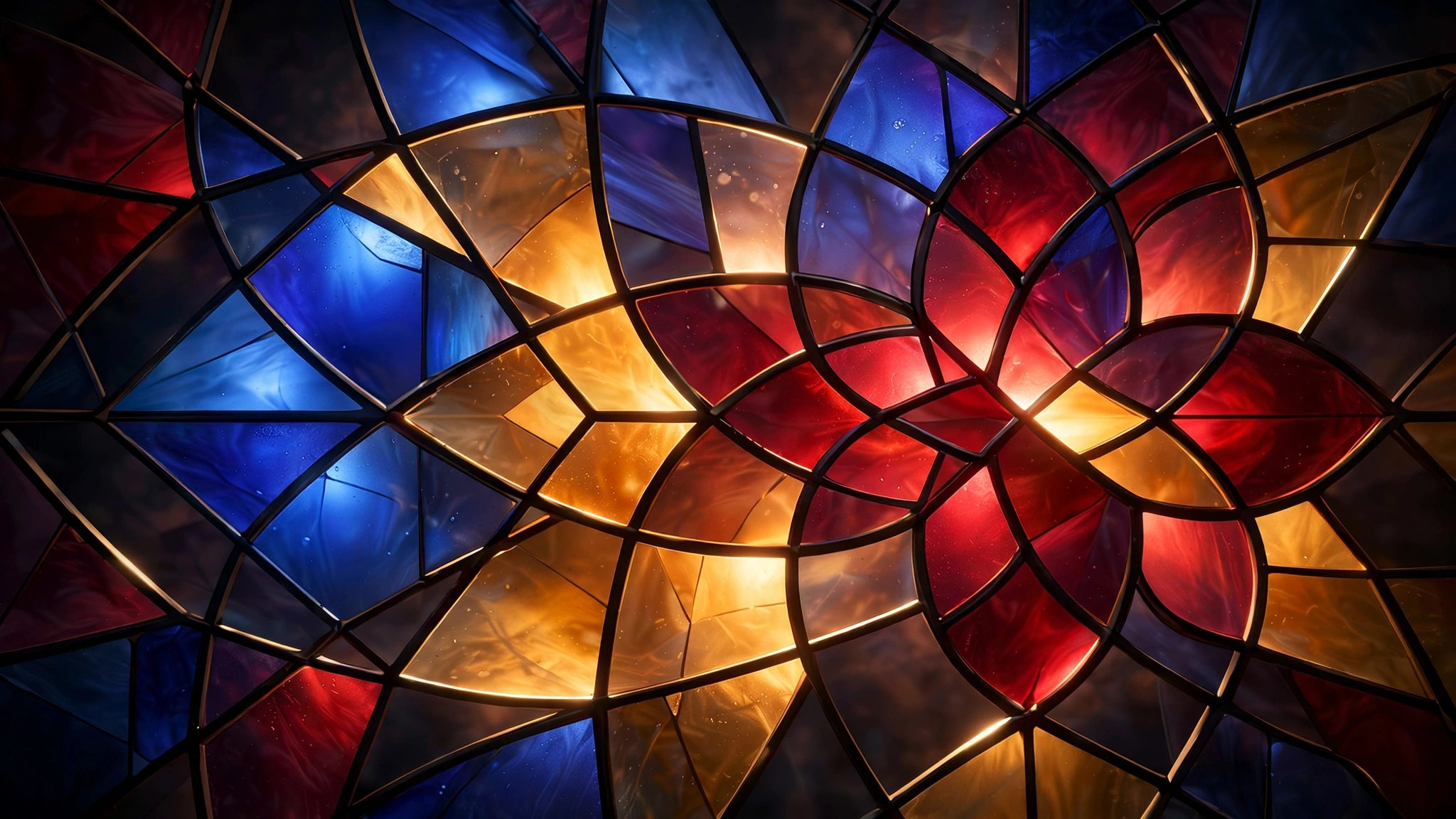
Stand in a Gothic cathedral as sunlight strikes the windows, and you will witness one of humanity’s finest collaborations with light: jewel-toned glass glowing like captured gems, dark lead lines drawing the composition, the whole wall breathing color. A stained glass abstract wallpaper brings that luminous architecture to your screen — not the saints or stories, but the pure visual grammar: light, color, and leading.
Stained glass’s power as wallpaper is its luminosity. Unlike pigments, which reflect light, stained glass transmits it — the color glows from within, lit by the sun behind. On a screen, which is itself a light source, that transmitted quality feels native: the wallpaper and the medium share the same physics. Where 3D abstract texture art builds surfaces that catch light, stained glass is light, colored and composed.
The Craft of Light
Stained glass is made by cutting colored glass into pieces, joining them with lead strips (cames), and painting details with vitreous enamel — a craft perfected over eight centuries. The lead lines are structural necessity become design element: they draw the composition even as they hold it together, the dark tracery as important as the glowing panes.
As wallpaper, that tracery is the style’s signature. The smoke silver metallic art aesthetic loves luminous surfaces; stained glass adds the lead’s discipline — glow, organized by darkness, into meaning.
Light as Medium
The crucial insight: in stained glass, light is not illumination but material — the artwork is made of light, the glass merely its filter. A screen shares this ontology: its images are also made of light. Stained glass wallpapers thus feel uniquely at home on displays — the medium and the subject in perfect sympathy, light depicting light.
Composing with Leading
Stained glass wallpapers are composed around the lead lines’ character — each treatment a different architecture of glow. The main treatments are:
- Geometric leading — bold tracery of diamonds, triangles, and radiating patterns
- Organic leading — flowing, vine-like lead lines in the Art Nouveau manner
- Abstract fields — pure color fields joined by expressive leading, without narrative
Geometric Leading
Bold geometric tracery — diamonds, triangles, radiating patterns in dark lead. These wallpapers feel architectural and timeless: the geometry giving the glow its structure, the lead drawing with authority. They suit formal setups and pair beautifully with the geometric mint background design tradition’s love of precise pattern.
Organic Leading
Flowing, vine-like lead lines — the Art Nouveau window, nature rendered in glass. These feel alive: the tracery growing rather than constructed, the glow filtered through organic form. They suit creative spaces and nature lovers, the screen becoming a garden of light.
Abstract Fields
Contemporary stained glass abandons representation entirely: pure color fields joined by expressive leading, the window as abstract painting in light. These are the most versatile stained glass wallpapers — the luminosity without the narrative, glow as pure composition. The blue marble wallpaper aesthetic’s love of luminous material finds a kindred spirit here.
The Jewel Palette
Stained glass color is famously rich — and the richness has chemistry behind it: cobalt for blue, gold for red, manganese for violet, the medieval palette still unmatched.
Ruby and Sapphire
The definitive pairing: deep red and blue glowing side by side, the cathedral’s heartbeat. These wallpapers have genuine grandeur — the colors of ceremony, of significance. They suit statement roles and users who want their screens to feel consequential. A neon red abstract texture draws its red from electric glow; the ruby pane draws its from gold in glass.
Amber and Emerald
The warm pairing: golden ambers and rich greens, light as honey and leaves. These feel welcoming and organic — the glow of late afternoon through old glass. They suit home spaces and creative work, the warmth making the screen feel inhabited. An abstract digital gold texture chases this same golden warmth in pixels; here it arrives as real light through real color.
Violet Mysteries
The contemplative palette: purples and deep blues, the colors of twilight services. These are the most meditative stained glass wallpapers — the glow turned inward, light as prayer. They suit quiet hours and reflective moods.
Styling Luminous Architecture
On desktops, stained glass wallpapers transform the workspace into something sacred — the glowing panes lending the screen a cathedral calm. They are superb for meaningful work: the luminosity suggesting that what happens on this screen matters.
On phones, a stained glass lock screen is a small daily chapel: the glowing panes framing the interface like a window onto light. And in bright rooms, where most wallpapers wash out, stained glass designs hold their own — they are, after all, designed to be seen in sunlight, competing with the sun and winning.
The Medieval Light Show
Stained glass was the Middle Ages’ cinema — and its engineers were theologians of light. At Chartres, the twelfth-century glaziers achieved a blue so deep it seems to generate its own luminescence: the famous Chartres blue, made with cobalt, glowing in the gloom like a piece of the sky brought indoors. The medieval mind read it literally: light as the divine made visible, the window as the boundary between the earthly and the eternal.
Sainte-Chapelle in Paris took the idea to its ecstatic limit: walls of glass, fifteen towering windows, the whole chapel a lantern of biblical narrative in colored light. Enter on a sunny afternoon and the effect is overwhelming — the stone dissolving into radiance, the air itself seeming tinted. It was multimedia before the term: the stories told in light, the congregation immersed in glowing narrative. The stained-glass wallpaper is that immersion, miniaturized: the medieval light show, desktop-sized.
The craft behind the glow was formidable: pot-metal glass colored through its substance, silver stain for the yellows, the leading as both structure and drawing — the black lines not just holding the glass but composing the image. Each window was a collaboration across trades, years in the making, designed to outlast its makers by centuries. The light they captured is still arriving, eight hundred years on.
Windows, Still Glowing
What the medieval glaziers understood — and what the wallpaper borrows — is that colored light changes the room it enters: the white wall becomes the canvas, the plain space becomes the chapel. Your screen does the same to your desk: the leaded colors casting their implied glow, the workspace warmed by borrowed radiance.
Keep the windows of light as that borrowed glow: the medieval craft, still working, still coloring whatever it touches. The glaziers are centuries gone; their light arrives daily, through your screen now, not the chapel wall. Some technologies are too beautiful to become obsolete. The colored light is one of them.
A stained glass window does not depict light; it is light, given color and form. A stained glass wallpaper brings that identity to your screen — not an image of luminosity, but luminosity itself, composed.
Keep it for the meaningful hours. Let its jewel panes remind you that light can be structured, that color can be architecture, and that eight centuries of craftsmen, cutting glass for cathedrals, were really building windows for your screen. The light is still coming through. It always was.
Related posts:


If this set speaks to you, Mosaic Tile Abstract Wallpapers: Tessellated Glass Color continues the abstract-texture conversation in a new direction.
Bookmark this set for the next time your screen needs a new mood.

