
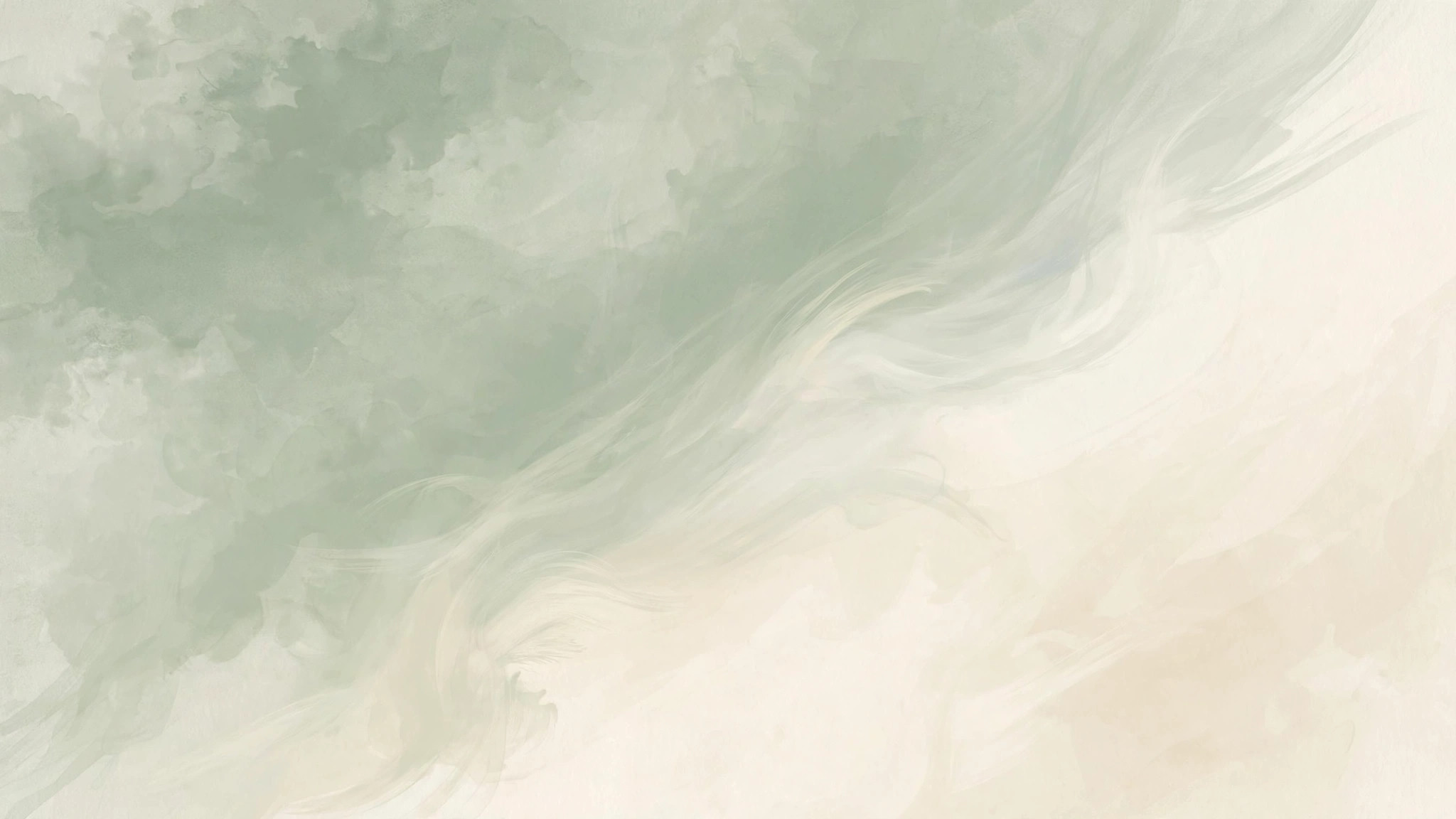
If you want a minimal background that still feels alive, a soft diagonal minimal wallpaper is worth a close look. It divides the screen into two gentle slant fields, such as sage meeting cream along a feathered edge, so the composition rests without falling asleep. People choose it for desktops and phones when they want calm with a quiet sense of direction, and it works because the tilt suggests movement without demanding attention. How it achieves that balance comes down to the angle, the softness of the edge, and the relationship between the two fields.
The charm lies in how diagonals behave. Pure horizontal divisions rest and pure verticals stand, but diagonals move, and they move softly when the colors are gentle and the edge is feathered. That softened movement gives these wallpapers a distinct temperament, like minimal backgrounds with a pulse and a quiet suggestion of going somewhere. Where minimal PC wallpaper often seeks perfect stillness, the soft diagonal allows a whisper of motion instead.
The idea also sits comfortably inside minimalism more broadly, where restraint is the point rather than emptiness. Nothing extra is added here. The slant alone does the work, proving that a composition can breathe without becoming busy.
The Gentle Geometry of Slant
Diagonal compositions carry inherent energy because the eye follows the slant and the mind registers direction. Energy does not have to mean excitement, though, and softened with gentle colors and feathered edges the dynamism becomes a lullaby rather than a fanfare. It is the difference between a hillside and a cliff, where the geometry is the same but the feeling is utterly different.
As wallpaper, that gentled energy does subtle work throughout the day. The composition feels alive without being demanding and directed without being pushy, which is a rare combination for something you see so often. The minimal abstract art tradition sometimes risks sterility, but the soft diagonal guards against it because the slant shows the composition is breathing.
Its defining feature is the edge itself. Instead of the hard line of bold diagonals, there is a feathered, gradual transition where the colors meet like mist rather than colliding like planes. That softness makes the style wearable daily, since the division suggests rather than declares and the movement is implied rather than imposed.
Composing the Slant
Soft diagonal wallpapers are composed around the character of the division, and each choice shapes the gentle movement in a different way. Angle, color, and proportion all tune the same quiet energy. Small changes in any one of them can shift the mood from restful to purposeful.
The main composition choices include:
- Shallow diagonals close to horizontal, which feel like landscapes and suggest a distant hillside
- Steeper diagonals approaching vertical, which feel more dynamic and insistent
- The classic gentle diagonal at around 15 to 30 degrees, enough slant to move but not enough to disturb
- Equal fields that create balance, or unequal fields where the larger field dominates and the smaller one accents
Color relationships define the mood just as strongly. Analogous hues such as sage and cream or dove and pearl create the gentlest divisions, where the slant barely disturbs the calm. Contrasting hues such as terracotta and slate or amber and charcoal give the diagonal more presence and the movement more conviction.
Readers who enjoy restrained color stories may also like Abstract Black, White, Pink Art: Trends & Meanings, which explores a similarly limited palette from a different angle. The comparison is useful because both approaches rely on a few hues doing careful work. In the diagonal wallpaper, that work is carried by the feathered edge and the fields on either side of it.
The Diagonal in Design History
The diagonal has a revolutionary pedigree that reaches back a century. When the Russian Constructivists tilted their compositions in the 1920s, with El Lissitzky’s famous red wedge driving into the circle, they were making a political statement as much as an aesthetic one. For them the diagonal meant dynamism, the future breaking into the present, and art that refused to sit still.
The De Stijl movement offered the counterpoint through Mondrian’s strict horizontals and verticals, where the grid stood for universal harmony. Against that orthodoxy, the diagonalists around Theo van Doesburg, who tilted the whole movement into Elementarism, argued that the diagonal was not chaos but a higher order. Their debate, conducted in manifestos and paintings a century ago, is the quiet inheritance of every slanted background.
There is a classical theory behind it as well. Art historians trace a baroque diagonal through centuries of painting, the line from corner to corner that gives a composition its thrust, from Tintoretto’s swooping altarpieces to the dynamic symmetry of modern graphic design. The soft diagonal wallpaper is that grand tradition at its most restrained, with the baroque thrust domesticated into a background and the dynamism present but polite.
Part of that power is physiological, because the eye moves more readily along diagonals than along horizontals or verticals and the oblique path feels like travel rather than scanning. Interface designers use the same mechanism when a slanted divider draws the eye toward a call to action and guides without commanding. A wallpaper borrows it at ambient scale, giving the whole screen a barely perceptible direction while the gaze is gently led.
Styling Gentle Movement
On desktops, these wallpapers create workspaces with quiet direction, and the slant gives the screen a subtle sense of purpose. They suit steady work particularly well because the composition is calm enough for focus and directed enough to prevent stagnation. You are unlikely to catch yourself following the diagonal, yet the screen simply feels less static, less boxy, and less like a grid of obligations.
On phones, a soft diagonal lock screen is gently distinctive, dividing the interface with understated elegance. Explorations such as Abstract Surreal White Patterns: Design & Aesthetics share the same love of soft transition, even though the diagonal adds a clearer sense of direction. As a transitional wallpaper for the hours between high energy and rest, the style is ideal, with movement softened and direction gentled.
A soft diagonal minimal wallpaper proves that minimalism does not need to stand perfectly straight. A gentle lean, a feathered edge, and a whisper of direction can make the calm more alive without making it less calm. Keep it for the steady days, and let its slanted fields remind you that progress need not be dramatic, because the gentlest slant, sustained, still arrives.
Related posts:



Pieces in minimalism talk to each other across pages — follow the thread with Single Orb Minimal Wallpapers: One Glowing Sphere.
Pass this link to someone who appreciates bold, abstract design.

