
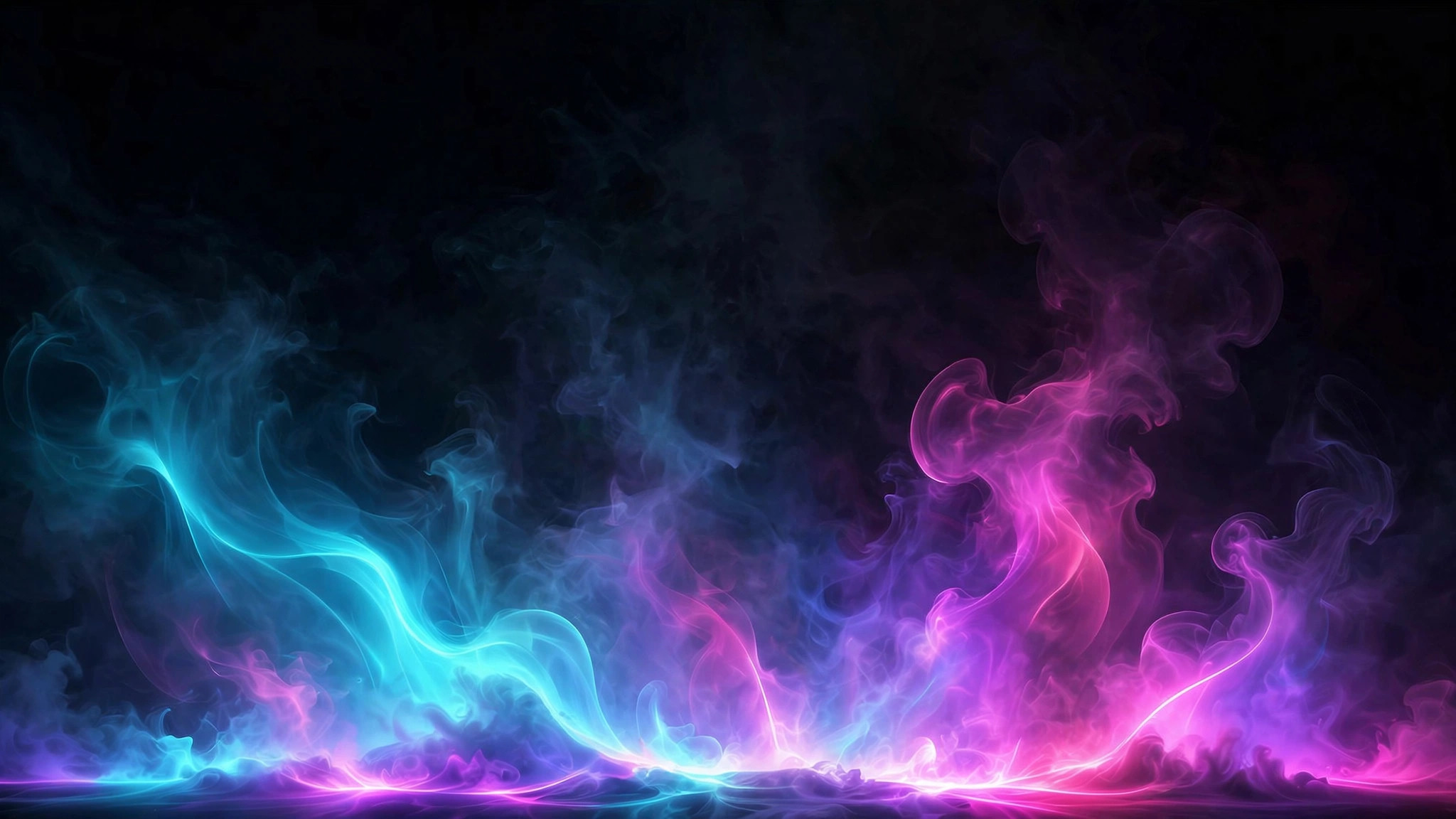
What is neon underglow when it leaves the car and becomes a screen design, and why does light from below feel so dramatic? Neon underglow wallpapers take the ground-effect idea from car culture, where neon tubes mounted beneath a chassis spilled colored light onto asphalt and made the vehicle seem to float on its own glow. Who uses the style now, and where? Abstract designers and screen users use it on phones, monitors, and desktops when they want darkness above, radiance below, and a subject that appears to levitate on light.
The visual logic is primal. Light from below is unnatural, because the sun shines down and screens glow forward, so underlit scenes feel dramatic and even supernatural. On a wallpaper, deep blacks or dark gradients occupy the upper field while color blooms upward from the bottom edge like sunrise in reverse.
The Anatomy of Underlight
A true underglow composition has three zones that work together. The arrangement is simple, but the balance between those zones decides whether the image feels cheap or expensive. A harsh transition can flatten the effect, while a long and smoky falloff gives the light volume.
- The dark crown is the upper portion, near-black, where the eye rests and icons live comfortably.
- The glow band is the luminous base, where color concentrates in cyan, magenta, amber, or electric green, often with a hot core fading outward.
- The transition is the gradient between them, where light dissolves into darkness and much of the artistry lives.
The glow itself is rarely a flat color. The best underglow wallpapers build it in layers, with a near-white hot core at the very bottom, the signature hue at full saturation around it, and desaturated tones feathering upward as the light climbs. This mimics how real underglow behaves, intense at the source and atmospheric at a distance.
Classic underglow colors carry automotive DNA, and cyan and magenta dominate, with purple, green, and ice-blue in support. Cyan feels technological and clean, like the color of science-fiction interfaces, while magenta is wilder and more nightclub than laboratory. Amber is the contrarian choice, offering warm light in a cool genre and suggesting embers rather than electronics.
The wider neon context in neon lighting helps explain why these hues feel electrical rather than painted. In an underglow wallpaper, however, the color is not spread evenly across the frame. It stays low, concentrated near the base, and lets darkness do the framing.
Compositional Strategies
Underglow wallpapers solve the oldest wallpaper problem, legibility, by architecture. The dark upper field is naturally friendly to icons, because light text and colorful icons sit comfortably on near-black. The glow lives at the bottom, where docks and taskbars often reside, turning functional screen furniture into part of the light show.
That makes underglow one of the few abstract styles that is practical by construction rather than by compromise. Artists still vary the formula to suit different temperaments and screen shapes. The common thread is always darkness deferring to light rising from below.
Three recurring variants show how flexible that formula can be:
- Horizontal band glow is the purist form, minimal and architectural, like a clean horizon at midnight.
- Pooled glow spreads like spilled liquid across the lower third, feels more organic, and works beautifully on ultrawide screens.
- Blooming glow sends tendrils upward, as if the light refuses to stay down and the darkness can barely contain it.
A bolder variant centers the glow as a single low point source, distilling underglow to one glowing presence in the frame. Horizontal designs feel calm, pooled designs feel fluid, and blooming designs feel theatrical. Choosing among them is less about correctness than about how much movement the screen should suggest.
For readers exploring the broader neon family, Neon Abstract Illustration: The Ultimate Guide to Modern Digital Art provides a wider view of modern digital neon. Underglow is narrower and more positional. Its identity depends on where the light sits, not only on how bright it is.
Underglow Beyond the Car
The aesthetic has outgrown its automotive roots. Contemporary underglow wallpapers borrow from stage lighting, where performers are rimmed from below, and from architecture, where buildings are washed with ground-level spots. They also borrow from gaming setups, where LED strips behind desks create the same floating effect in real rooms.
That range makes the wallpaper a mirror of the physical setup. Screen glow can echo desk glow, so the whole station appears to levitate. Even without hardware, the wallpaper suggests a space that glows from beneath rather than a flat decorated surface.
The mobile side of the style matters as well, and Neon Abstract Canvas for iPhone: Elevate Your Device Aesthetics shows how neon abstraction is adapted for a smaller device. On a phone, the low glow can anchor the lower screen while leaving the upper field calm. The result keeps the drama without filling every corner with color.
Underglow wallpapers are dark-mode natives. They assume and reward dark interfaces, dark rooms, and dark everything, because the glow needs darkness the way a stage needs a blackout. On a bright setup, the effect dilutes and the levitation weakens.
DIY Underglow: Extending the Aesthetic
The underglow look pairs naturally with physical light. A simple LED strip behind a monitor, set to the glow color of the wallpaper, extends digital light into the real room and dissolves the edge of the screen. The wallpaper provides the composition, the LEDs provide the ambience, and together they turn a desk into a single glowing installation.
Even without hardware, the wallpaper alone carries the idea. With hardware, the idea becomes an environment rather than only an image. That continuity between screen and room is part of the pleasure of the style.
Consider the room when choosing an underglow design. In a dark room, intense glow bands feel cinematic and immersive. In a room with ambient light, softer underglow with wider falloffs and less saturated cores holds up better, because real-world light competes with the painted kind.
The goal is coherence. The glow of the screen should feel as if it belongs in the space, not as if it is fighting that space. When the match is right, glancing at the setup feels less like looking at a monitor and more like looking into a place.
Light From Below, Mood From Within
There is a reason underlit scenes feel cinematic, because filmmakers have used the technique for a century to signal drama, mystery, and the uncanny. Neon underglow wallpapers bottle a drop of that cinema for the desktop. Every glance at the screen becomes a tiny establishing shot, with the interface floating above its own glow.
The style remains abstract art with a light source, and that single decision changes everything about the darkness above it. Darkness is no longer empty; it is the space that makes levitation possible. Light from below gives the screen a floor, a mood, and a quiet sense of theater.
Related posts:


Drawn to these shapes and colours? Neon Abstract Illustration: The Ultimate Guide to Modern Digital Art explores a nearby corner of the same abstract world.
Save the pieces you love and share the collection with your circle.

