
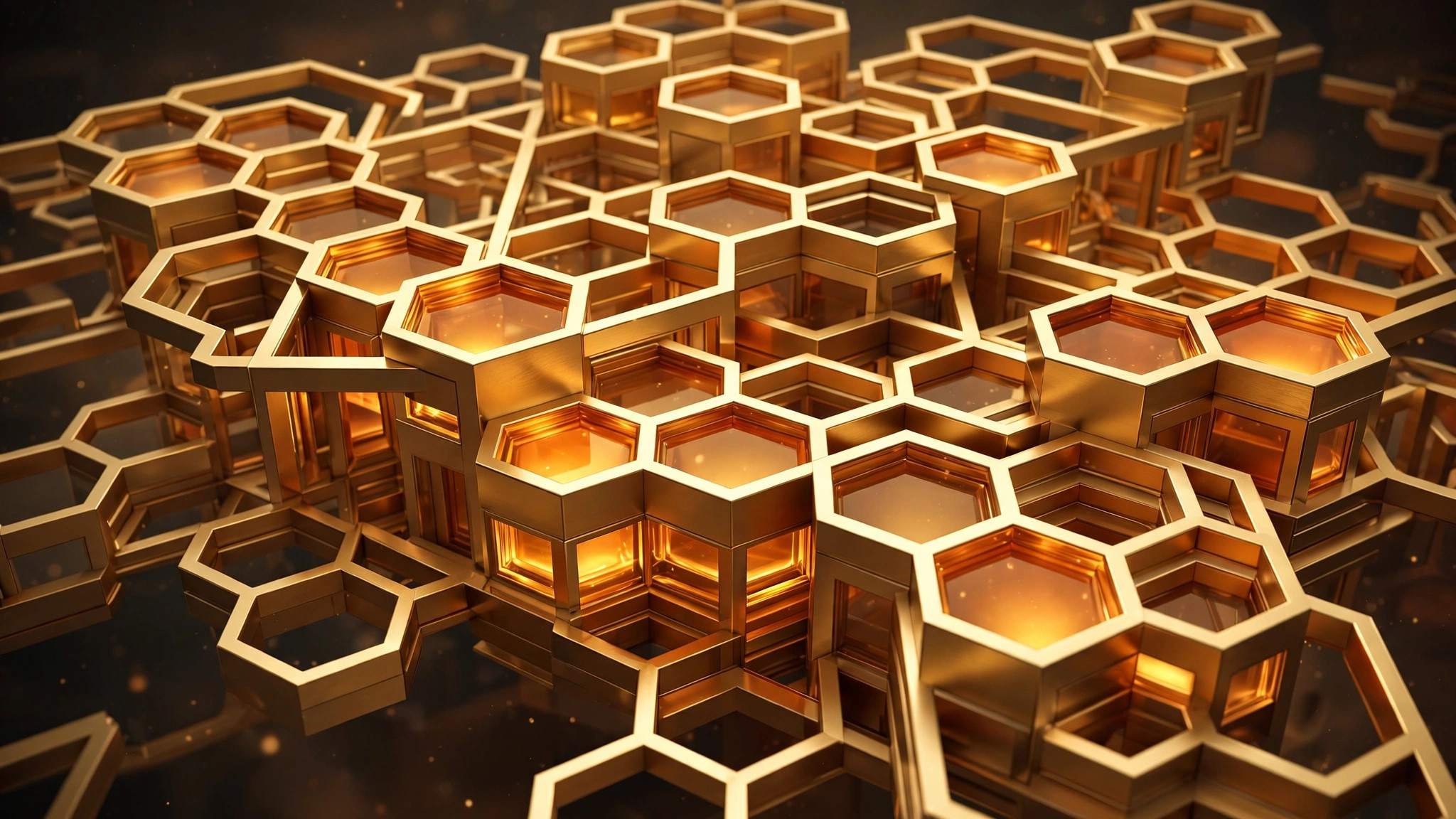
Anyone searching for a structured, architectural background will find it in 3D honeycomb render wallpapers, where designers extrude hexagonal cells into golden depth. What bees achieved in wax millions of years ago — maximum storage for minimum material — digital renders now rebuild as architecture you can almost walk through. Why the pattern feels so intelligent, and how its cells are composed and coloured, follows nature’s own blueprint, the flat efficiency of the hive given dimension.
The honeycomb render captivates because it is structure made visible. You see not just the hexagonal pattern but its depth, its walls, and its engineering. The extrusion transforms the familiar into the architectural, the hive becoming a city and the cells becoming rooms.
Where 3D abstract texture art often builds fantasy surfaces, the honeycomb builds on nature’s own blueprint. Nature’s blueprints are hard to beat. The result feels designed by necessity.
The Engineering of the Hive
The honeycomb’s efficiency is mathematical. Among regular tilings, the hexagon encloses the most area with the least perimeter, less wax per cell and more honey per hive, a geometry described in the honeycomb structure bees build. Bees do not know the math, since evolution found it through trial and error over eons.
Human engineers rediscovered it for aerospace honeycomb sandwich panels, architecture, and packaging, the same geometry serving the same efficiency. As wallpaper, that engineered quality gives honeycomb renders their distinctive character, the pattern feeling intelligent, purposeful, and designed by necessity. The geometric abstract tradition values pattern, while the honeycomb adds purpose, every cell earning its place through efficiency.
Depth as Revelation
Extruding the hexagons, giving the flat pattern walls and depth, reveals what the 2D hive hides. The cells appear as containers, as rooms, as architecture. The depth transforms the pattern from decoration to environment.
You are no longer looking at a honeycomb but into it, the golden walls receding like a city of hexagons. It is the difference between a map and a place. That shift is the render’s central pleasure.
Composing the Hive
Honeycomb renders are composed around the presentation of the cells, each arrangement a different architecture. Top-down cities show the hive from above, hexagonal wells receding into golden depth and the pattern as urban plan. These feel architectural and vast, the cells becoming courtyards and the render becoming aerial photography of an impossible city.
They suit large screens, where the cellular city has room to sprawl its geometry. The breadth of the style shows in this visual guide to 3D abstract graphics in 4K wallpaper, which surveys the wider world of dimensional renders. Oblique architectures show the hive at an angle, cell walls catching light and depth raking across the frame.
Oblique views are the most dramatic honeycomb renders, revealing the walls’ height and the light sculpting each hexagon’s rim. They suit statement roles, the dimensional geometry impossible to ignore. The black geometric aesthetic’s love of structured depth finds a golden cousin here.
Macro cells are extreme close-ups, a few cells filling the frame and the wax-like walls looming. These are the most intimate honeycomb renders, the architecture at human scale and the hexagons becoming rooms you could enter. They suit phones, where the small screen intensifies the immersion, the hive in your palm.
The Golden Palette
Honeycomb renders favour the palette of the hive itself, with the render’s power to perfect it. Amber depths are the definitive honeycomb, golden ambers and honey yellows in the colours of the hive’s product. These glow with natural warmth, the screen seeming lit by the honey itself.
- Amber depths use golden ambers and honey yellows from the hive itself.
- Metallic hives render the cells in brass, copper, and bronze.
- Monochrome cells keep a single hue, all gold or all amber.
Amber suits cosy spaces and warm lighting, providing chromatic comfort, and the dark abstract art tradition’s drama finds its warm opposite in the hive’s glow. Metallic hives are the industrial honeycomb, brass, copper, and bronze cells, the hive as machine and nature’s geometry in manufactured materials. These feel precise and luxurious, the efficiency aesthetic rendered in precious metal.
Metallic versions suit professional setups and pair beautifully with black geometric discipline, different materials sharing the same rigour. Monochrome cells are single-hue honeycombs, all gold or all amber, the purist’s hive. Without colour variety, the architecture takes centre stage, every wall, every depth, and every shadow visible.
These are the most elegant honeycomb renders, efficiency distilled to form and light. Smaller screens carry the pattern well too, as explored in 3D abstract pattern trends and tips for iPhone. On desktops, honeycomb renders create workspaces with architectural character, the cellular depth giving the screen a sense of constructed space.
The Hexagon’s Efficiency
The honeycomb’s hexagon is nature’s answer to an optimisation problem, and mathematicians took centuries to prove the bees right. The honeycomb conjecture holds that, of all ways to divide a plane into equal cells, the hexagonal grid uses the least wall. Thomas Hales finally proved it in 1999, confirming what the hive had known for millions of years.
The hexagon is the most economical shape, the maximum storage for the minimum wax. The bees were doing calculus, and we just caught up. Its efficiency echoes across nature, in the basalt columns of the Giant’s Causeway, cooling lava cracking into hexagonal pillars.
Graphene, the single-atom carbon sheet, uses a hexagonal lattice, the strongest material known built on the bee’s geometry, alongside the snowflake’s six arms and the insect’s compound eye. Wherever nature needs to pack, to structure, or to economise, the hexagon appears. It is the shape of doing the most with the least.
Human engineering borrowed it wholesale, the honeycomb sandwich panel of two skins over hexagonal core becoming aerospace’s favourite structure and the strength-to-weight champion. The hex grid also underlies strategy games, cellular networks, and beehive-inspired architecture. On phones, a honeycomb lock screen is richly dimensional, the extruded cells seeming to recede behind the interface, and on any screen the pattern models a structure that wastes nothing.
Bees do not know they are mathematicians, yet their hives embody one of mathematics’ most elegant results. A 3D honeycomb render brings that embodied wisdom to your screen, the hexagon’s efficiency given depth and light. Its golden cells suggest that the best structures waste nothing, that every hexagon earns its place, and that beauty, like honey, is sweetest when efficiently made.
Related posts:



Pieces in 3d-abstract talk to each other across pages — follow the thread with 3D Dune Render Wallpapers: Sculpted Sand-Like Waves.
Save the pieces you love and share the collection with your circle.

