

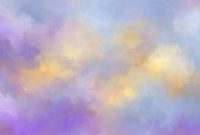
If you are curious how thousands of tiny dots can become a glowing field of color, a pointillism dot abstract wallpaper shows the process on your own screen. In the 1880s Georges Seurat placed tiny dots of pure color side by side instead of mixing colors on the palette, letting the viewer’s eye do the mixing. People use these wallpapers on desktops and phones when they want luminous color that changes with distance, at home or at work and in daylight or evening light. How it works, through optical mixing rather than blended pigment, is what makes the style feel both artistic and quietly interactive.
The magic is easiest to see in two positions. Stand close and you see only dots, distinct and separate and almost mechanical in their regularity. Step back and the dots dissolve into glowing color that is more luminous than any mixed pigment could be, and on a screen that transformation happens continuously as you lean in and out.
The technique behind it is pointillism, and its central discovery is that color is not just seen but constructed by the mind from fragments. Where some fluid styles blend pigment physically, pointillism blends it optically. The mixing happens in you, not on the surface.
The Science of Dots
Seurat’s technique was informed by contemporary color theory, especially Chevreul’s law of simultaneous contrast and the understanding that adjacent colors influence each other’s perception. The dots exploit that influence directly, so a red dot beside a yellow dot reads as orange but more vibrant than mixed orange. The eye blends additively, with light rather than pigment, and preserves a brightness that physical mixing tends to lose.
That additive luminosity is the point of the wallpaper. Where transparency can produce glow in other fluid traditions, pointillism achieves it through fragmentation, with each dot’s purity preserved and the eye completing the alchemy. The result is color that seems lit from within rather than laid on the surface.
Viewing distance becomes part of the artwork itself. The piece changes as you move, with dots resolving into fields and back again, so leaning in reveals the craft and leaning back reveals the glow. It is among the most interactive of static wallpapers because the image responds to your body without moving at all.
Composing in Dots
Pointillist wallpapers are composed around how the dots behave, and each arrangement creates a different optical experience. Warm fields radiate, cool fields recede into a kind of night, and rhythmic fields seem to shimmer with motion. Scale matters throughout, because the same dots read as texture up close and as light from across the room.
The main dot arrangements include:
- Sunset fields, warm reds, oranges, and golds building glowing fields like Seurat’s own sunsets
- Cool constellations, blues, teals, and violets forming a pointillist night of small lights
- Chromatic rhythms, dots arranged in flowing patterns that suggest a current of color moving in dotted waves
Sunset fields suit cozy spaces and evening hours, with optical warmth that comforts as the screen seems lit from within. Cool constellations feel like starfields rendered as art, each dot a small light and the field a galaxy, which suits contemplative setups. Chromatic rhythms are the most dynamic, because the dots’ rhythm suggests motion and the field seems to shimmer.
Color temperature changes the reading dramatically, as a comparison with Neon Red Abstract Texture: Design & Mood makes clear. Neon red pushes mood through saturated intensity, while pointillist warmth builds its glow from many separate touches. Both are vivid, but they reach the eye by very different routes.
Beyond Seurat: The Dot’s Descendants
Seurat died young at thirty-one, but the dot outlived him and its descendants are everywhere. Paul Signac carried pointillism forward by loosening the dots into mosaic-like touches, and Henri-Edmond Cross pushed them toward pure luminosity. Together they proved that the eye does the mixing, the fragments do cohere, and color built from dots glows with a light mixed pigment cannot match.
The dot’s strangest descendant is Roy Lichtenstein, who took the printer’s halftone dot, the mechanical cousin of Seurat’s hand-placed point, and blew it up to fine-art scale. His Ben-Day dots are pointillism industrialized, using the same optical principle and the same fragment-into-field transformation while confessing their mechanical origins. A dotted wallpaper with bold, regular dots is therefore Lichtenstein’s heir as much as Seurat’s.
The halftone deserves its own thought, because for a century it was how the masses saw photographs in newspapers, with the world rendered in dots over breakfast. It taught the public, without anyone noticing, to read dots as images, building the visual literacy that makes every dotted wallpaper instantly legible. That is why these wallpapers feel simultaneously artistic and familiar, sitting at the intersection of the museum and the newspaper.
Then there is the pixel itself, the dot’s ultimate descendant. Every digital image is pointillism in practice, with millions of tiny color fragments mixed optically by the eye and glowing additively, so a pointillist wallpaper on a screen is dots depicting dots. Readers interested in how geometric color fields behave at screen scale may also enjoy Cubism Mint Abstract Texture: Design Guide, which takes a cooler and more structured approach to a related problem.
Styling Optical Color
On desktops, pointillist wallpapers reward normal working distance, where the dots resolve into luminous fields and the screen glows with optical color. They suit creative work because the technique itself is a reminder that perception is construction and that the eye builds what it sees. On phones, the dots’ small scale becomes intimate, with the optical mixing happening inches from your face at palm size.
As a tribute to Seurat, these wallpapers carry art history in every pixel. The radical experiment of the 1880s is still teaching the screen how fragments can become light. Few backgrounds make their own method so visible while remaining easy to live with.
Seurat’s gamble was that fragments could be more luminous than wholes and that the eye, given dots, would build something greater than pigment. A pointillism dot wallpaper makes that gamble daily, with thousands of tiny colors waiting for your eye to unite them. Keep it for the perceiving days, step back, and let the dots merge, because the sunset is in you as much as on the screen.
Related posts:


Abstract work rewards a second look — browse more of abstract-texture when you are ready for a new backdrop.
Save the pieces you love and share the collection with your circle.

