
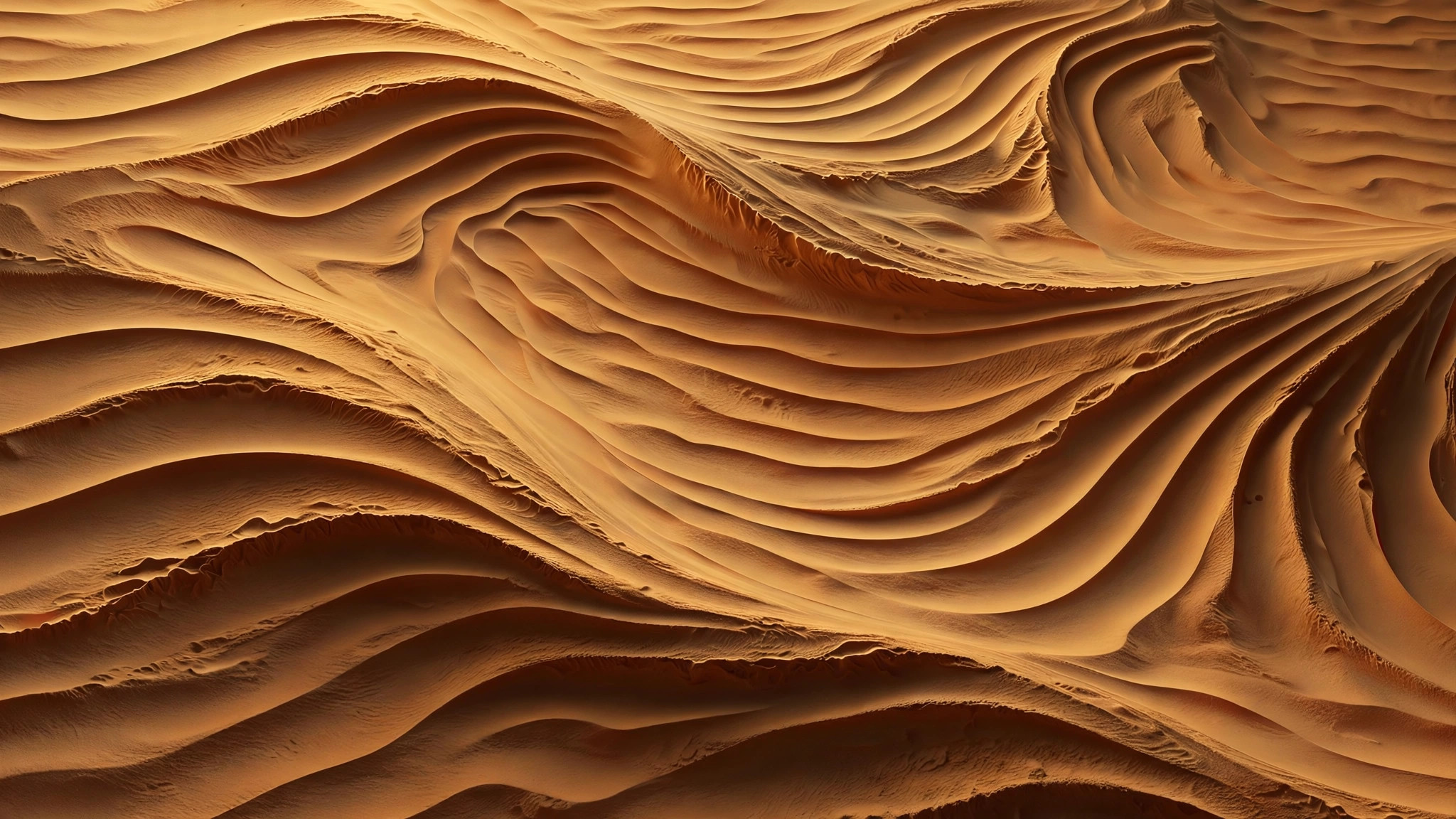
Anyone searching for a calm, warm background will find it in 3D dune render wallpapers, where digital artists sculpt sand-like waves in warm ochre and sienna. What wind does in real deserts — lifting grains and carving rippled ridges over long stretches of time — the render perfects on screen, for desktops and phones alike. Why these images soothe, and how their rhythm is composed, comes from the desert’s own patience rendered as background.
Dune renders captivate because they are simultaneously natural and impossible. The forms are unmistakably wind-carved, yet too perfect, too rhythmic, and too ideal to be real desert. That idealisation is the render’s gift, nature’s logic perfected.
Where 3D abstract texture art often invents new forms, the dune render perfects a familiar one. The familiar, perfected, is deeply satisfying. It is calm you recognise at once.
The Sculpture of Wind
Dunes form through saltation, wind lifting sand grains and dropping them on the lee side, the ridge growing and migrating downwind. The ripples, those perfect parallel ridges, form through a subtler instability. It is the wind’s own rhythm written in sand, as a real dune takes shape through physics as artistry.
As wallpaper, that sculptural quality gives dune renders their distinctive calm. The regular rhythm soothes the eye, and the flowing forms suggest motion without demanding it. The chrome wallpaper aesthetic celebrates the artificial, while the dune render celebrates the natural, perfected — wind’s work, polished.
Rhythm and Repetition
The dune’s ripple rhythm, ridge after ridge in hypnotic sequence, is visual music. The eye moves along the beats, and the mind settles into the pattern. It is the same satisfaction as waves or breath, or any natural rhythm.
Dune wallpapers thus calm almost physiologically. The rhythm entrains the eye, and the eye entrains the mind. Few abstract backgrounds settle a screen so quietly.
Composing the Dunes
Dune renders are composed around the behaviour of the waves, each arrangement a different desert dream. Ripple fields show endless parallel ripples, the classic dune with rhythm unbroken. These wallpapers are meditative, the repetition creating a visual mantra and the eye flowing along the ridges without destination.
They suit calm workspaces and pair beautifully with a love of rhythmic pattern in wave design, different mediums sharing the same hypnosis. Readers comparing formats will also find guidance in 3D abstract wallpaper options for dark mode at 8K resolution when choosing a render for their display. Dune crests take the sharper line, the ridge where wind meets resistance.
Crests are dunes at their most dramatic, catching light like breaking waves. They have more energy than ripple fields, the crests suggesting motion and the sand visibly in flight in the mind’s eye. They suit dynamic setups and users who want their calm with a spine.
Aerial vistas show the dunes from above, vast fields of sand waves whose patterns become abstract at scale. These are the most painterly dune renders, the desert as canvas and wind as brush. They suit large screens, where the vista has room for its full grandeur, and they carry a genuine sense of place seen from impossible height.
The Desert Palette
Dune renders favour the palette of real deserts, with the render’s power to perfect it. Ochre classics are the definitive dune, warm ochres and siennas like the Sahara at golden hour. These feel like heat made visible, the screen radiating desert warmth.
- Ochre classics bring warm ochres and siennas, like the Sahara at golden hour.
- Monochrome sands use a single hue, all gold or all rust.
- Twilight dunes pair violet shadows with amber crests at dusk.
Ochre suits cosy spaces and cold days, providing chromatic comfort, and the black marble aesthetic’s cool drama finds its warm opposite here. Monochrome sands are single-hue dunes, all gold or all rust, the purist’s desert. Without colour variety, the forms take centre stage, every ripple and crest rendered in shades of one warmth.
Monochrome versions are the most elegant dune wallpapers, the desert distilled to rhythm and light. Twilight dunes appear at dusk, with violet shadows and amber crests at the desert’s most dramatic hour. These are the most atmospheric renders, the low light sculpting ripples into high relief.
Twilight suits evening use and contemplative moods, the screen holding the day’s last warmth. For more on shaping three-dimensional forms on screen, see this guide to wallpaper design with 3D rendered abstract shapes. Every palette keeps the same sculpted rhythm underneath.
The Singing Sands
Some dunes sing. In deserts around the world — the Taklamakan, the Namib, and the Mojave’s Kelso — certain sands produce sound, low booming tones and musical notes, the desert humming to itself. The phenomenon, called singing or booming sand, happens when avalanching grains synchronise their vibrations, the whole slope resonating like a giant instrument.
Marco Polo reported it, Darwin puzzled over it, and physicists finally explained it. The physics is dune-specific, since the grains must be well-rounded, uniform in size, and dry, the wind’s long sorting work producing sand of unusual purity. When the surface avalanches, the grains vibrate in lockstep, and the synchronised collisions amplify into audible tone at frequencies around 70-100 Hz, the desert’s bass note.
Each singing dune has its own pitch and its own voice, the landscape literally resonating. The 3D dune render is that music’s silent score, the sculpted waves holding the shape of the sound. The render cannot sing, but it shows the instrument, the slopes that would boom and the curves tuned by centuries of wind.
On desktops, dune renders create workspaces with natural calm, the rhythmic waves seeming to slow the screen’s tempo. They are superb for sustained work, interesting enough to prevent flat-screen fatigue yet regular enough to never distract. On phones, a dune lock screen is warmly tactile, the rippled sand seeming to shift under the thumb.
The singing sands perform rarely, and only for those who climb, the avalanche triggered by footfall and the boom rising from the slope. Your screen’s dunes are quieter, the music implied and the patience visible. A dune is wind’s autobiography written in sand over centuries, every ripple a gust remembered and every crest a storm’s signature, and the render holds that patient art still.
Related posts:



Abstract work rewards a second look — browse more of 3d-abstract when you are ready for a new backdrop.
Save the pieces you love and share the collection with your circle.

