
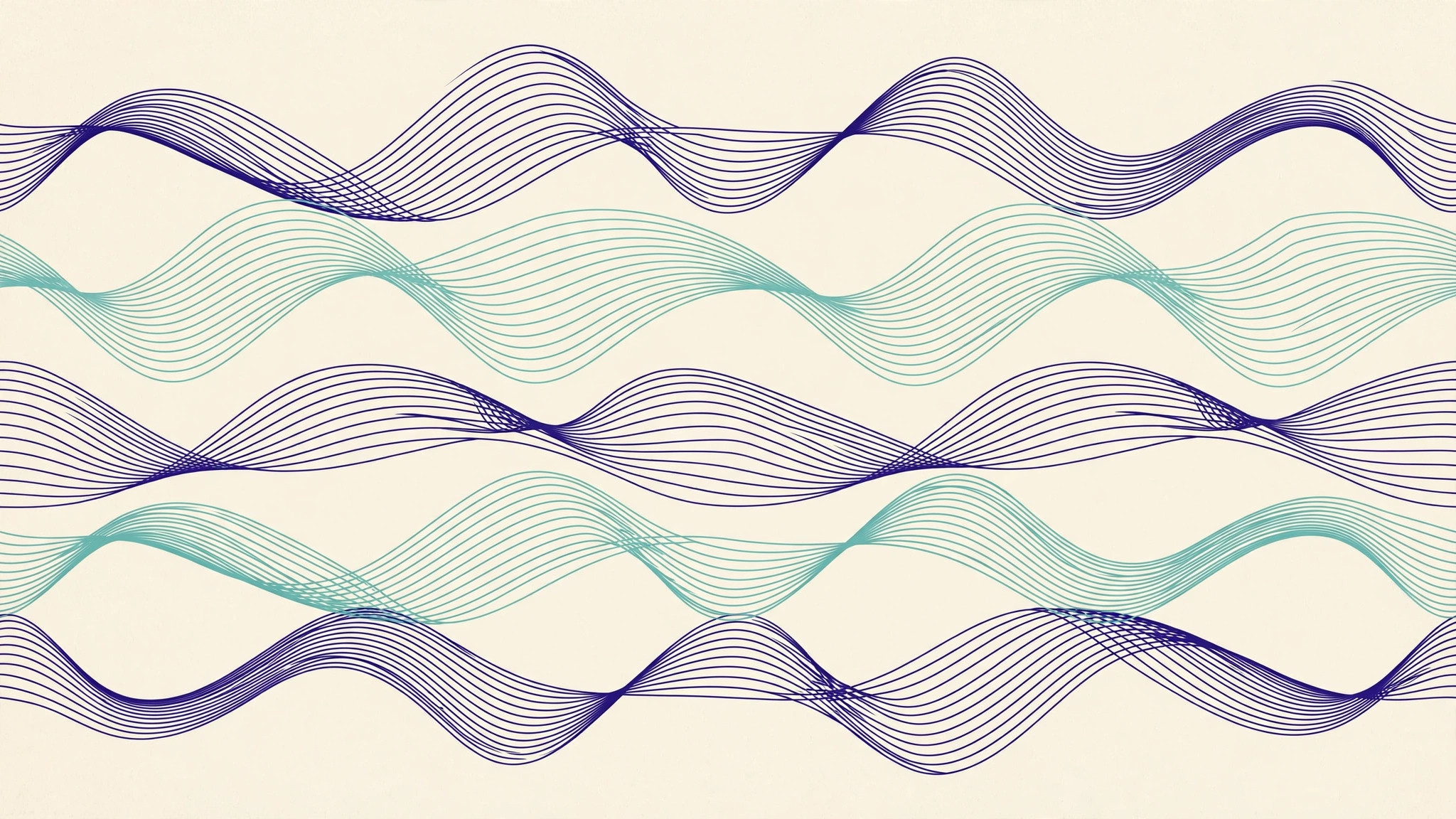
Who reaches for a geometric wave wallpaper? Anyone whose screen needs calm with a pulse. The what is simple: structured sine curves rendered as design — the sine wave is mathematics’ most graceful curve, smooth, periodic, endlessly repeating, the shape of sound, of light, of the ocean’s swell abstracted to pure form. Flowing across a desktop or phone in indigo and seafoam, these wallpapers show why mathematical rhythm calms, and how: exact lines and precise periods, the wave disciplined into geometry.
Geometric waves captivate because they are simultaneously natural and constructed: the curve is the ocean’s, but the regularity is the mathematician’s. That duality gives wave wallpapers a unique calm — the eye follows the curves’ rhythm the way it follows breath, while the mind appreciates the precision. Where wave grey pattern designs explore waves as texture, geometric waves explore them as structure — the sine, honored.
The Mathematics of Rhythm
Sine waves describe oscillation itself: the back-and-forth that underlies sound, light, tides, and heartbeats. To render sine curves as wallpaper is thus to depict rhythm’s pure form — the visual equivalent of a steady pulse. It is no accident that wave wallpapers calm: the curves’ regularity entrains the eye, the eye entrains the mind, and the mind settles into the wave’s tempo.
The black wave abstract wallpaper aesthetic shares this rhythmic power; geometric waves add the mathematician’s clarity — the curves exact, the periods precise, the beauty accountable.
Harmony in Superposition
Multiple sine waves, layered — different frequencies, phases, amplitudes — create interference patterns of surprising beauty: beats, moirés, the visual equivalent of chords. The best geometric wave wallpapers exploit this: not single lonely sines but choirs of them, the curves harmonizing into complexity. It is music, drawn.
Composing the Curves
Wave wallpapers are composed around the curves’ behavior — each arrangement a different rhythm:
- Parallel flows — sine curves flowing side by side, rhythm unbroken.
- Interfering fields — waves crossing at angles, creating moiré-like beats.
- Amplitude landscapes — waves whose amplitude varies, swelling and subsiding like terrain.
Parallel Flows
Sine curves flowing side by side — the classic wave wallpaper, rhythm unbroken. These are meditative: the parallel lines creating a visual current, the eye drifting along the flow. They suit calm workspaces and pair beautifully with the geometric mint background design tradition’s love of clean line — different curves, same discipline.
Interfering Fields
Waves crossing at angles — the interference creating moiré-like beats, complexity from simplicity. These are the most dynamic wave wallpapers: the crossings generating visual energy, the pattern seeming to shimmer. They suit creative spaces, the interference keeping the eye engaged.
Amplitude Landscapes
Waves whose amplitude varies — the curves swelling and subsiding like terrain, the rhythm given topography. These feel like landscapes drawn by mathematics: hills and valleys of pure sine, the wave as place. The fluid ink art design aesthetic’s organic flow finds a structured cousin here.
The Wave Palette
Wave wallpapers favor palettes that honor the curves’ serenity — colors that flow as smoothly as the lines.
Indigo Currents
The definitive wave palette: deep indigo lines on lighter grounds, the color of deep water and night skies. These wallpapers feel profound and calm — the wave as depth, the rhythm as meditation. They suit focused work and contemplative moods.
Seafoam Drifts
The gentle wave: pale seafoam curves on cream, the rhythm at its softest. These are the most serene wave wallpapers — the curves barely there, the pattern a whisper. They suit restful devices and calm hours, the wave as lullaby.
Styling Mathematical Rhythm
On desktops, geometric wave wallpapers create workspaces with unusual tranquility — the sine rhythms seem to regulate the screen’s tempo. They are superb for sustained work: the pattern interesting enough to prevent flat-screen fatigue, regular enough to never distract. The same disciplined geometry drives geometric abstract poster 4K wallpaper design.
On phones, a wave lock screen is quietly hypnotic: the curves flowing behind the interface like a visual metronome. And as a focus aid, wave wallpapers are genuinely functional — the regular rhythm providing a subtle pacing cue, the screen breathing with you.
The Sine Wave’s Secret Life
The sine wave on your wallpaper is secretly the most important curve in science. Joseph Fourier’s great insight — that any waveform, no matter how complex, can be decomposed into sine waves — means the humble sine is the atom of all vibration: every sound, every signal, every oscillation is sines in combination. The geometric wave wallpaper is thus a portrait of nature’s building block, the curve from which the world’s complexity is assembled. The pattern’s elegance is not decorative; it is fundamental.
Follow the sine into the world and it multiplies: sound waves are pressure sines traveling through air — the music you love is sine waves in elaborate combination. Light waves are electromagnetic sines, the colors you see determined by their frequency. The alternating current in your walls is a sine wave, sixty (or fifty) smooth oscillations per second, the entire power grid breathing in sines. Your wallpaper’s curves are the same curves that light your room and carry your music: the sine, everywhere, quietly running the world.
Engineering lives on the sine: bridge designers calculate resonant frequencies in sines, radio engineers modulate them to carry voices across oceans, medical scanners reconstruct bodies from sine-wave mathematics. The curve’s purity makes it calculable, and its calculability makes it useful — the rare case where the most beautiful solution is also the most practical. A geometric wave wallpaper is engineering’s aesthetic made ambient: the working curve, appreciated as art — much as geometric abstract painting turns structured form into art on canvas.
Riding Your Own Frequency
The metaphor the sine offers is resonance: systems vibrate most strongly at their natural frequency, the wave finding its match. Life has its resonances too — the work rhythm that fits your energy, the creative hour when ideas come easily, the rest that actually restores. The sine wallpaper, with its regular peaks and troughs, is a quiet reminder that oscillation is natural: the peaks need the troughs, the energy needs the rest, the wave is whole only with both.
So ride the sine the way the wallpaper suggests: accept the rhythm, trust the cycle, know that the trough is not failure but physics — the necessary low before the next high. The curve on your screen has been oscillating since Fourier described it, since the power grid adopted it, since the universe first vibrated. It will keep oscillating, patient and perfect, whether you watch or not. Match its patience with your own, and let the structured waves carry you: peak, trough, peak again — the oldest rhythm there is, drawn in geometry, glowing on your screen.
The sine wave is the universe’s handwriting — the curve it uses for light, for sound, for the tides. A geometric wave wallpaper brings that handwriting to your screen: rhythm, made visible, in indigo and seafoam.
Keep it for the steady hours. Let its structured curves remind you that beneath the noise — the notifications, the chaos, the everything — there are rhythms, patient and precise, carrying on. Ride the sine. It knows the way.
Related posts:

Abstract work rewards a second look — browse more of geometric-abstract when you are ready for a new backdrop.
Bookmark this set for the next time your screen needs a new mood.

