
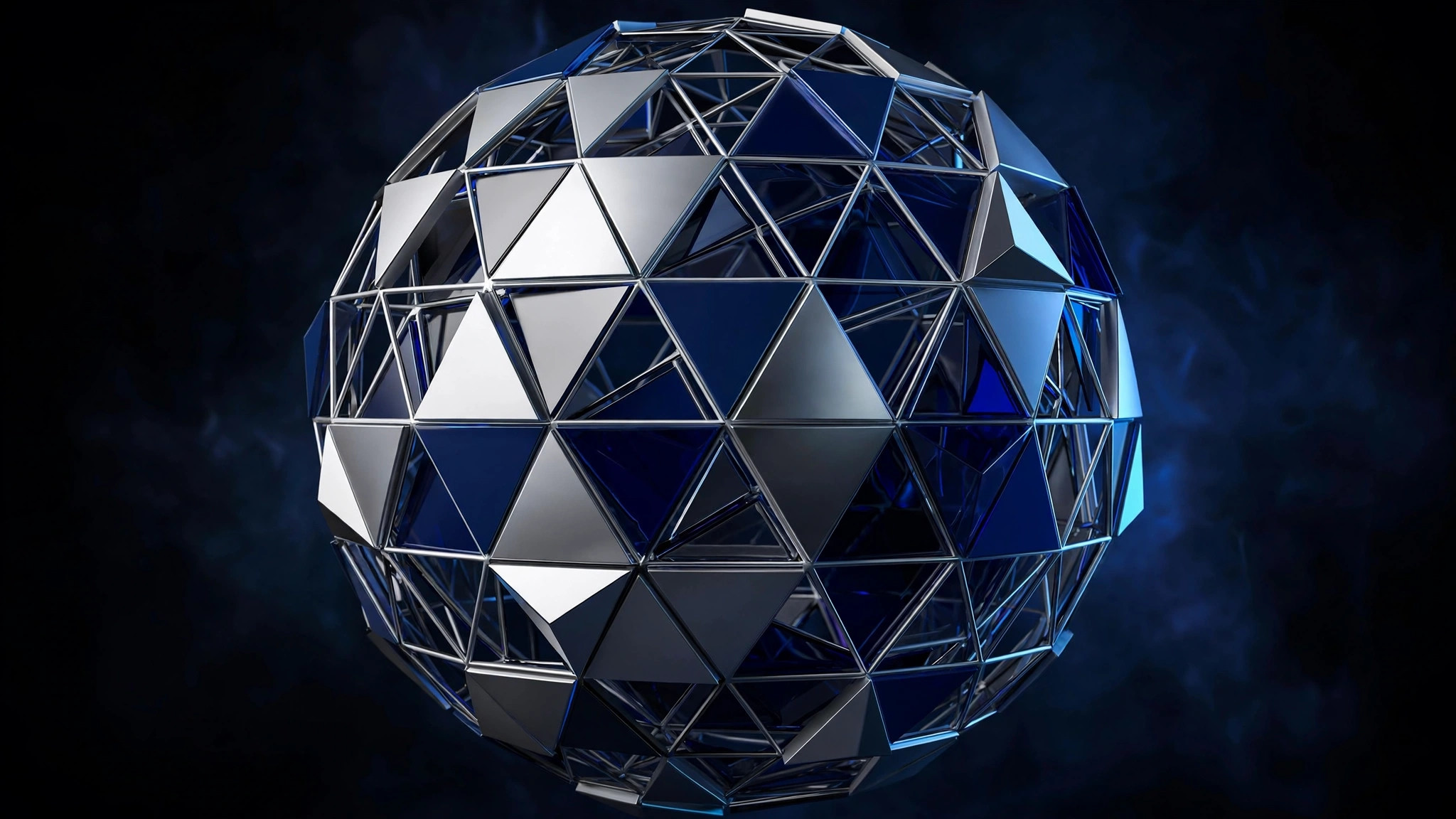
In 1954, Buckminster Fuller patented a structure made of nothing but triangles — a dome that was stronger, lighter, and more efficient than anything built before it. The geodesic dome went on to house world expos, radar stations, and utopian communes. As a wallpaper, its triangulated skeleton becomes pure visual poetry: a sphere of interlocking triangles, each facet catching light differently, floating in digital space like a mathematical jewel.
A geodesic dome wallpaper is geometry you can feel — the triangles are not decoration but structure, and the eye senses that integrity. Every facet belongs exactly where it is, locked into its neighbors with engineering precision, and the result is a background with unusual authority: calm, intelligent, and quietly spectacular.
The Architecture of Triangles
The triangle is the only polygon that cannot be deformed without changing its side lengths — push a square and it skews, push a triangle and it holds. That rigidity is why triangles dominate engineering, from bridges to bicycle frames to Fuller’s domes. A geodesic dome wallpaper inherits that sense of rightness: nothing is arbitrary, everything is load-bearing, and the beauty comes from necessity rather than ornament.
Visually, the dome reads as both sphere and crystal. From a distance, the facets merge into a smooth globe; up close, each triangle asserts itself. This dual reading — whole and parts simultaneously — is what makes the style so watchable over time. Your perception keeps shifting between the sphere and its facets, and the wallpaper never quite settles into background noise.
Fullerene Dreams
There is a delightful scientific echo here: the carbon molecule C60, discovered in 1985, is a perfect geodesic sphere of sixty carbon atoms — scientists named it buckminsterfullerene after Fuller himself. A geodesic dome wallpaper is thus, at a molecular scale, a portrait of one of nature’s most elegant structures. Knowing that the pattern on your screen also exists in soot and stardust adds a quiet wonder to the geometry.
Rendering the Dome
Geodesic wallpapers vary enormously in how the dome is presented, and each treatment creates a different mood:
- Wireframe domes — just the triangulated skeleton, glowing lines on darkness; blueprints of an impossible building.
- Faceted domes — every triangle filled with color, catching imaginary light like a jewel.
- Fragmented domes — a hemisphere rising from the edge, or a crown dissolving into particles; geometry with open sky for icons.
Wireframe Domes
The purist’s choice: just the triangulated skeleton, glowing lines on darkness. Wireframe geodesic wallpapers are the most architectural, and they suit dark desktops beautifully. Thin lines in cyan or silver on near-black create a technical, focused atmosphere, like working inside a particularly beautiful CAD program.
Faceted Domes
Fill each triangle with color and the dome becomes a jewel. Faceted renders in metallic silvers, deep blues, and copper tones catch imaginary light across hundreds of faces, creating a disco-ball sophistication. These are the most dramatic geodesic wallpapers — spectacular on large screens, where the facet count can climb into the hundreds and the light play becomes genuinely mesmerizing.
Fragmented and Partial Domes
Some of the most artistic treatments show only part of a dome — a hemisphere rising from the bottom edge, or a dome dissolving into particles at its crown. These compositions use the geometry as a starting point rather than a cage, and they solve the practical problem of icon space: the open sky above a partial dome is perfect for widgets and windows.
Color and Light
Because the dome is inherently structural, color choices read as material choices: what is this dome made of?
Metallic Domes
Silver, chrome, and gunmetal domes feel technological and precise — the aesthetic of space programs and science fiction. They pair naturally with dark interfaces and blue accent lighting.
Warm Material Domes
Copper, bronze, and gold domes feel artisanal — less NASA, more cathedral. The warm metals catch light in a way that feels almost organic, like a pinecone or a seed head rendered in precious metal. These suit home offices and creative spaces, where the geometry provides structure and the warmth provides welcome.
Glass and Light Domes
Translucent domes — glass triangles glowing from within — are the most ethereal. They read as lanterns, as ideas, as things not yet built. On OLED screens, a glowing wireframe dome against true black is genuinely stunning: light without source, structure without weight.
Styling the Sphere
Scale determines everything. A dome that fills the frame becomes an environment — you are inside the geometry. A smaller dome floating in negative space becomes an object — a jewel to contemplate.
For desktops, the environmental scale is immersive and impressive; for phones, the object scale works better, a single perfect sphere centered behind your apps like a planet. Consider also the dome’s position: centered domes are meditative and symmetrical, while off-center domes leave room for interface elements and feel more dynamic. And for ultrawide monitors, a horizon of partial domes — a skyline of triangulated hills — creates one of the most distinctive panoramic wallpapers in the abstract catalog, a panorama that deep-dives into geometric abstract painting trends rarely match for sheer structure.
Fuller’s Dream
Buckminster Fuller dreamed in domes: the geodesic dome — the sphere triangulated, the most enclosure for the least material — was his answer to humanity’s shelter problem. The 1949 breakthrough was the geometry that does more with less, the structure that gets stronger as it gets bigger. The Montreal Biosphere still stands as the dream’s monument: the triangulated sphere, the future’s shape.
The mathematics was ancient — the icosahedron, the Platonic solid — but the application was revolutionary: the dome as the efficient shelter, the lightweight enclosure, the architecture of the possible. Fuller’s followers raised domes as homes, as greenhouses, as the counterculture’s geometry: the triangle, democratized, the sphere made buildable. Keep the geodesic as that triangulated integrity — the most with the least, the sphere from triangles, the dream still standing. Your screen holds Fuller’s geometry quietly, the depth in the triangulation, the strength in the pattern — and as geometric abstract poster designs prove, few motifs reward a big print or a big screen as reliably.
Geometry With Integrity
What distinguishes geodesic dome wallpapers from other geometric styles is their sense of necessity. Every triangle is there for a reason; remove one and the structure fails. That integrity gives the style a philosophical depth that pure decoration lacks — it is beauty derived from truth, the way a well-built bridge is beautiful.
In a digital world full of arbitrary decoration, there is something deeply satisfying about a background whose every element earns its place. The geodesic dome does not decorate your screen; it engineers it. And like all good engineering, it happens to be beautiful.
Related posts:

Drawn to these shapes and colours? Diagonal Stripe Geometric Wallpapers: Rhythm Through Repetition explores a nearby corner of the same abstract world.
Bookmark this set for the next time your screen needs a new mood.

