
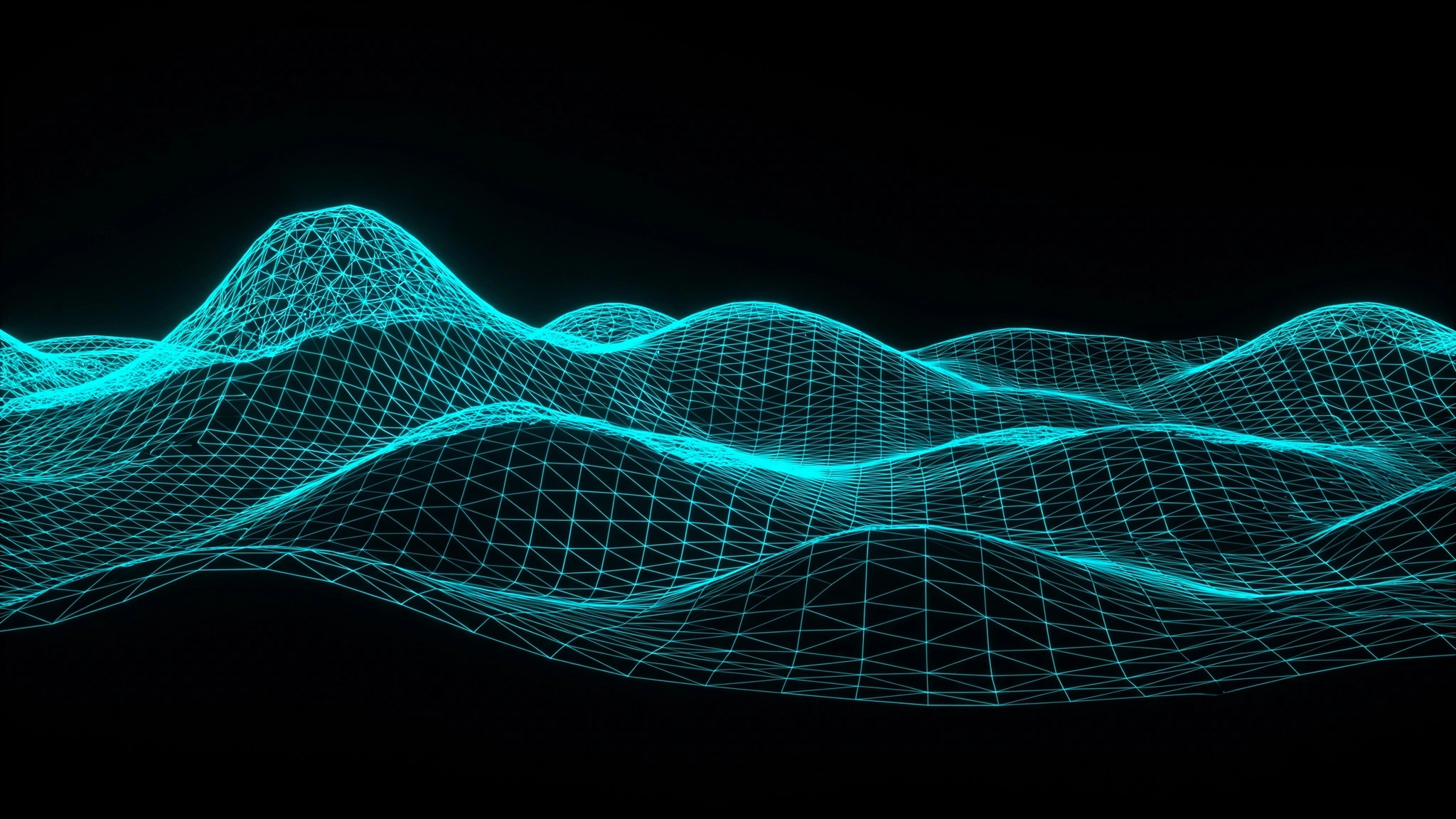
What happens when a 3D landscape is stripped down to its skeleton, and why would the hidden scaffolding become the artwork? Wireframe terrain 3D wallpapers answer by exposing every polygon edge and every vertex as a node in a glowing net, turning digital topography into abstract art for phones, desktops, and other screens. Who makes them, and how? Artists either import real elevation data or sculpt imaginary terrain in 3D software, then render the mesh itself so ridge lines and valley nets float in digital space instead of hiding beneath a finished surface.
The look is unmistakable. A mesh of triangles or quads drapes over invisible hills, usually as luminous lines against darkness or dark lines against light in the blueprint variant. It reads as technical and poetic at the same time, like a topographic map drawn by a machine that dreams.
From Elevation Data to Art
Real wireframe terrains often start as real data. Digital elevation models, the same datasets used for maps and flight simulators, can be imported into 3D software and rendered as pure mesh. The result carries a ghost of reality, because those ridges really exist somewhere and those valleys hold real rivers.
Other artists sculpt imaginary terrain instead. They push and pull virtual clay into impossible formations such as floating islands, endless dunes, and fractal highlands. The choice between real and invented land changes the feeling, but both approaches trust structure to carry the image.
Mesh density is the first big decision. Dense wireframes use thousands of tiny polygons and read as smooth, flowing surfaces, with individual triangles dissolving into texture. Sparse wireframes go graphic, with big bold facets in which each polygon is a visible decision and the terrain feels chunky and crystalline.
Mesh topology shapes the aesthetic more than most viewers realize:
- Triangulated meshes feel energetic and crystalline, because every surface resolves into sharp facets.
- Quad-based meshes flow more smoothly, with grid lines following the terrain like contour lines.
- Broken or stretched topology lets the mesh tear or pull, turning errors into features rather than hiding them.
In wireframe art, the grid is never neutral. It always draws its own picture on top of the landscape.
The technical foundation is the wire-frame model, in which edges and vertices define a three-dimensional form. Terrain wallpapers make that normally hidden definition visible. The model is no longer only a step toward a surface; it is the surface itself.
Light, Color, and the Void
Wireframe renders live or die on their backgrounds. The classic treatment uses glowing lines on black, making the mesh float in an endless void with each edge as a filament of light. It remains powerful because it feels technical, nocturnal, and infinite.
The inverse has a quieter appeal. Dark mesh on paper-white or pale grey reads as an architectural drawing, precise and daylight-clean.
Colored wireframes open a third path. Gradient-mapped meshes use cool blues in the valleys and warmer reds on the peaks, encoding elevation as color and turning the render into a hybrid of wireframe and heat map. Single-hue treatments, such as a full mesh in electric cyan or warm amber, unify the composition around one chromatic idea.
Line treatment defines the mood as much as color does. Glowing lines with bloom and halo feel energetic and digital, crisp vector lines feel drafted and deliberate, and fading lines add atmosphere as far ridges dissolve into fog. Each choice tells the viewer whether to read the image as energy, document, or dream.
That range connects naturally with broader 3D abstraction in 3D Rendered Abstract Shapes: Wallpaper Design Guide. Wireframe terrain is more specific because the shape is a landscape, even when the landscape is imaginary. Its lines imply height, depth, and travel across a surface.
Composition: Taming the Infinite Mesh
A raw wireframe terrain can feel endless, which is both its power and its problem. The best wallpaper compositions give that infinity a frame. A horizon line where the mesh meets the void, a dramatic peak as a focal point, or a valley drawing the eye into depth can turn an unlimited field into a readable scene.
Camera angle does heavy lifting. A low, grazing angle makes ridges monumental, while a top-down view turns terrain into pure pattern that is almost textile-like. The same mesh can therefore feel like a place from one angle and like a diagram from another.
Negative space is the secret weapon of the wireframe artist. A mesh that fills the frame edge to edge can feel claustrophobic, while one occupying the lower two-thirds and dissolving into void above can breathe. That breathing room also conveniently leaves icon space, so composition serves the interface as well as the image.
Some designs fragment the terrain into floating islands, each a self-contained mesh world adrift in darkness. The fragmentation adds narrative, suggesting not one landscape but an archipelago of digital geology.
Great wireframe wallpapers suggest movement they do not contain. A mesh can ripple like water, ridges can lean as if wind-shaped, and valleys can spiral inward, so the static image implies forces that the mind animates. Some artists enhance this with motion-blur-like effects on the lines or by rendering the mesh mid-deformation, caught between two states.
Wireframe in the Wild: Variations
The wireframe terrain concept spawns endless variations. Some artists render the mesh as topographic contour lines instead of triangle edges, presenting the terrain as a traditional map elevated to art. Others combine wireframe with solid shading, letting the mesh glow on top of a dark rendered surface so structure and substance appear in one image.
A particularly striking variant inverts the relationship. The terrain is rendered solid black, while the wireframe is implied by glowing gaps between floating landmasses. The mesh is present by its absence, which makes the viewer complete the structure mentally.
Format changes how these variations land, and 3D Abstract Pattern for iPhone: Design Trends & Tips is relevant to the smaller-screen side of 3D abstraction. On a phone, a clear peak, horizon, or island can keep the mesh legible at a glance. On a larger display, finer density and fading distance have more room to register.
Wireframe terrain begs to move by rotating, morphing, and rippling, and much of its online life is animated. Static versions have their own strength, because the frozen mesh invites inspection and lets the eye trace edges as it would trace a map. The best static versions choose a camera angle with inherent dynamism, like a moment of implied rotation caught mid-turn, so stillness feels like a pause rather than a limitation.
The Honesty of the Skeleton
There is an appealing honesty to wireframe aesthetics. Most 3D art hides its construction, but wireframe terrain flaunts it and trusts that the structure is beautiful enough to carry the image. That trust is usually repaid, because the skeleton explains the land while also decorating it.
These wallpapers appeal to the part of us that likes to see how things work, the same instinct that makes exploded diagrams and cross-sections fascinating. The terrain is not finished by hiding its mesh; it is finished by revealing it.
Related posts:


Abstract work rewards a second look — browse more of 3d-abstract when you are ready for a new backdrop.
Save the pieces you love and share the collection with your circle.

