
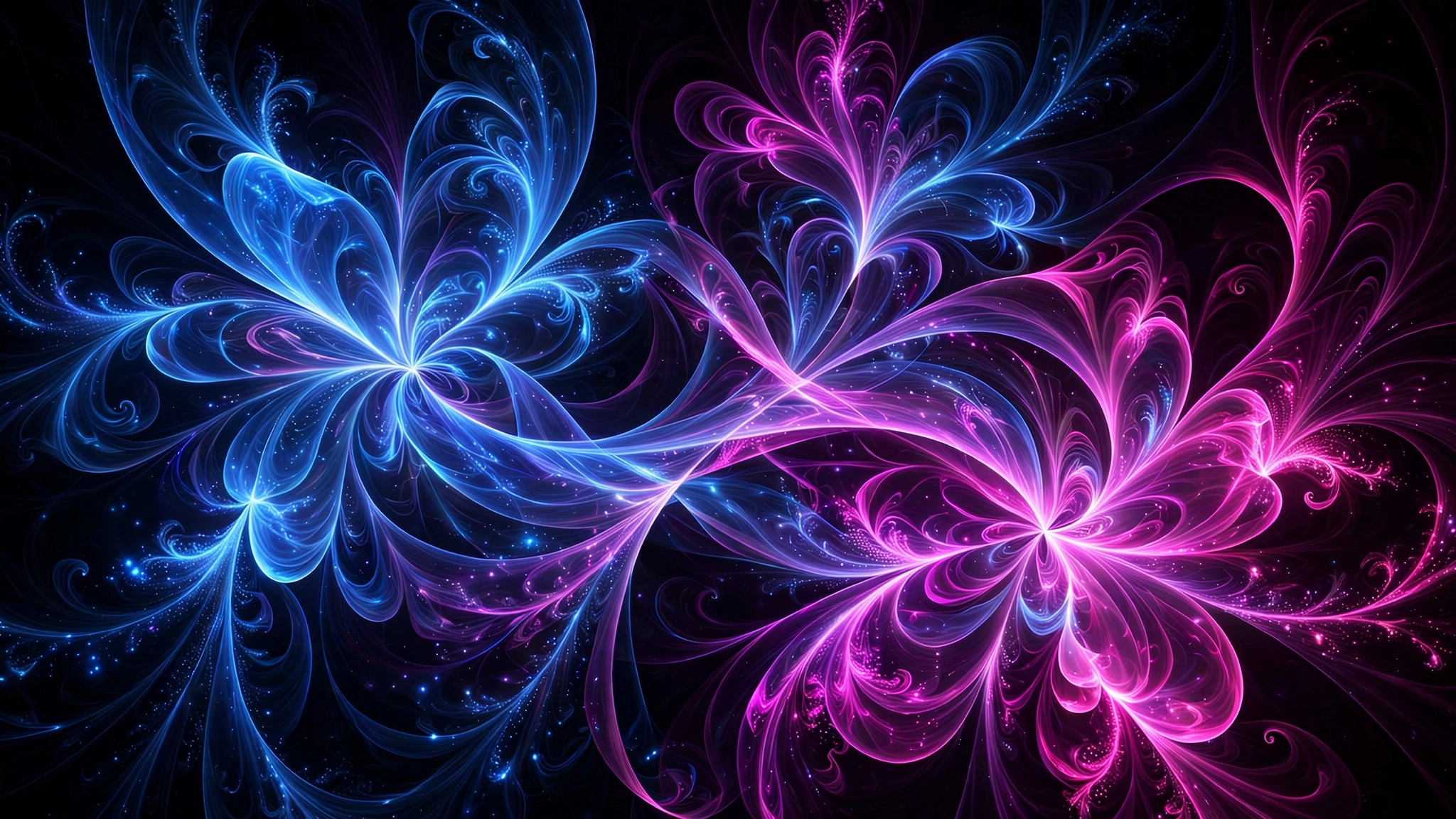
Apophysis-style fractal wallpapers are luminous, flowing flame fractals created with free, open-source software that let anyone with a home computer explore one of digital art’s most beautiful techniques. Apophysis implements the flame fractal algorithm through an artist-friendly interface of variations and transforms, and its results — organic, glowing, and gloriously intricate — defined an era when a global community shared parameters on early internet forums and rendered overnight. The style suits curious newcomers and longtime digital-art lovers alike, working best as a vivid phone or desktop background where its bright cores and delicate filaments can glow against darkness.
What gives these wallpapers their lasting appeal is not polish from an industry, but generosity from a community. Apophysis and descendants like Chaotica kept the tools open and shared, so beauty became a commons. The history of the fractal flame algorithm shows how that combination of mathematics and openness produced such a distinctive look.
The Apophysis Aesthetic
Variation richness is the first hallmark. The software offers dozens of mathematical variations, including sinusoidal, spherical, swirl, and horseshoe, which can be combined in countless ways. From those combinations come effects ranging from flowers and galaxies to impossible architectures.
Luminous accumulation gives flames their characteristic glow. Density-estimation rendering builds bright cores that fade into delicate filaments, like long-exposure photography of light itself. Darkness is not empty in these compositions; it is the void the flame burns in, and it makes up half the picture.
Organic emergence is what people remember most. The best Apophysis art looks grown rather than computed, and the mathematics disappears into visual poetry. Democratic craft completes the picture, since the style carries the ethos of its tools: open, shared, and community-driven, made by enthusiasts for the love of beauty.
- Variation richness: dozens of combinable variations create an enormous range of forms.
- Luminous accumulation: bright cores fade to fine filaments for a signature glow.
- Organic emergence: the finest pieces feel grown, not calculated.
- Democratic craft: free tools and shared parameters shaped the whole style.
Apophysis-Style Wallpaper Families
Classic flames are the iconic look that defined the genre. Flowing luminous filaments appear in vivid hues on black, thrilling now as they were when the technique was new. They serve as historical documents of digital art’s Cambrian explosion, a moment when new forms seemed to appear daily.
Floral and organic flames guide the algorithm toward natural resonance. Flower-like, creature-like, and galaxy-like forms feel alive, familiar, and wonderful. These are the most emotionally engaging members of the family, and they show how warm the mathematics can become.
Architectural flames move in the opposite direction. Their variations produce structured, geometric forms, impossible buildings, crystalline lattices, and ordered complexity. They merge organic flow with architectural precision, which makes them the most intellectually fascinating of the group. A useful overview of how such flames fit into fractal art more broadly is Fractal Art Wallpapers: Design Guide & Inspiration.
Minimal flames restrain the technique. Sparse filaments, limited palettes, and generous darkness prove that flame fractals can whisper as well as shout. They are the most sophisticated option and often the most wearable for daily use.
A Brief History Worth Knowing
The flame fractal story is a lovely chapter in art history. Mathematician-artists developed the algorithm, programmers built free tools, and a global community shared flame parameters like recipes. The Electric Sheep project even turned the idea into collaborative animation, so the work grew through participation as well as individual experiment.
Before accessible renderers, fractal art required programming skill. After Apophysis, it required only curiosity and taste, much as the camera once changed who could make photographs. That democratization produced an explosion of creativity, with thousands of artists exploring the parameter space and developing distinct styles.
A genuine craft tradition formed around the software. Techniques with names, including fractal flame portraits, bokeh-style flames, and deep-space compositions, were invented, refined, and taught in forums and tutorials. Masters emerged whose work rivals other digital art in compositional sophistication and chromatic richness, all generated from mathematical transforms.
What distinguished the best artists was parameter intuition. They learned to predict, roughly, what a set of transform values would produce, and to navigate toward beauty deliberately rather than randomly. That intuition, built over hundreds of renders, combines mathematical understanding, aesthetic judgment, and patience, proving that free access never made excellence automatic. Readers drawn to intense color will also enjoy Psychedelic Rainbow Abstract Art: A Guide to Vibrant Visuals for a different route to vivid abstraction.
Choosing Flames Well
Look first for variation interest. The best flames use their variations creatively, not just as default swirls, and produce genuinely surprising forms. Images that make you wonder how they were made tend to hold attention longest.
Density balance is next. Rich cores with delicate extremities give the classic flame structure, while uniform density looks flat. Good flames breathe from dense to sparse, so the eye can travel.
Palette intention matters just as much. Color should serve the form, not mask it, and the most enduring flames use disciplined, harmonious palettes. Respect the dark as well, because black backgrounds shape the composition and give the glow its contrast.
The aesthetic legacy now reaches far beyond the original software. Wispy, luminous, flowing qualities Apophysis made famous have influenced music visualizers, movie effects, and contemporary 3D art, often among people who have never heard its name. That is the mark of a truly influential tool: its look becomes part of the visual vocabulary of an age.
Apophysis-style fractal wallpapers remind us that some of the most beautiful art of the digital age was made freely, shared openly, and created by a community rather than an industry. Complexity grows from simplicity here, and beauty grows from code and generosity together. To carry a flame as your daily background is, in a small way, to carry the pioneers’ overnight renders with you, still glowing in your pocket.
Related posts:



If this set speaks to you, Burning Ship Fractal Wallpapers: The Mandelbrot’s Fiery Sibling continues the fractal-patterns conversation in a new direction.
Bookmark this set for the next time your screen needs a new mood.

