
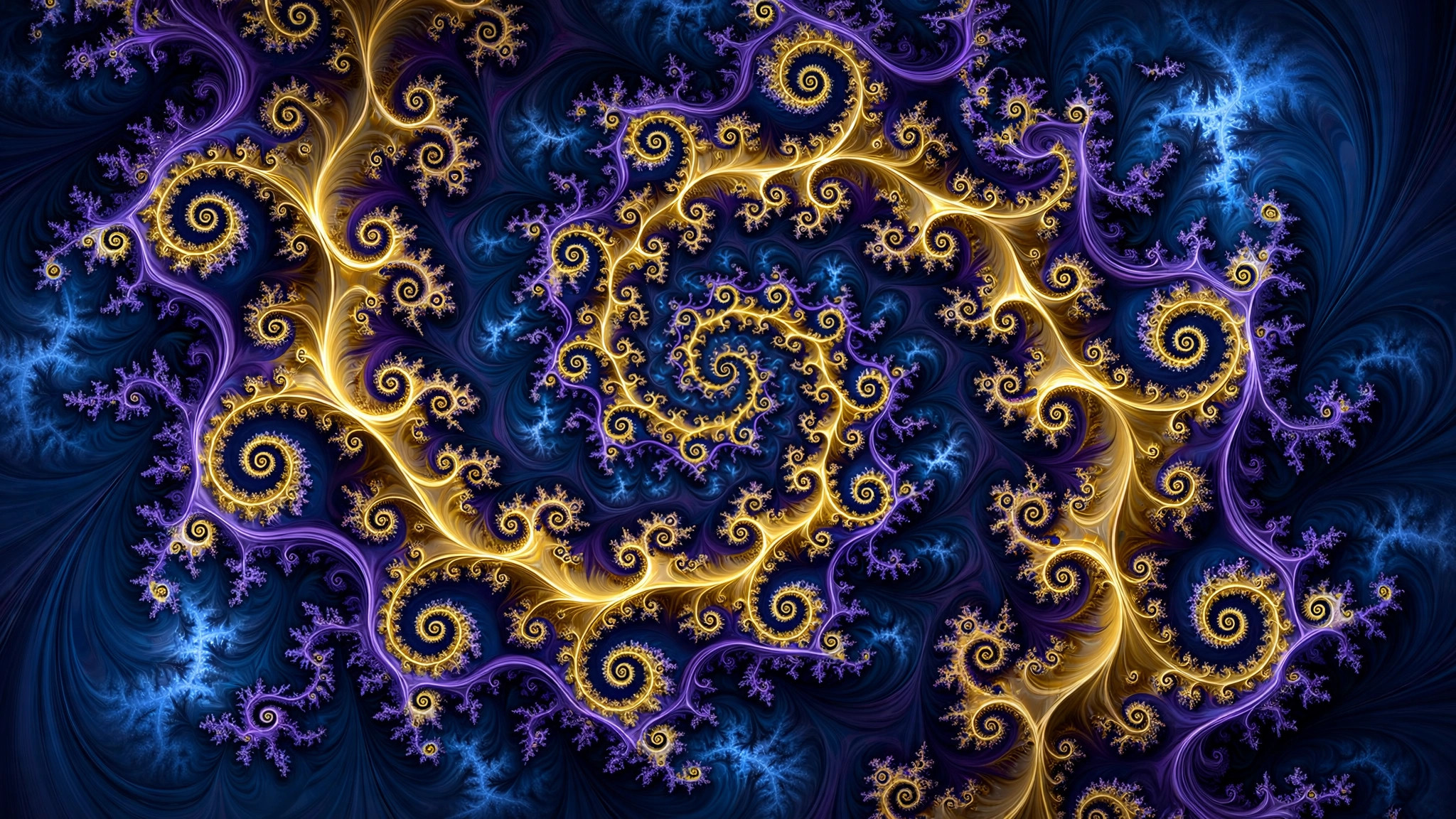
Zoom into a fractal and the pattern never ends. Spirals contain smaller spirals, branches split into tinier branches, and every level of magnification reveals new structure that echoes the whole. It is mathematics made visible — and as a wallpaper, it produces some of the most intricate, hypnotic imagery you can put on a screen. No photograph, no painting, no 3D render quite matches the infinite detail of a well-crafted fractal.
Fractal art wallpapers occupy a unique corner of abstract design. They are simultaneously organic and precise: the forms recall seashells, lightning, coastlines, and galaxies, yet every curve is generated by pure calculation. That duality gives them broad appeal, from math enthusiasts to anyone who simply likes getting lost in visual complexity. This guide explores what makes fractals special as wallpapers, the main families of fractal art, and how to choose pieces that mesmerize without overwhelming.
What Exactly Is a Fractal
A fractal is a pattern that repeats at different scales — the technical term is self-similarity. A coastline looks jagged whether you view it from orbit or from the beach; a fractal works the same way. In digital art, fractals are typically generated by iterating simple mathematical formulas thousands or millions of times and mapping the results to color. The famous Mandelbrot set is the best-known example, but it is only one member of an enormous family.
What matters for wallpaper purposes is not the math but its visual consequence: infinite detail. A fractal image contains interesting structure at every zoom level, which means it never looks empty or flat. Even a calm, dark fractal rewards close inspection, with filaments and spirals emerging wherever your eye lingers. Few wallpaper styles reward high-resolution displays so directly.
The Main Families of Fractal Art
Mandelbrot and Julia sets
The classics. Mandelbrot renders produce those iconic bulbous forms fringed with infinite filigree — seahorse tails, spirals, and dendritic branches that look almost biological. Julia sets, close mathematical cousins, generate more varied compositions: swirling storms, lace-like networks, and crystalline symmetries.
Both share a distinctive look of organic complexity emerging from pure order. They are the most recognizable fractal style and the easiest entry point for newcomers.
Flame fractals
Flame fractals trade the Mandelbrot’s crisp detail for something softer and more painterly. Built from systems of nonlinear transformations, they produce wispy, smoke-like forms with gorgeous color gradients — galaxies, nebulae, and flowing hair rendered in light. If you find classic fractals too busy, flame fractals offer the same infinite quality in a dreamier package. They overlap visually with atmospheric styles like smoke abstract illustration, though their structure is purely mathematical.
3D fractals: Mandelbulb and beyond
Extend fractal iteration into three dimensions and you get the Mandelbulb — a sculptural object of impossible complexity, all folded surfaces and endless crevices. Rendered with realistic lighting and materials, 3D fractals look like alien architecture or deep-sea formations. They combine the infinite detail of fractals with the tactility of 3D art, making them spectacular on large monitors.
Geometric and kaleidoscopic fractals
Not all fractals are swirly. Iterated geometric constructions — Sierpinski triangles, fractal trees, kaleidoscopic tilings — produce crisp, architectural patterns with mathematical rhythm. These suit minimalists who want the fractal concept without the visual density, and they pair beautifully with structured design sensibilities like those in our guide to geometric abstract textures.
Why Fractals Make Great Wallpapers
The strongest argument for fractal wallpapers is depth without subject. A fractal fills the screen with visual interest at every scale, yet it depicts nothing recognizable:
- no faces to notice
- no text to read
- no horizon to orient around
That makes it ideal background material: endlessly engaging in peripheral vision, never demanding focus.
Fractals are also natural conversation pieces. There is something genuinely wondrous about an image that contains infinite structure, and people notice. A fractal desktop in a shared workspace or a fractal phone glimpsed by a friend tends to prompt the same question: what is that? For a device that doubles as self-expression, that curiosity is a feature.
Finally, fractals scale beautifully. Because detail exists at all levels, the same fractal can work as a phone wallpaper and a 4K desktop background — you simply frame different regions. Many fractal artists publish zoom sequences of a single piece, which makes for a coherent wallpaper collection across all your devices.
Choosing the Right Fractal for Your Screen
Managing visual density
The number one consideration is how busy the image is. Dense, high-contrast fractals are thrilling for a few minutes and tiring for a full workday. For primary screens, favor fractals with a clear focal region and calmer surrounding areas — a detailed spiral floating in dark space, for instance, rather than detail wall-to-wall. Save the maximalist pieces for lock screens or secondary displays where you glance rather than stare.
Color palettes
Fractal coloring is an art in itself, and palettes range enormously. Deep-space palettes — blues, violets, blacks with electric highlights — are the most popular and the most livable, echoing the cosmic associations of the forms. Fiery palettes of gold, orange, and red feel energetic and warm.
Pastel and monochrome fractals exist too, and they are criminally underused: a soft grey fractal can be as elegant as any minimalist wallpaper while hiding far more detail. Our guide to grey abstract vector design shows how restrained palettes elevate complex forms.
Composition and orientation
Look for fractals with a natural resting place for your eyes — and for your icons. The best wallpaper fractals have their densest detail off-center, leaving a relatively calm zone where the clock, widgets, or desktop icons can live. Centered, symmetrical fractals (kaleidoscopic pieces especially) make stunning lock screens but can fight with interface elements on home screens.
Resolution: Where Fractals Demand the Best
If any wallpaper style justifies hunting down the highest resolution available, it is fractals. The entire appeal is fine detail, and a low-resolution fractal is a contradiction — a promise of infinity delivered as blur. For phone screens, use sources at least matching your display resolution; for desktops, 4K sources are worth seeking even on 1440p monitors, because the downscale preserves filament detail that would otherwise dissolve.
Be wary of over-compressed downloads. Fractal detail — thousands of thin filaments and tiny spirals — is exactly the kind of high-frequency information that JPEG compression destroys first. A heavily compressed fractal develops muddy patches where crisp structure should be. Prefer PNG sources or high-quality JPEGs, and avoid re-saving or screenshotting, which compounds the damage.
One delightful property: because fractals are generated mathematically, they can be re-rendered at any resolution without quality loss. Some artists offer custom renders on request, and fractal software lets you generate your own at exactly your screen’s dimensions. It is one of the few art forms where “remastered in 8K” is literally always possible.
Living With a Fractal Daily
Fractal wallpapers reward a particular kind of attention: the idle glance. While waiting for a file to load or a call to start, your eyes wander into the structure and find something new. Many fractal enthusiasts report that their wallpaper never gets old precisely because it cannot be fully seen — there is always another level of detail you have not noticed. In that sense, a fractal is less like a picture and more like a window.
That said, rotation still helps. Keep a small collection spanning different fractal families — a Mandelbrot spiral, a flame fractal nebula, a geometric tiling — and switch between them. The variety keeps the sense of discovery alive. For color-driven alternatives in the same spirit of endless variation, rainbow backgrounds offer a different route to visual richness.
A vibrant, color-driven relative of the style is covered in Psychedelic Rainbow Abstract Art: A Guide to Vibrant Visuals.
Common Mistakes
Choosing maximum density is the classic error. The most impressive fractal in a gallery — detail at every pixel, colors at full saturation — is often the worst daily wallpaper. Restraint reads as sophistication on a screen you face for eight hours.
Ignoring the interface is the second. A fractal’s beauty is irrelevant if your clock is unreadable or your icons vanish into the pattern. Always preview with your real layout, and do not fall in love with a piece before checking legibility.
The third is settling for watermarked or low-quality versions. Fractal communities are generous with free high-resolution downloads; there is rarely a reason to use a compressed, logo-stamped copy. And if a fractal ever feels too wild, the structured line work of line art abstracts offers precision with calmer energy.
Final Thoughts
Fractal art wallpapers put infinity on your screen — structure without end, generated by some of the simplest equations ever written. They are as intellectually satisfying as they are visually rich, and they reward good displays like no other style. A piece with room to breathe, sourced at the highest quality you can find, offers a background that you will never fully finish exploring. For a deeper, moodier branch of the family, psychedelic navy illustration explores similarly boundless territory in darker tones.
Related posts:


Pieces in fractal-patterns talk to each other across pages — follow the thread with Mandelbrot-Inspired Fractal Wallpapers: Infinite Detail Explained.
Bookmark this set for the next time your screen needs a new mood.

