
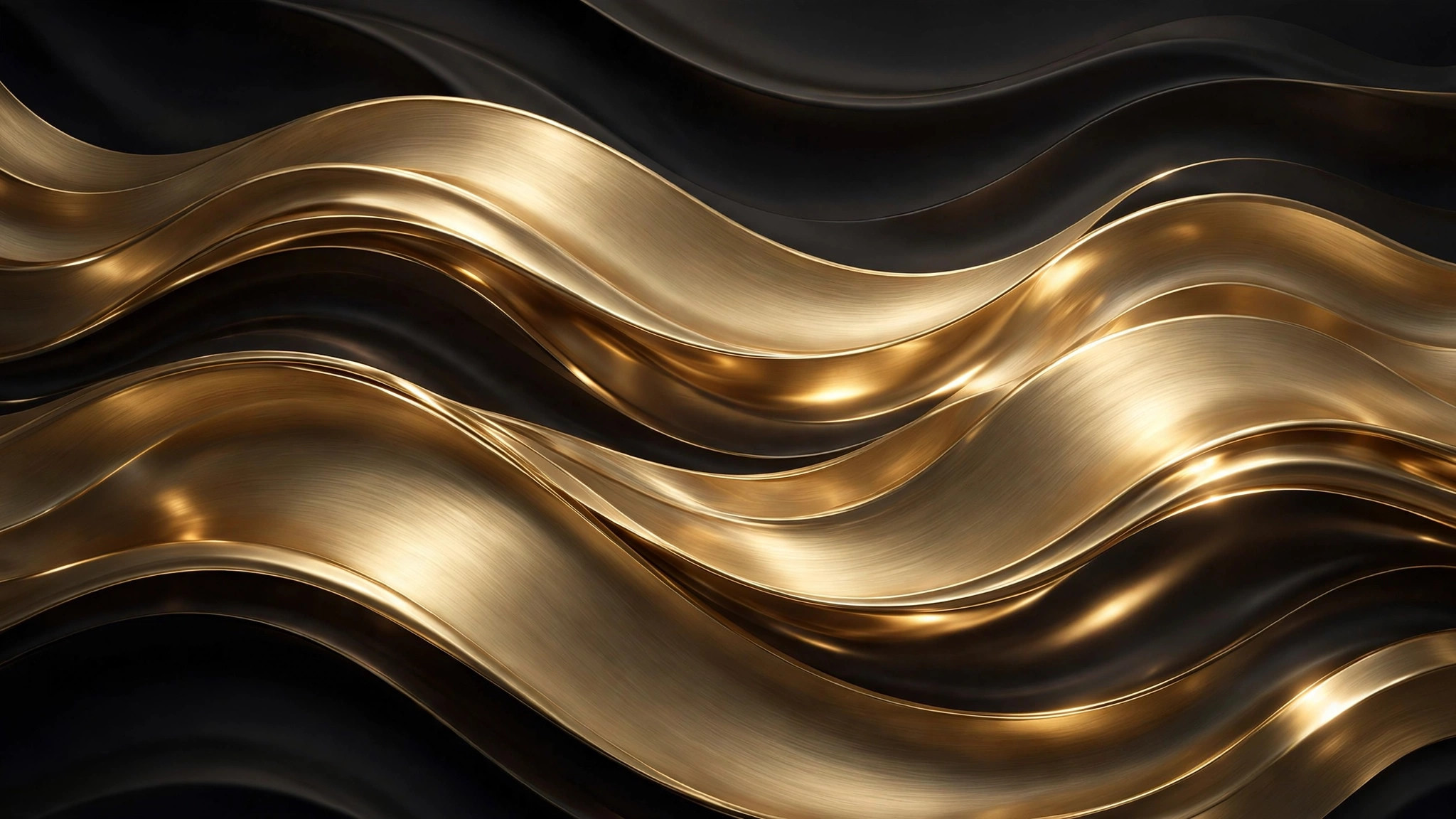
Metallic 3D wave wallpapers are sculpted, sound-like surfaces in luminous metal — imagine a symphony frozen mid-crescendo, or ocean swells cast in bronze, their curves catching light as they roll. What they show is a continuous flowing surface, rendered in chrome, brushed metal, gold or gunmetal. Who they suit is anyone who wants a background with real presence that still depicts nothing distracting.
They work best on large, high-quality screens and in both professional and personal setups, because they operate at the level of pure visual pleasure rather than theme or subject, like music without lyrics. Why they compel is the tension at their core: waves imply motion, yet rendered in metal they are frozen at the perfect moment. How to choose one is to match the wave’s tempo and the metal’s character to the mood you want — majestic and calm, or tight and electric.
The Sculptural Wave
Wave forms in 3D art draw from multiple inspirations: ocean swells, sound waveforms, draped fabric and wind-shaped dunes. What unites them is the flowing surface — continuous, curving, catching light in long gradients. Rendered in metallic materials, those surfaces gain a second dimension of beauty: reflection.
Metallic reflection on a wave does something magical. As the surface curves, it shows different parts of its imaginary environment — bright sky-bands on the crests, deep darks in the troughs. The wave becomes a landscape of light, each curve a new vista, making this the most painterly of the 3D metal styles.
The underlying wave is a pattern that recurs across nature, from water to sound, which is why these surfaces feel familiar even when they represent nothing literal. Waves imply motion — they were moving, they will move — but in metal they hold still. That tension between implied dynamism and material stillness gives these wallpapers an electric calm.
The most compelling pieces borrow their logic from sound visualization, the idea that a surface can be “played” like an instrument, its undulations corresponding to frequencies and amplitudes. Whether or not the artist literally used audio data, the best work has a rhythmic quality, with crests arriving in musical regularity. That rhythm separates mesmerizing wave art from mere bumpy metal, because the eye, like the ear, loves pattern with variation.
Metallic Wave Styles
Finish is personality in this family. The wave geometry may be identical from one piece to the next, while the surface tells a completely different story.
- Chrome ocean swells: large, smooth metallic waves in mirror chrome, the most dramatic of the family. They have the presence of monumental sculpture — powerful, flowing, gleaming statement wallpapers.
- Brushed metal ripples: finer wave patterns with a brushed-metal texture, subtler and more sophisticated than mirror chrome. The brushing adds a tactile, crafted quality, excellent for professional screens where drama must be restrained.
- Gold and bronze waves: waves in warm metallics, the luxury end of the family. Gold waves carry an almost mythic quality — treasure in motion, wealth made fluid — and are the most opulent and emotionally warm options.
- Sound-wave sculptures: waves explicitly referencing audio waveforms — ridged, rhythmic, pulsing. They merge the visual language of music production with sculptural 3D, perfect for musicians, producers and anyone whose life has a soundtrack.
- Dark metallic seas: near-black metallic waves with sharp bright crests, the stormy end. Powerful and moody, like dark water under moonlight in gunmetal and silver, they are superb on OLED, where the troughs vanish and the crests seem to float.
To see how wave surfaces compare with other sculpted 3D forms, the 3D Rendered Abstract Shapes: Wallpaper Design Guide is a good companion. It helps clarify whether you want a single bold object or a surface that fills the whole frame.
Choosing Metallic Waves Well
Wave scale sets the mood first. Large, slow waves feel majestic and calm, while tight, energetic ripples feel dynamic — the wave’s “tempo” is the wallpaper’s emotional register. Broad, slow undulations with few crests across the frame feel oceanic, like swells on deep water, whereas rapid ripples feel closer to vibration than to waves.
Most viewers find the middle range most satisfying for daily use. Waves frequent enough to create rich highlight-shadow interplay, spaced enough to read as flowing rather than buzzing, hit the visual equivalent of a comfortable tempo.
Four checks help when comparing pieces:
- Wave scale: decide on the tempo first, since large swells calm and tight ripples energize.
- Metal character: mirror chrome is dramatic and cool, brushed metals are sophisticated and warm, gold is luxurious, and dark metals are powerful.
- Light direction: consistent, believable lighting sells the metal, so look for coherent highlight flow across the surfaces.
- Composition: waves need room to roll; cramped crops feel restless, generous ones feel oceanic.
Patina and finish refine that choice further. Mirror-polished waves feel futuristic and pristine, brushed or satin waves feel crafted and warm, and darkened or oxidized waves feel ancient and mysterious, like artifacts recovered from deep water. The 3D Abstract Graphics 4K Wallpaper: The Ultimate Visual Guide is useful here, because subtle metallic gradations are exactly what higher resolution protects.
Sound, Light and Display
The metallic surface transforms wave behavior into light behavior. Each crest catches the imaginary light and each trough falls into shadow, creating on polished metal the characteristic traveling-highlight effect. Bright bands seem to move as the eye moves, even in a still image — the wallpaper never literally changes, but it never quite sits still either, which is the closest a static image comes to shimmering.
For practical screen use, metallic waves are remarkably versatile. Their flowing, non-representational nature means they never depict anything distracting, while their luminosity keeps the screen feeling alive. They are professional enough for offices and beautiful enough for personal devices.
Display quality is worth emphasizing, though. The smooth falloff from highlight to shadow across curved metal is exactly what poor displays render worst, producing banding that shatters the illusion. On a quality panel the transitions are seamless and the metal feels liquid, so this is a style that rewards good hardware more than most — and on a great screen, great metallic waves are genuinely stunning.
Metallic 3D wave wallpapers suggest that beauty has a frequency — that the same patterns govern ocean swells, sound waves and brushed steel. As a daily backdrop they are a reminder of that hidden harmony: everything flows, everything reflects, everything moves in rhythm, and your screen becomes a quiet instrument playing a visual music of metal and light.
Related posts:



Abstract work rewards a second look — browse more of 3d-abstract when you are ready for a new backdrop.
Pass this link to someone who appreciates bold, abstract design.

