
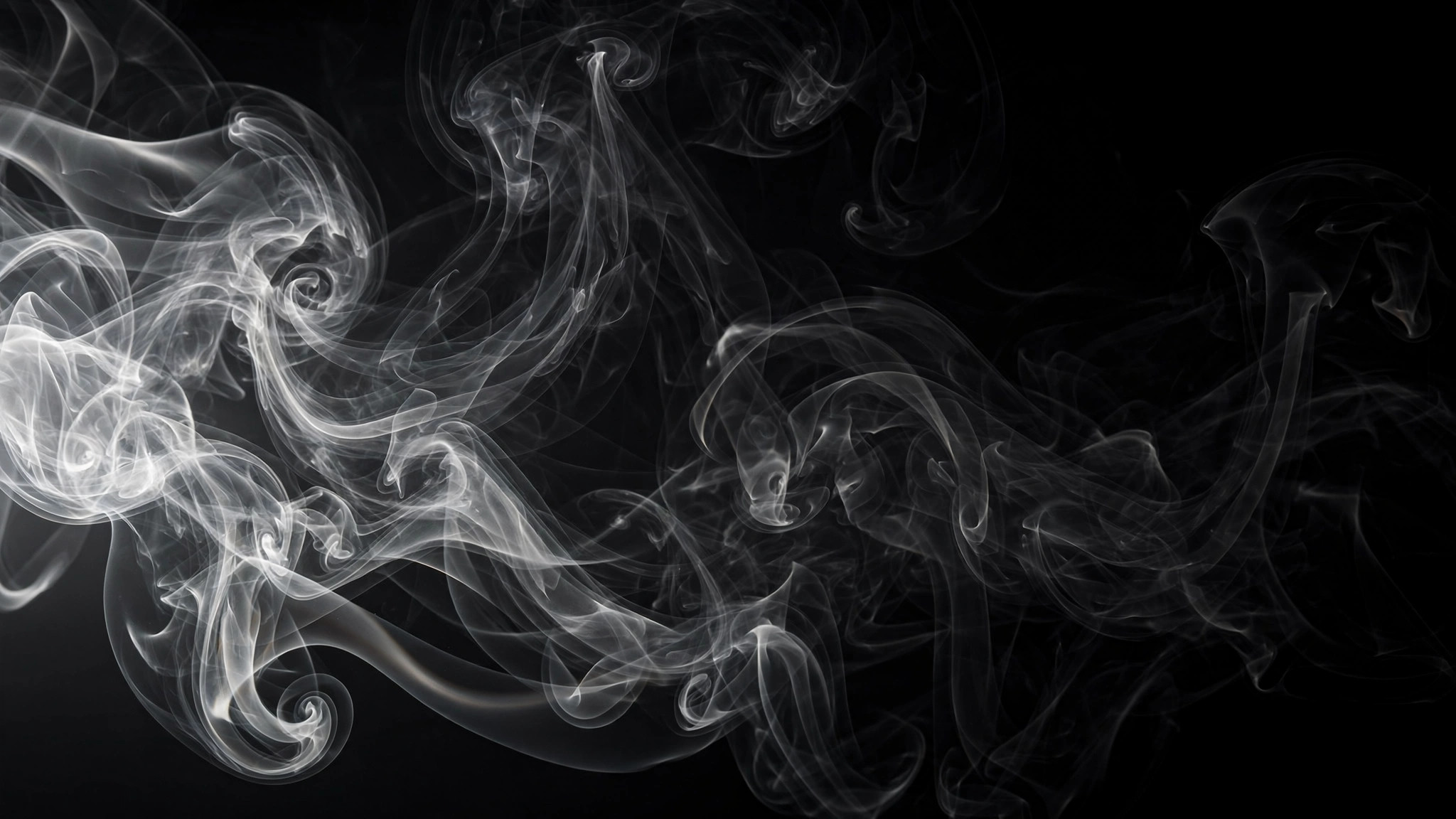
If you want a background with genuine atmosphere, dark smoke wallpapers show what happens when black vapor is photographed at the exact moment it curls, billows, and vanishes against darkness. Smoke cannot be posed, repeated, or fully controlled, so who is behind the camera matters less than when the shutter fires, where the light falls, why the black ground transforms the vapor, and how a fraction of a second becomes a lasting abstraction. This guide follows that process from the physics of a single plume to the choice between dense fog and a delicate wisp, so you can judge which mood will actually live well on your screen.
On screen, dark smoke has a presence that flat darkness lacks, because smoke-filled darkness feels inhabited rather than empty. There is something in the dark, moving slowly and almost alive, and the effect is cinematic and a little mysterious, the visual equivalent of a low cello note. Readers comparing mood-first backgrounds often place these images alongside a dark aesthetic abstract wallpapers design guide, since both approaches treat darkness as material rather than absence.
The Physics of the Photogenic
Smoke photographs beautifully because it is a master of tonal gradation, containing the full range from near-white core to invisible edge in a single plume. Against a black background, that range becomes pure drama, with every grey in between on display. The wisps catch light selectively, edges glowing while interiors fall to shadow, which creates a three-dimensionality that flat graphics struggle to match.
No renderer quite captures the chaotic authenticity of real smoke, because its turbulence is genuinely random and each curl is unrepeatable. In general terms, smoke is vapor made visible just long enough to be remembered, and dark smoke wallpapers collect those ephemeral moments rather than inventing them.
Artists create these images with surprising simplicity, using incense sticks, fog machines, or vapor against black velvet, lit from the side and shot fast. Controlling the smoke is still a craft, because the vapor must be coaxed into photogenic shapes without dissipating or blowing out. The best smoke photographers learn to read air currents like sailors read wind, positioning lights and subjects to catch the vapor at its most expressive moment.
The black background is not just a backdrop but an active participant, since the vapor emerges from darkness the way thoughts emerge from sleep. The same smoke against white would read as dirty or grey, while against black it reads as luminous, almost silver. This is the chiaroscuro principle applied to vapor, darkness as the canvas that lets light perform, a tonal discipline also central to an abstract dark black texture guide to modern moody aesthetics.
Styles of Smoke Abstraction
Monochrome smoke is the purist choice, grey vapor on black with the full tonal range on display and nothing to distract from the form. These images have a timeless quality, as if they could come from any decade, and they age gracefully. The shapes carry everything, from a curl like a breaking wave to a column like a cathedral pillar or a dissipating wisp like a held breath released.
Tinted smoke introduces color without sacrificing mood, but the tinting is usually restrained because smoke is fundamentally a creature of tone. Deep blue smoke on black feels cold and nocturnal, while amber-tinted vapor suggests fire just out of frame. Subtle violet wisps carry a supernatural charge, yet heavy color can cheapen the effect, so the most effective designs use hue like a film colorist, as a wash of atmosphere over a tonal foundation.
The density choice defines the personality of the wallpaper as clearly as color does:
- Dense, billowing smoke that fills the frame with churning vapor for a dramatic and immersive effect on large screens
- Delicate wisps that use vast blackness with minimal vapor, a single curl in an ocean of dark for a minimalist result
- Monochrome grey plumes that keep attention on form, gradation, and timeless tonal contrast
- Restrained tints in blue, amber, or violet that add temperature and suggestion without overwhelming the vapor
Delicate wisps pair especially well with a calmer, night-oriented use of darkness, where smoke acts as a gentle companion rather than a drama. Dense fog suits bold tastes and larger displays, while the wisp rewards restraint.
Composition in a Chaotic Medium
Composing with smoke means surrendering control and then reclaiming it in the edit, because photographers shoot hundreds of frames to get a handful of keepers. They select for accidents that look intentional, such as a curl that resembles a wave or a column with perfect symmetry. Digital artists then refine the captures by adjusting contrast to deepen the blacks, dodging and burning to guide the eye, and sometimes compositing multiple captures into impossible smoke sculptures.
The most important compositional decision is the placement of the vapor mass. Centered smoke has confrontational power, with the plume addressing the viewer directly, while off-center smoke feels more natural, like weather glimpsed through a window. Smoke rising from the bottom edge creates the classic narrative of something emerging, whereas smoke drifting across the top feels like sky and atmosphere with somewhere to go, and each placement tells a different micro-story over time.
Every smoke photograph is also a paradox of motion captured in stillness. The best ones preserve the sense of movement, so you can feel which way the vapor was traveling and sense the curl about to complete itself.
While most smoke wallpapers freeze a single instant, some artists use long exposures to record motion over seconds, drawing the path of the vapor as a continuous ribbon rather than a frozen curl. These images trade crisp detail for flowing continuity, and the smoke becomes calligraphy. Both approaches are valid, since frozen captures emphasize the sculptural instant while long exposures emphasize the dance, together showing a range from architecture to handwriting in vapor.
Smoke, Memory, and Atmosphere
Smoke photographs engage more than vision, because they trigger smell memories and the phantom scent of incense or campfire even through a screen. That synesthetic quality is unusual among abstract wallpapers, since geometric patterns do not smell like anything, while smoke carries its history in every curl. Artists exploit this by choosing smoke sources with character, such as sandalwood incense for warmth or stage fog for neutrality, knowing the image will evoke more than it shows.
Dark smoke wallpapers offer something increasingly rare in digital design, which is genuine atmosphere rather than the simulated depth of gradients or the crisp authority of geometry. They preserve the real, chaotic, and unrepeatable texture of a physical process, reminding the screen that darkness is not empty but full of slow motion, vapor, and shadow. In a world of sharp edges and flat colors, that dissolving beauty feels like a mercy, and it is why a little smoke can change the entire mood of a device.
Related posts:
Drawn to these shapes and colours? Dark Iridescent Wallpapers: Subtle Rainbow on Black explores a nearby corner of the same abstract world.
Share this page with a fellow art lover looking for their next wallpaper.

