
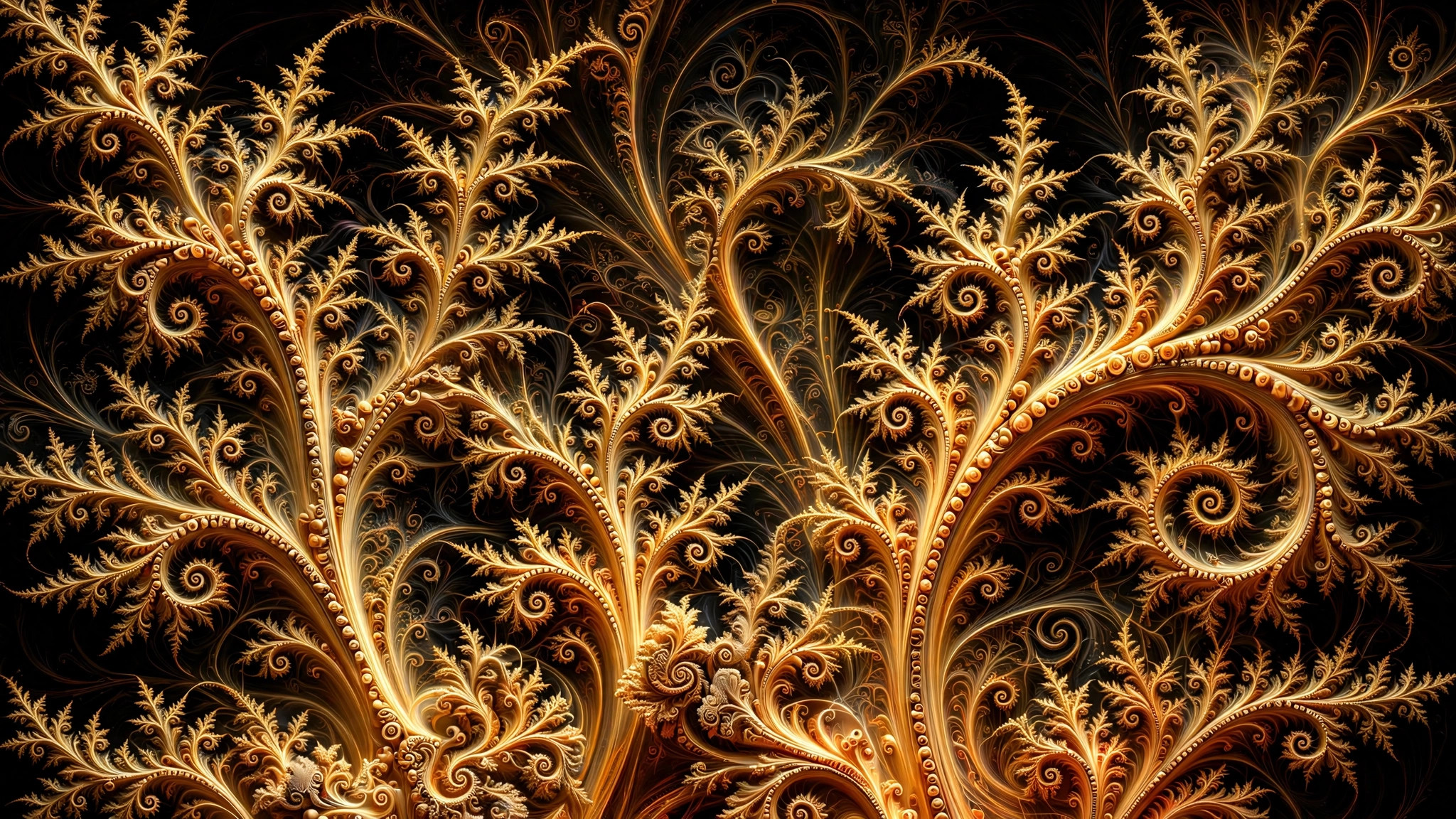
If you are looking for Pickover stalk wallpapers, you are looking for the most delicate corner of fractal art, where fern-like formations grow deep inside the Mandelbrot set and reward anyone who zooms past the familiar shapes. Named after Clifford Pickover, the scientist and author who popularized these structures, the stalks show what happens when a render follows how closely an orbit approaches the axes instead of how quickly it escapes to infinity. This guide explains who shaped the view, what the stalks are, where they live in the margins of the set, when they work best on a high-resolution screen, why they feel alive rather than chaotic, and how artists color and frame them for phones and desktops.
On screen, the stalks read as organic architecture, with branching towers, spiraling minarets, and lace-like scaffolding that seems both grown and built. The forms have a biological quality, like deep-sea corals or alien flora, yet every curve obeys strict mathematics. As wallpapers, they offer detail without chaos and complexity with grace, which is why a broader fractal art wallpapers design guide and inspiration collection still treats them as fractal art at its most refined.
What Grows in the Margins of the Mandelbrot Set
The boundary of the Mandelbrot set is infinitely complex, and the stalks inhabit its most elaborate neighborhoods. They emerge from a rendering technique Pickover championed, tracking near-misses rather than escapes to build images from the internal structure of the set. Standard renders blur past that filigree at the edges, while stalk renders bring it forward as the main subject.
That technical difference matters aesthetically, because standard Mandelbrot images are famous for bold, rounded bulbs and cardioids with almost cartoonish symmetry. Stalk renders are the opposite, fine, linear, and filigreed, more like engraving than painting. The Pickover stalk approach therefore changes not only the method but also the whole visual character of the result.
What makes the stalks so fine is the mathematics of the boundary itself, where tiny changes in position produce wildly different orbits. Near the edge, the dynamics become exquisitely sensitive, and that sensitivity renders as fine structure. The stalks are essentially visualizations of mathematical sensitivity, chaos resolved into lace, so the most delicate images come from the most unstable mathematics.
The detail rewards close inspection in a way that few fractal styles match. On a high-resolution screen, a stalk wallpaper becomes a landscape to explore, with new structures appearing every time you look closer.
Coloring the Infinitely Small
Stalk wallpapers live or die on their coloring, and the classic treatment uses deep backgrounds such as black or midnight blue. Against that darkness, the stalks appear in luminous gradients, each branch glowing like fiber optics so the eye can trace individual threads. Light filigree on dark ground keeps the finest detail legible instead of letting it dissolve into noise.
The most sophisticated renders use coloring to encode information rather than decoration alone. Orbit-influenced palettes might color stalks by their closest approach to a geometric shape, while escape-time blends might fade the finest filaments into the background to create depth.
Artists generally return to a few proven palette families, each with a different effect on the same underlying structure:
- Luminous gradients on black or midnight blue, which maximize legibility and give the branches a fiber-optic glow
- Dark stalks on pale grounds, which turn the mathematics into something closer to an ink drawing
- Full-spectrum coloring that maps orbit characteristics to rainbow hues for an immediately striking result
- Monochrome treatments such as white on black or gold on charcoal, which emphasize structure over spectacle
Monochrome renders are often described as the connoisseur choice because, without color to distract, the eye follows the branching logic and the hierarchy of trunk and twig. Full-spectrum versions bloom in different hues across each region, but fine detail plus varied color can overwhelm and turn into visual noise. For many viewers, the sweet spot is a limited palette of two or three related hues, a balance also explored in psychedelic rainbow abstract art and its guide to vibrant visuals when color needs energy without fragmentation.
Framing Infinity on a Real Screen
Because stalk fields are effectively infinite, composition becomes an act of curation, and the artist chooses a region, a magnification, and a frame. Wide views show stalk forests, with many formations in a single landscape where the mathematics reads as terrain. Tight crops isolate a single stalk and monumentalize it, so the filigree becomes architecture.
The most successful compositions respect the linear and vertical nature of these branching forms, which want room to grow upward through the frame. Portrait phone screens suit them naturally, while landscape desktops benefit from horizontal stalk fields marching across the wide frame like a mountain range. In both cases, giving the finest detail room to breathe is essential, because cramped stalks feel busy while well-spaced ones feel majestic.
A practical consideration is that the finest stalk detail can exceed what screens comfortably show. Filaments thinner than a pixel shimmer and crawl, creating moire-like artifacts that distract from the pattern. Good wallpaper artists choose magnifications where the important structure sits comfortably above the pixel threshold, or apply subtle anti-aliasing that preserves the lace-like quality without the shimmer.
The goal is a result that feels infinitely detailed without ever feeling noisy.
Hunting Your Own Region
Part of the appeal is that anyone can go hunting, because fractal exploration software lets users dive into the boundary of the Mandelbrot set themselves. Panning through infinite filigree until a formation catches the eye is a peculiarly meditative activity, and hours can pass navigating mathematical space. Each zoom reveals new architecture, so the search itself becomes part of the aesthetic experience.
Many wallpaper artists started as explorers who captured regions they discovered personally. That personal discovery adds an intangible quality, because the wallpaper is not just a pattern but a place someone visited, a corner of infinity with a story. The image carries both the mathematics and the memory of finding it.
Fractal art also raises a gentle philosophical question about who owns a region of the Mandelbrot set. The mathematics belongs to everyone, but the curation, including the choice of region, magnification, and coloring, is genuinely creative. The best stalk wallpapers acknowledge both sides, treating the infinite pattern as shared heritage and the specific framing as personal art.
Pickover stalks represent fractal art at its most contemplative, without the bombast of full Mandelbrot zooms and without relying on the obvious beauty of other fractal forms. Instead, they offer the pleasure of inexhaustible delicacy, a pattern that reveals more the longer you look. As a wallpaper, that quality is a lasting gift, because the background rewards the thousandth glance as richly as the first, and in the margins of mathematics the stalks simply keep growing.
Related posts:


Pieces in fractal-patterns talk to each other across pages — follow the thread with Fractal Orbit Trap Wallpapers: Trapped Path Color Fields.
Save the pieces you love and share the collection with your circle.

