
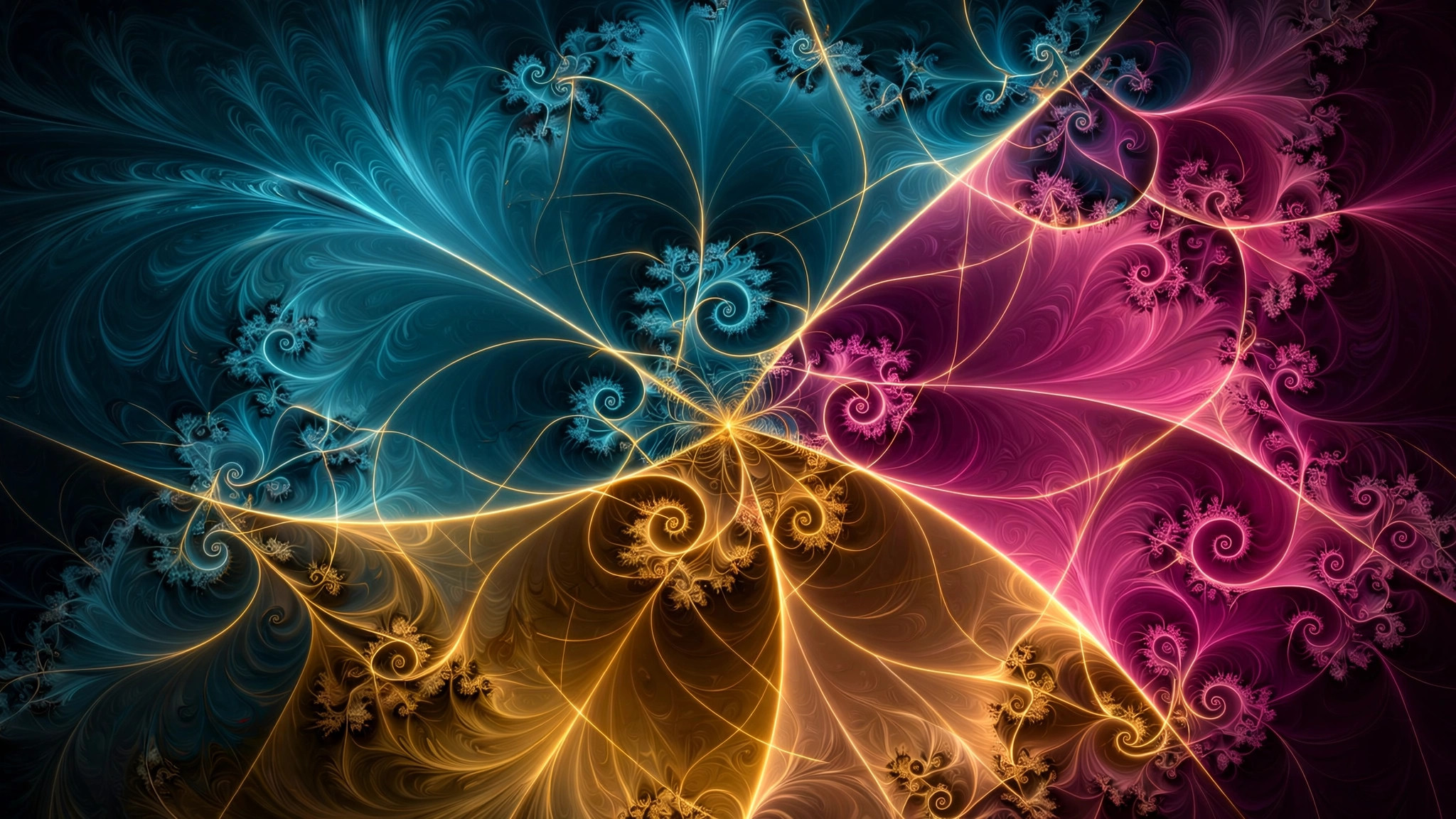
When you ask mathematics a simple question, where are this equation’s roots, and answer it with Newton’s method, colouring each starting point by which root it finds, the result is a Newton fractal wallpaper of striking clarity. Developed from one of mathematics’ great workhorses, this design shows who arrives where, why nearby points can meet different fates, and how a practical algorithm becomes art when its journeys are coloured across the plane. Each coloured region represents a journey, and the boundaries between regions hold infinite complexity.
Newton fractals captivate because they visualise process, not just pattern, so every hue carries meaning as a destination. The boundaries, where infinitesimally close starting points diverge to different destinations, are where the fractal magic lives in filigree frontiers of infinite detail. Readers drawn to Psychedelic Rainbow Abstract Art: A Guide to Vibrant Visuals will find colour used abstractly elsewhere, while the Newton fractal gives colour a precise mathematical job.
The Method Behind the Beauty
Newton’s method is elegantly simple: to find a root, start with a guess, follow the tangent line to a better guess, and repeat. For equations with multiple roots, different starting guesses converge to different roots, and the boundaries between those convergence zones are fractals of stunning complexity. Given a function and a starting guess, the method draws the tangent, follows it to the axis, and repeats, each step roughly doubling the correct digits.
That convergence is famously fast, which is why the method sits inside calculators, inside engineering software, and inside the modern world’s equation-solving. The fractal appears when the method is applied to complex polynomials, with each starting point converging to one of the roots. Colouring by destination reveals the basins of attraction, the territories belonging to each root.
The classic Newton fractal uses the equation z³ = 1, which has three roots, and the resulting image shows three coloured basins meeting in endlessly intricate boundaries. It is a visualisation of mathematical destiny, where nearby points can have wildly different fates. A broader Fractal Art Wallpapers: Design Guide & Inspiration celebrates pattern in general, while Newton fractals show what happens at the borders, and the borders are where the art lives.
Basins and Boundaries
The basins, the solid-coloured regions, represent certainty, because starting there means the outcome is assured. The boundaries represent sensitivity, because the slightest nudge changes everything. As wallpapers, the basins provide calm through large areas of pure colour, while the boundaries provide fascination through infinite filigree that rewards close looks, making this the rare fractal that offers both serenity and complexity in one frame.
What the image really shows is sensitivity, since the algorithm is deterministic and the same start reaches the same root every time, yet arbitrarily close starts can diverge. It is the butterfly effect rendered, a deterministic system with unpredictable edges and order containing its own beautiful chaos. The fractal is also the method’s failure modes made gorgeous, the places where convergence becomes drama.
Colouring the Search
Newton fractal wallpapers are defined by their basin palettes, the colours assigned to each root’s territory, and the background in the Newton fractal tradition shows how much mood those choices control. The mathematics stays identical, but the feeling transforms completely with the palette. Three rendering ideas shape most designs.
- Classic triads: three roots and three colours, such as teal-magenta-gold, blue-red-yellow, or violet-emerald-amber.
- Shaded depths: each basin shaded by convergence speed, with fast regions glowing bright and slow regions deepening toward black.
- Boundary emphasis: glowing filigree lines tracing the frontiers where certainties meet.
Classic Triads and Shaded Depths
Three roots and three colours form the traditional Newton image, and popular triads include teal-magenta-gold for a vibrant, modern mood. Blue-red-yellow feels primary and bold, while violet-emerald-amber feels rich and sophisticated. The triad choice sets the wallpaper’s entire mood, giving colour mathematical meaning.
Advanced renderings shade each basin by convergence speed, how quickly the starting point reaches its root. Fast regions glow bright and slow regions deepen toward black, adding a luminous dimension with valleys and peaks of computational effort. These are among the most beautiful Newton wallpapers because the mathematics is rendered with genuine depth, while boundary-focused versions emphasise the infinite lacework itself.
Equations as Art
Different equations produce different Newton fractals, and each polynomial becomes its own universe of basins and boundaries. Higher powers such as z⁴ and z⁵ bring more roots, more basins, and more complex frontiers. Higher-power Newton fractals are busier and more intricate, suiting large screens where the complexity has room to unfold.
Newton’s method applied to transcendental functions, including sines and exponentials, produces wild and unexpected fractals with basins within basins. These explorer’s wallpapers suit users who want their mathematics strange as well as beautiful. Flowing complexity becomes grounded here, because the image always traces back to roots being sought and found.
Styling the Search
On desktops, Newton fractal wallpapers create workspaces with intellectual character, since the calm basin regions sit well behind windows and the boundary filigree rewards idle moments. They are superb for analytical work, because the wallpaper itself visualises problem-solving as ambience. On phones, a crop of boundary filigree filling the frame becomes intricate jewellery at intimate scale.
For educators and students, Newton wallpapers offer daily inspiration from the beauty hidden inside numerical methods. Newton devised the method for solving, and the fractal reveals what the solving looks like from above: the territories, the borders, and the infinite filigree where certainties meet. Keep one for the problem-solving hours, and let its coloured basins remind you that convergence is possible, iteration works, and every starting point belongs to some basin journeying toward its root.
Keep the Newton fractal as that contemplated convergence: the method working, the roots found, and the boundaries blooming. The screen holds mathematics’ most practical algorithm at its most beautiful, the workhorse dreaming. The beauty of convergence is inseparable from its edges, where the method hesitates and the hesitation becomes art.
The roots are found, yet the boundaries are the reward that keeps the eye returning. Each basin is a promise that starting somewhere and iterating honestly leads to an answer. Each frontier is a reminder that the path matters too, and that small differences near the borders lead to different destinations.
Related posts:
Drawn to these shapes and colours? Burning Ship Fractal Wallpapers: The Mandelbrot’s Fiery Sibling explores a nearby corner of the same abstract world.
Bookmark this set for the next time your screen needs a new mood.

