
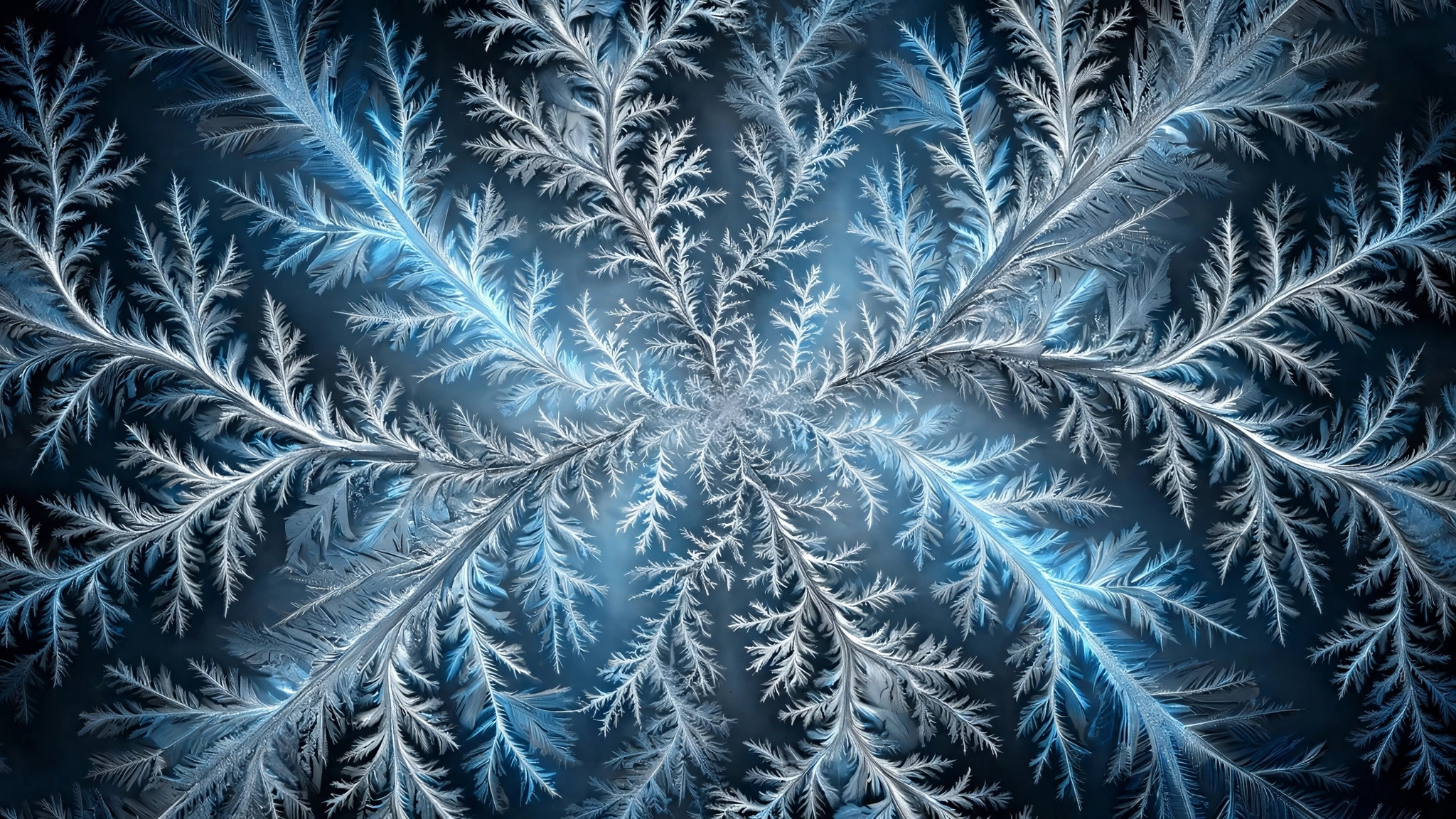
Watch frost form on a windowpane and you will see who makes these wallpapers and why they matter: ice crystals spreading, splitting, and re-splitting in fractal obedience to physics. Those branching formations are dendrites, and a fractal dendrite wallpaper renders their growth as art — metallic frost spreading from a center, recursive branches in silver and ice-blue, winter’s mathematics made visible.
Dendrites captivate because they are growth made visible: you see not just the pattern but the process — the crystal advancing, choosing branches, exploring space. That sense of becoming gives dendrite wallpapers a unique vitality among fractals, because they feel alive, still growing. A finished fractal shows mathematics completed; the dendrite shows mathematics in the act of growing.
The Physics of Branching
Dendrites form through diffusion-limited aggregation: particles wandering randomly, sticking where they touch the growing cluster. The tips grow fastest, since they meet the most wanderers, so branches sprout branches — the fractal emerging from pure statistics. It is the same process behind lightning, river deltas, neurons, and frost: nature’s favorite way to explore space. The scientific background is covered in Wikipedia’s article on the dendrite, the branching crystal form itself.
As wallpaper, that universality deepens the beauty: the frost on your screen shares its mathematics with the lightning in the sky and the neurons in your head. The smoke silver metallic art aesthetic’s love of branching form finds its mathematical root here — literally. Readers exploring the wider family of fractal backgrounds will also enjoy a fractal art wallpapers design guide for companion styles and inspiration.
Growth as Composition
Dendrite wallpapers are composed around the growth’s origin: the seed point from which the crystal spreads. That origin becomes the composition’s heart — the eye returning to where it all began, then following the branches outward. It is narrative in pure form: beginning, expansion, the story of growing.
Rendering the Frost
Dendrite wallpapers are defined by their material rendering — how the crystal growth is staged. Three stagings dominate the style:
- Metallic frost: silver branches on deep blue-black, the frost as metal and the growth as jewelry.
- Ice crystals: pale blue-white branches, the frost as frost — honest, cold, and beautiful without ornament.
- Dark growths: inverted dendrites, dark branches on light grounds, the growth rendered as shadow or ink.
Metallic Frost
The classic: silver branches on deep blue-black, the frost as metal, the growth as jewelry. These wallpapers have genuine glamour — the dendrites seeming precious, the ice become silverwork. They suit elegant setups and pair beautifully with the black marble wallpaper aesthetic’s love of dark luxury: different materials, same refinement.
Ice Crystals
The naturalistic dendrite: pale blue-white branches, the frost as frost. These feel like winter windows — the crystal growth honest and cold, beautiful without ornament. They suit calm setups and cold days, the screen holding winter’s clarity.
Dark Growths
Inverted dendrites — dark branches on light grounds, the growth as shadow, as ink. These are the most artistic: the fractal rendered as drawing, the crystal as calligraphy. They suit minimal setups and pair with the black abstract wallpaper tradition’s graphic discipline.
Composing Growth
Dendrite wallpapers are composed around the growth’s extent — each arrangement a different stage of becoming.
Single Seeds
One dendrite, spreading from a single origin: the purest composition, growth’s portrait. These wallpapers are meditative — the single crystal’s journey from seed to spread, the eye following every branch. They make superb lock screens, the dendrite’s growth framing the interface like winter’s own design.
Dendrite Fields
Multiple growths overlapping — the frost spreading everywhere, crystals colliding and intertwining. These are the richest dendrite wallpapers: the growth become environment, the screen a window onto deep winter. They suit large displays, where the field has room to achieve its full intricacy.
Macro Branches
Extreme close-ups — individual branches filling the frame, the recursion visible at intimate scale. These are the most abstract dendrite wallpapers: no longer “frost” but pure branching, the mathematics at jewelry scale. They suit users who love the pattern for its own sake — growth, distilled.
Styling the Growth
On desktops, dendrite wallpapers create workspaces with organic intricacy — the branching growth providing visual interest that never distracts, the fractal’s natural logic sitting calmly behind active windows. They are superb for analytical work: the wallpaper itself a visualization of exploration, growth as ambiance. For a bolder counterpoint in the same fractal family, a psychedelic rainbow abstract art guide shows how vibrant the visuals can become.
On phones, a dendrite lock screen is delicately stunning: the frost’s branches framing the interface like winter’s filigree. And as seasonal wallpapers, dendrites are unmatched — the mathematics of frost for the months when frost itself appears, the screen in sympathy with the season.
Dendrites Everywhere
Once you learn to see the dendrite — the branching crystal form — you see it everywhere. The neuron, with its branching dendrites reaching for connections: the brain is a forest of them, thought itself taking the branching form. The river delta, photographed from above: water’s dendrite, the flow splitting and re-splitting toward the sea.
Frost on a windowpane: winter’s dendrite, crystallizing overnight into ferns of ice. Lightning, frozen in a photograph: the sky’s dendrite, the discharge branching as it seeks the ground. The universality isn’t coincidence — it’s physics.
Branching is how nature solves the distribution problem: how to reach the most area with the least material, how to connect a center to a periphery efficiently. Lungs branch, trees branch, blood vessels branch, all following the same mathematical logic: the dendrite as optimal plumbing, evolution’s favorite network topology. The fractal dendrite wallpaper is that universal solution, rendered as art.
Even human systems branch dendritically: the organization’s org chart, the website’s navigation tree, the family genealogy — information, too, flows best in branches. And the computer chip’s circuits, the internet’s routing, the subway map: the dendrite as infrastructure, the pattern too useful to abandon. We build in branches because branches work; the wallpaper simply shows the blueprint.
Growing, Always
What makes the dendrite moving as a background is its implication of growth: the branches seem mid-extension, the crystal still forming, the pattern unfinished. Unlike static geometry, the dendrite suggests process — the screen holding not a shape but a happening, growth caught in the act. It’s the rare abstract that feels alive without depicting life.
Let it grow on you, literally: the branching form as a reminder that growth is directional but not linear — that progress splits, explores, backtracks, tries again. The dendrite doesn’t grow in a straight line; it grows in all promising directions at once, and prunes what doesn’t work. That’s not just crystallization — it’s a strategy. The neurons knew.
The rivers knew. The frost knows. Now, on your screen, the branching crystal teaches daily: grow, always, in every direction that might work.
A dendrite never finishes growing — given time and material, the branches keep branching, the fractal keeps exploring, and a dendrite wallpaper holds that endless growth on your screen: the crystal, forever becoming. Keep it for the growing days: each branch an experiment, each split a decision, and the most beautiful structures are the ones still growing.
Related posts:


If this set speaks to you, Lyapunov Fractal Wallpapers: Stability Rendered in Color continues the fractal-patterns conversation in a new direction.
Share this page with a fellow art lover looking for their next wallpaper.

