

L-System fractal wallpapers turn a simple set of growth rules into branching designs that look genuinely grown, not drawn. The style began in 1968, when biologist Aristid Lindenmayer devised a mathematical system to model how plants grow, and it still works best for people who want a calm, organic background on a phone, tablet, or desktop. Because the patterns follow the same branching logic as real ferns, trees, and corals, they suit work and study screens especially well, bringing the quiet of nature indoors without showing any real place.
What sets this approach apart is that it does not copy how nature looks. It simulates how nature actually grows. That is why an L-system tree feels convincing in a way a hand-drawn tree often does not, and why these wallpapers appeal to anyone drawn to the meeting point of mathematics, biology, and art. You can explore the underlying idea further in the L-system entry, which explains the rewriting system behind the images.
How an L-System Grows
An L-system starts with an axiom, a simple initial string of symbols. It also has production rules that say to replace one symbol with another string. Apply those rules again and again, then read the result as drawing instructions: move forward, turn, branch, and continue.
After only a few iterations, surprising complexity appears. Ferns unfurl, trees spread, and corals and abstract branching forms take shape. None of it was drawn branch by branch, which is exactly the point.
The deeper lesson is simple and quietly profound. A fern does not know it is a fern; it just follows growth rules faithfully. L-system wallpapers make that invisible logic visible, and beautiful.
Real plants work the same way. They do not carry a blueprint of their final form, only local rules executed by each cell. Global complexity emerges with no central planner, and looking at an L-system tree means seeing a demonstration of how plants actually work, not just a picture of one.
Four Ways L-Systems Fill a Screen
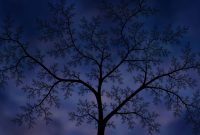
Botanical L-systems stay closest to nature. Trees, ferns, algae, and corals are rendered with botanical fidelity, like scientific illustrations of imaginary species. They carry calm without depicting a real landscape.
Abstract branching pushes the same logic beyond botany. The structures appear in impossible colors and geometries, keeping the organic feel while becoming fully abstract art. These are the most versatile versions, welcome anywhere organic complexity fits.
Monochrome growth studies strip everything back to a single tone. The pure structure becomes the entire subject, rendered with scientific clarity. They suit thoughtful, minimal screens beautifully.
Colored growth symphonies take the opposite path, using rich, artistic palettes. Here the branching gives structure to bold color, preventing chaos while allowing real vividness. If you enjoy that bolder end of the spectrum, Psychedelic Rainbow Abstract Art: A Guide to Vibrant Visuals shows how far saturated color can go while still holding together.
- Botanical designs feel most like nature and work well when you want calm.
- Abstract branching keeps the growth feel but reads as contemporary art.
- Monochrome studies offer elegance and clarity for minimal setups.
- Colored symphonies are the most striking, balancing vivid color with clear structure.
Angles, Depth, and Why Branching Soothes
The branching angle shapes the character of a piece more than almost anything else. Narrow angles produce tall, poplar-like forms that feel vertical and formal. Wide angles produce spreading, oak-like forms that feel generous and sheltering.
The most beautiful work varies the angle slightly with each generation. That small irregularity mimics nature and keeps the result from looking mechanical. Perfect regularity reads as artificial, while slight variation reads as alive.
Recursion depth controls the texture. Shallow recursion, with few generations, produces bold, graphic trees with strong silhouettes and clear structure. Deep recursion produces delicate, lacy canopies that feel intricate and almost textile-like.
Shallow versions tend to work better as bold wallpaper statements. Deep versions work better as rich backgrounds that reward close looking. Both honor the same growth logic, just at different scales.
There is also a psychological reason these images rest so easily on a screen. Branching is the visual signature of living things, from forests and rivers to lungs, so the eye finds it familiar and comforting. At the same time, the pattern suggests growth itself: branching outward, reaching, and elaborating, which is a hopeful image to live behind your daily work.
Choosing and Growing Your Own
Density is the first choice to make. Dense growth feels rich and immersive, while sparse branching feels elegant and calm. Match the density to what the screen is for, whether that is focused work or relaxed browsing.
Color deserves the same care. In the best colored pieces, the growth logic stays readable, and color enhances the branching rather than obscuring it. Composition matters too, because growth needs room to reach; cramped L-systems feel stunted rather than thriving. A broader overview in Fractal Art Wallpapers: Design Guide & Inspiration helps place these choices alongside other fractal styles.
One of the delights of the form is how accessible it is to try yourself. The rules fit on an index card, yet the results can fill a screen. Anyone with basic scripting ability can grow a first L-system tree in an afternoon, and watching a few lines of rules unfold into a forest still feels magical.
That economy gives the art its honesty. The complexity comes from iteration, not from an artist adding detail by hand, so every branch is exactly where the rules put it. Because the parameter space of angles, ratios, depths, and rules is so vast, no two well-grown trees are alike, and learning to spot the graceful ones becomes its own quiet connoisseurship.
L-system fractal wallpapers reveal that breathtaking complexity can grow from humble rules, faithfully followed. Every fern, tree, and branching coral is running a simple program, and the results are among the most beautiful structures on Earth. As a background to digital life, the meditation holds: you do not need complicated plans, only good rules, consistently applied, and the patience to grow.
Related posts:


If this set speaks to you, Fractal Noise Texture Wallpapers: Subtle Complexity for Modern Screens continues the fractal-patterns conversation in a new direction.
Share this page with a fellow art lover looking for their next wallpaper.

