
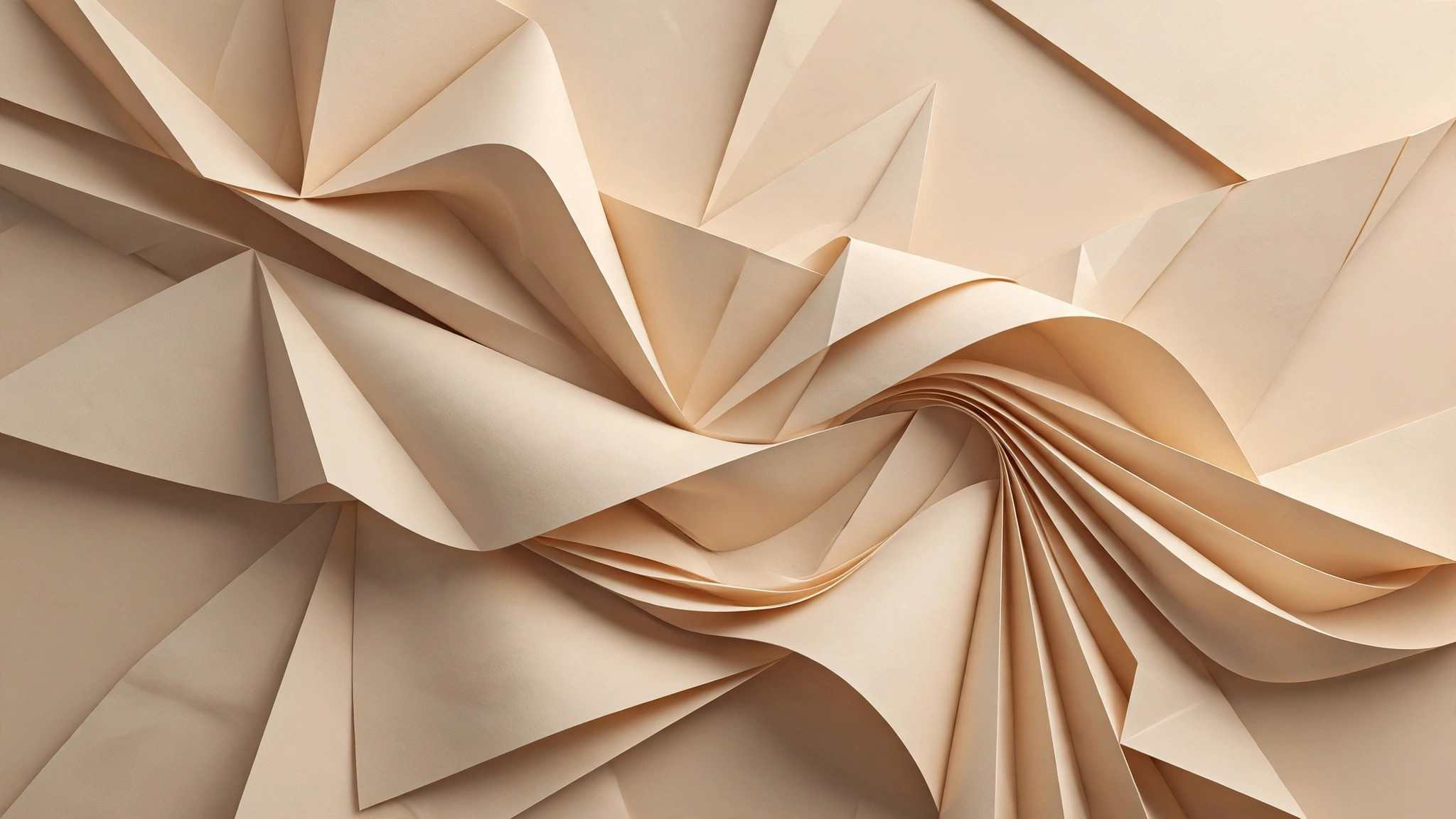
Fold paper and it remembers — the crease remains, a permanent record of the gesture. 3D folded form wallpapers explore that memory digitally: creased surfaces in warm beige render, folded like origami, like fabric, like geology, creating compositions with the quiet drama of bent planes. If you value structure expressed beautifully, this style shows how the simplest transformation — one flat plane, folded — becomes sculpture.
The fold is one of design’s most powerful moves. A flat plane, folded once, becomes three-dimensional; folded repeatedly, it becomes art. These wallpapers celebrate that alchemy.
The Geometry of the Crease
A fold is a discontinuity with memory — the surface changes direction abruptly but continuously, creating an edge that is also a connection. This duality gives folded forms their distinctive character: they are simultaneously broken and whole, divided and united. In 3D renders, folds are achieved through careful modeling — sharp edge loops, controlled creasing, subdivision that preserves the crispness — so the crease reads as both sharp and soft, precise and organic.
Hard folds — crisp, angular, origami-like — create compositions with graphic clarity and architectural presence. Soft folds — gradual, fabric-like — create organic flow and gentle rhythm. The most interesting folded renders mix both, the way real folded materials combine sharp creases with soft drapes, and mathematicians would approve: as origami research shows, the simple crease unfolds into serious science, with applications from space telescopes to medical stents.
Fold Density
Single bold folds create minimalist, sculptural compositions — one gesture, fully expressed. Dense fold fields create complex, textile-like surfaces — many gestures in conversation. The density choice shapes the wallpaper’s entire character, from gallery calm to crafted complexity.
Palettes of Folded Light
Three palettes carry the style:
- Warm beige — the essential folded palette: beige surfaces catching light on their planes and pooling shadow in their creases; the color of paper and parchment, the fold in its most honest tones.
- Monochrome origami — pure white or soft grey, form expressed through light and shadow alone; meditative purity, paper art elevated to digital sculpture.
- Bold folded color — cobalt, vermilion, emerald; dramatic renders whose creases catch color like faceted gems, for spaces where the sculpture must hold its own.
Warm beige has the quiet authority of well-made things. Monochrome is the origami ideal and the mark of confident craft. Bold color keeps the same geometry but turns the volume up — proof that the fold itself, not the palette, does the expressive work.
Folds Across Disciplines
Folding is universal — origami artists fold paper, fashion designers fold fabric, architects fold facades, geologists read folds in rock. Each discipline has developed its own fold vocabulary, and 3D folded renders borrow from all of them in a cross-disciplinary celebration of the crease.
Architects exploit the fold’s structural magic: folded plate roofs span great distances with thin material, the crease providing rigidity, from chapel roofs to stadium canopies. Fashion’s great pleaters — Fortuny’s Delphos gowns, Miyake’s pleated revolution — turned the fold into wearable architecture, engineering as elegance.
Even formal dining folded napkins into art: the bishop’s mitre, the swan, geometry as greeting. The wallpaper inherits all of it — controlled complexity, the simple fold repeated with precision — and applies it to the humble screen. A phone-specific piece like an iPhone X abstract wallpaper shows the same appetite for sculptural surfaces at handset scale.
Styling Sculptural Calm
Folded form screens pair with architectural, considered environments — spaces with clean lines and honest materials. They suit studios, galleries, and anyone whose aesthetic values structure. Matte folded forms hold a contemplative center; they are the fold as meditation rather than statement.
For the screen itself, folded renders are functionally superb — their planar surfaces provide visual interest without chaos, and their tonal modeling supports legibility. They are sculpture you can work on, geometry you can live with. A gentler cousin, the beige abstract wallpaper tradition, keeps the warmth while dropping the creases entirely.
Folded-plate architecture scales the miracle: concrete roofs folded like paper span halls that flat slabs could never cover, the creases doing the work of beams. Airports and exhibition halls still roof themselves with the principle. The wallpaper’s modest fold belongs to that structural family — geometry replacing mass, stiffness borrowed from shape alone.
Fashion pleated its way to the same discovery: Fortuny’s Delphos gowns and Miyake’s permanent pleats turned folding into luxury, garments that compress to nothing and bloom on the body. A pleat, like a pixel grid, is repetition with rhythm. The screen’s folded form shares that double nature — compact as a grid of pixels, expansive as sculpture.
The folded napkin keeps the art democratic: swans and crowns shaped from linen at a million dinner tables, origami’s etiquette branch. Its lesson is the wallpaper’s too — that a flat thing, folded with intention, stands up and performs.
Origami mathematics turned the fold into engineering: crease patterns computed like circuits, flat sheets programmed to become cranes, stents, or shelters. Space agencies fold solar arrays for launch and bloom them in orbit, the Miura pattern packing a wing into a box. The wallpaper’s single fold carries that whole research program in miniature — flatness, holding its breath.
3D folded form wallpapers celebrate transformation — flat becoming dimensional through the ancient act of folding. In warm beige render — creased, sculptural, serene — they turn the screen into origami, into architecture, into remembered gesture. The plane was flat; then it was folded; nothing was ever the same.
Related posts:


Drawn to these shapes and colours? 3D Particle Swarm Wallpapers: Thousands of Dots in Formation explores a nearby corner of the same abstract world.
Share this page with a fellow art lover looking for their next wallpaper.

