
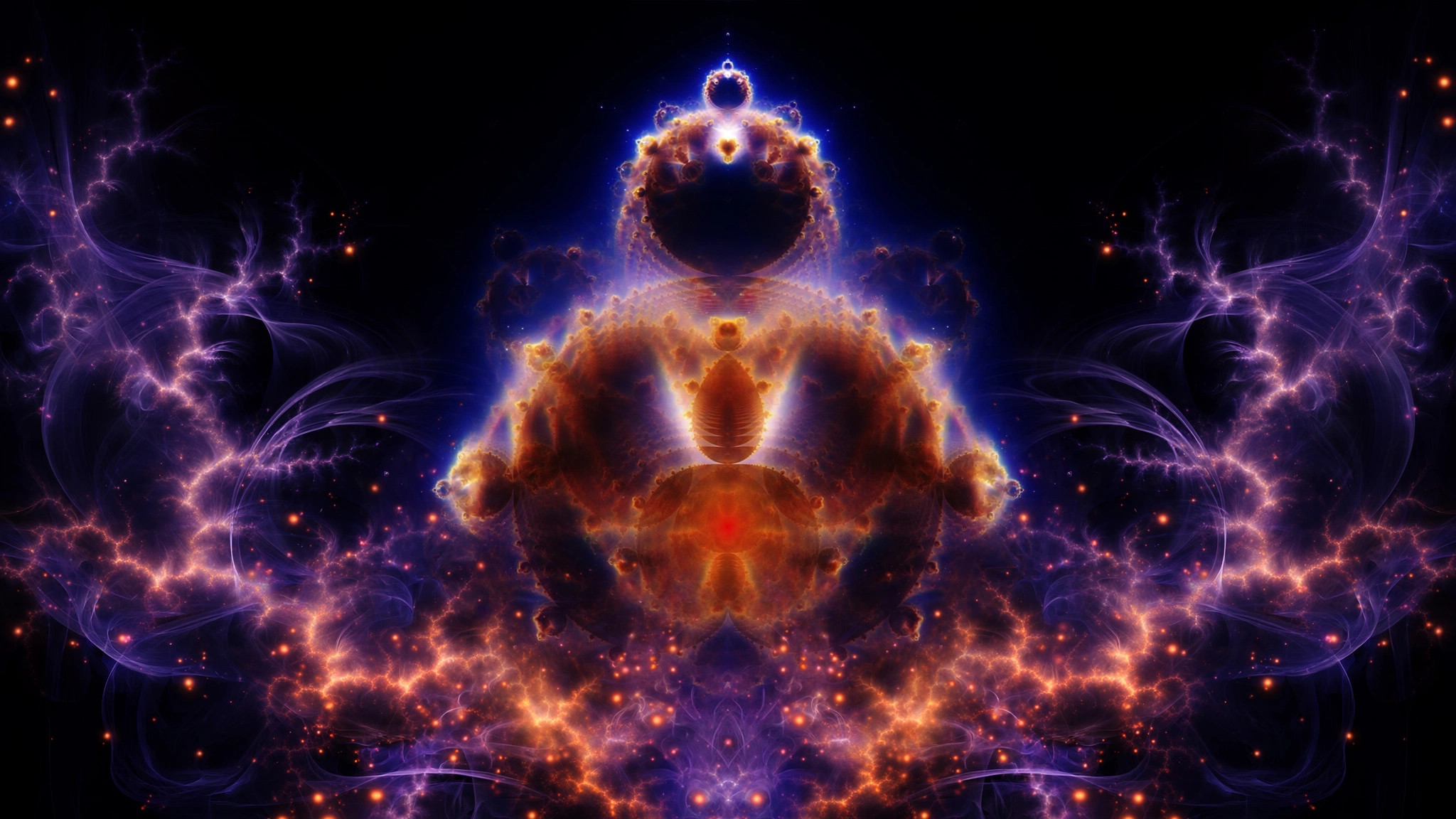
Render the Mandelbrot set not by which points escape, but by how often escaping paths visit each region — and something miraculous appears: a ghostly figure, seated in meditation, glowing like a nebula. This is the Buddhabrot, the most spiritual of all fractals, and a Buddhabrot wallpaper brings its meditative glow to your screen: smoky violet densities, ember-orange cores, mystery rendered as mathematics. Who first saw the figure, when the technique emerged, and how those densities are built are questions this guide answers as it explores why the image feels like presence rather than pattern.
The Buddhabrot captivates because it seems impossible: pure iteration producing what looks unmistakably like a meditating figure — the resemblance earning its name (Buddha + Mandelbrot). Whether pareidolia or profundity, the effect is haunting: mathematics dreaming of enlightenment. Where an ordinary fractal shows pattern, the Buddhabrot shows presence — the equations seeming to contemplate themselves.
The Technique of Ghosts
The Buddhabrot technique, discovered by Melinda Green in the 1990s, is beautifully inverted: instead of coloring points by their fate (the standard Mandelbrot rendering), it tracks the paths of escaping points and brightens each pixel by how many paths pass through. The frequently traveled regions glow; the rare ones fade. The result is a density map of the Mandelbrot’s dynamics — and the density, mysteriously, forms the meditating figure. Wikipedia’s Buddhabrot article documents the method and its history in full.
As wallpaper, that density rendering creates the Buddhabrot’s signature look: nebulous, glowing, the bright regions seeming to emit light rather than reflect it. The geometric abstract wallpaper guide tradition values crisp structure; the Buddhabrot offers the opposite — structure dissolved into glow, mathematics as atmosphere. For readers who prefer their abstraction vivid rather than ghostly, a psychedelic rainbow abstract art guide covers the vibrant end of the spectrum.
Coloring the Densities
Advanced Buddhabrot renders use different iteration counts for red, green, and blue channels — the “nebulabrot” technique — producing the characteristic multicolor glow: violet mists, ember cores, the densities painted in light. These are the most beautiful Buddhabrots: the mathematics rendered as cosmic art, the ghost in full color.
Rendering the Meditation
Buddhabrot wallpapers are defined by their rendering depth — how long the paths were tracked, how rich the densities. Three broad families cover most of what you will find:
- Classic ghosts: the meditating figure clear and central, smoky violet on black.
- Nebula depths: deep renders with billions of tracked paths and photographic richness.
- Abstract densities: crops and rotations that de-emphasize the figure, glow without ghost.
Classic Ghosts
The traditional rendering: the meditating figure clear and central, smoky violet on black. These wallpapers have genuine spiritual presence — the figure seeming to breathe, the glow pulsing (in the mind’s eye). They suit contemplative setups and pair beautifully with the dark neon wallpaper guide aesthetic’s love of luminous darkness: different mathematics, same reverence.
Nebula Depths
Deep renders — billions of tracked paths, the densities achieving photographic richness. These are the most spectacular Buddhabrots: the ghost dissolving into cosmic detail, the meditation becoming universe. They suit large screens, where the nebular complexity has room to achieve its full glory. The dark wallpaper for OLED screens tradition finds its most mysterious member here.
Abstract Densities
Crops and rotations that de-emphasize the figure — the densities as pure abstraction, glow without ghost. These suit users who love the Buddhabrot’s rendering but prefer their wallpapers non-figurative: the technique’s beauty without its pareidolia.
Styling the Ghost
On desktops, Buddhabrot wallpapers create workspaces with unusual atmosphere — the ghostly densities giving the screen a sense of depth and mystery. They are superb for evening work and contemplative tasks: the wallpaper that seems to meditate alongside you. A broader fractal art wallpapers design guide places the Buddhabrot among its fractal relatives.
On phones, a Buddhabrot lock screen is quietly profound: the glowing figure greeting you like a small shrine, the meditation in your pocket. And as a conversation piece, these wallpapers are unmatched — the story (escaping paths, density rendering, the accidental Buddha) never failing to fascinate.
The Meditators Who Render
The Buddhabrot has an unusual creation story, and it explains the technique’s contemplative reputation. It was discovered in 1993 by Melinda Green, who was exploring fractal rendering methods and noticed that tracking where escaping orbits traveled — rather than where they landed — produced hauntingly organic images. She named it the Buddhabrot because the central form resembled a meditating figure, and the name stuck: mathematics, contemplating itself, rendered in ghostly density.
What makes the Buddhabrot community distinctive is the practice the images demand. A quality render isn’t computed in seconds but in hours or days — millions of orbits traced, the density map accumulating slowly, the image emerging like a photograph in developer fluid. Renderers describe the process in meditative terms: you set the parameters, start the computation, and wait — checking in periodically as the ghost sharpens, the patience itself becoming part of the art. It is the opposite of instant generation, and its practitioners love it for exactly that.
That slowness shapes the aesthetic. Because each render costs real time, Buddhabrot artists choose parameters carefully, developing an intuition for how orbit counts, escape thresholds, and coloring methods will shape the final ghost. The community shares techniques like contemplatives sharing practices — the two-dimensional histograms, the Gaussian splats, the orbit-trap colorings — each a small refinement of the meditation. The images that result carry the quality of their making: unhurried, deep, the product of attention sustained.
Rendering as Practice
There is a lesson in the Buddhabrot workflow for the screen it ends up on. The wallpaper you see in seconds took days to become — and knowing that changes the viewing, slightly. The ghost on your desktop is not just an image but the record of a sustained attention, a meditation made visible. Some owners of Buddhabrot wallpapers report that the knowledge deepens the calm: the screen holding not just a shape but a practice, the patience of the render echoing in the patience of the gaze.
You don’t need to render your own to participate — though the software is free and the community welcoming — but understanding the making enriches the having. The next time the ghostly form catches your eye between tasks, remember the hours of orbits behind it: millions of tiny mathematical journeys, each contributing a single point of density to the whole. It is, in the most literal sense, a picture of accumulated attention. Let it remind you what attention, accumulated, can make.
Mathematics, Contemplating
Whether the Buddhabrot’s figure is meaning or coincidence, it reminds us of something true: that the deepest patterns often resemble the deepest states — that iteration, pursued far enough, starts to look like meditation.
Keep the ghost for the quiet hours. Let its nebulous glow remind you that even equations can seem to contemplate — and that the paths, tracked long enough, always lead somewhere luminous. The Buddha sits, in smoky violet, in your screen. Sit with it awhile.
Related posts:

Abstract work rewards a second look — browse more of fractal-patterns when you are ready for a new backdrop.
Share this page with a fellow art lover looking for their next wallpaper.

