
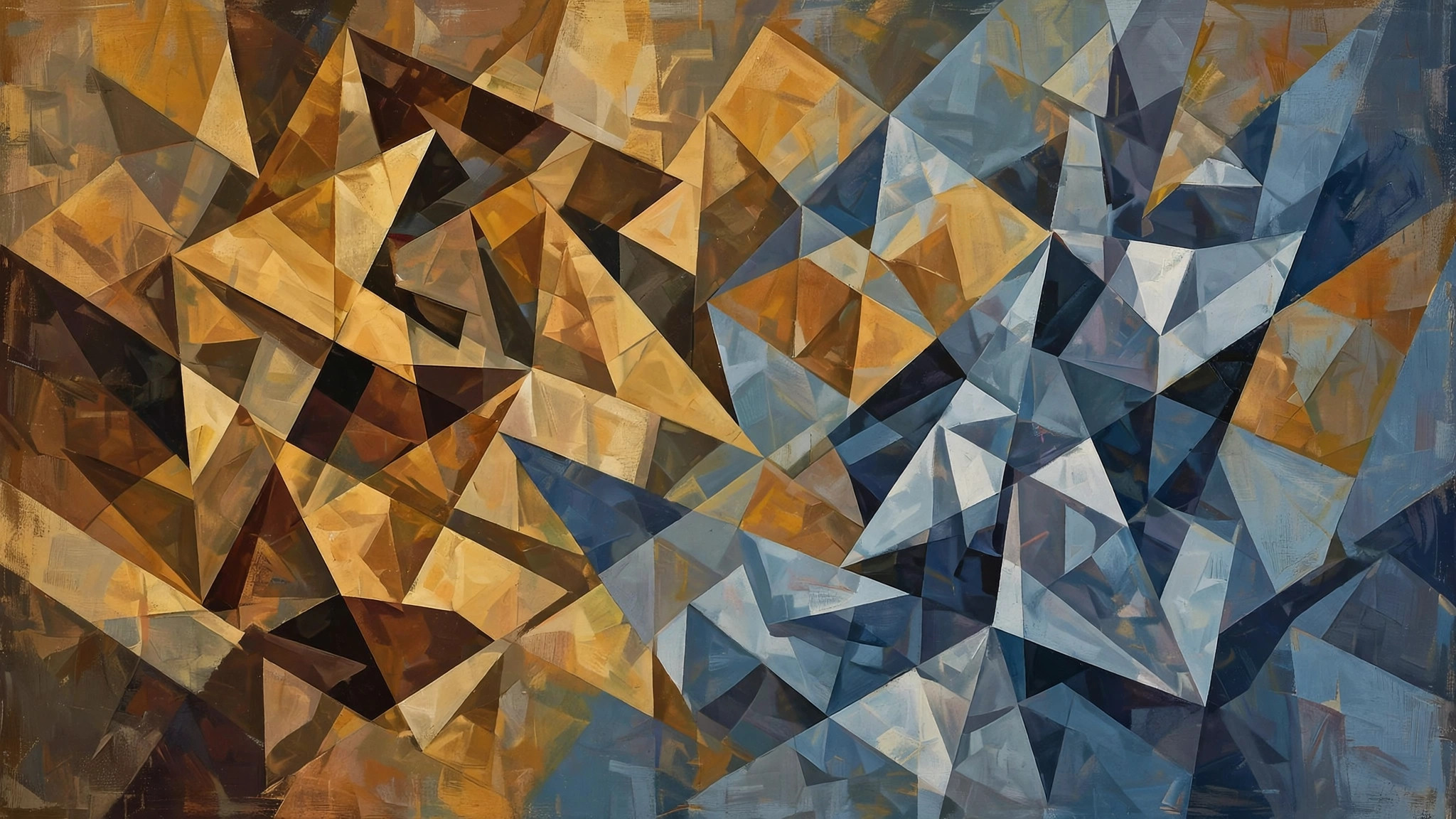
A century ago, a handful of painters decided that a single viewpoint was a lie. They shattered objects into interlocking planes, showing every angle at once, and called it Cubism. A cubist fragment wallpaper brings that revolutionary way of seeing to your screen — not as a museum piece, but as a living background: angular shards of color and form locked in perpetual, elegant tension.
Planes tilt, overlap, and collide; a warm ochre wedge pushes against a cool slate triangle, and a curve gets sliced by a hard diagonal. The composition feels argued rather than arranged — and that argument is exactly what makes it magnetic.
The Cubist Way of Seeing
The original Cubists — Picasso and Braque, working in Paris around 1908 — broke with five centuries of perspective in a single stroke. Instead of painting what the eye sees from one spot, they painted what the mind knows: the front, side, and top of a thing, all at once. The result looked broken to contemporary viewers. To us, it looks like the way memory actually works — fragmented, overlapping, simultaneous.
That is why cubist fragment wallpapers feel so modern despite their age. Our digital lives are cubist: a dozen windows overlapping, notifications stacking, attention split across planes. A background that mirrors that fragmentation — but organizes it into art — feels honest in a way that tidy patterns sometimes do not. Where guides to geometric abstract painting trends teach order, cubist fragments teach beautiful disagreement.
Analytic vs. Synthetic
Art historians divide Cubism into two phases, and both make excellent wallpapers. Analytic cubism (1909–1912) is the muted one: fractured planes in ochres, greys, and browns, dense and intellectual, like looking at thought itself. Synthetic cubism (1912 onward) is the bold one: brighter colors, flatter shapes, collage-like energy. Analytic-style wallpapers reward slow looking; synthetic styles are punchy, graphic, and immediate.
Anatomy of a Fragment Composition
Good cubist fragment wallpapers share a few structural habits worth understanding, because they help you choose well.
Interlocking Planes
The defining feature: shapes that lock together like puzzle pieces, with no background showing through. Every inch of the canvas is claimed by some plane. This density is what gives cubist designs their richness — and what makes them demanding. Behind a busy desktop, a dense cubist wallpaper can feel like visual competition, so give it room: cleaner desktops suit it best.
Limited, Confident Palettes
The strongest cubist wallpapers restrict themselves to a handful of colors — three or four, used with conviction. Ochre, umber, slate, and cream is the classic analytic recipe. Synthetic styles might swap in vermilion, cobalt, and black. Restraint in color lets the complexity live in the shapes, where it belongs: minimalism applied to color, maximalism reserved for form.
Implied Depth
Despite being flat, cubist fragments suggest space through overlap: this plane is in front of that one, this wedge recedes. The eye constructs a shallow, crystalline depth — like looking into a geode. It is a different depth than 3D rendering; more intellectual, less literal, and oddly more durable over time.
The anatomy, in short:
- Interlocking planes — no background showing through; every inch claimed.
- A handful of colors — three or four, used with conviction.
- Implied depth — overlap builds a shallow, crystalline space.
- Room to breathe — dense compositions reward cleaner desktops.
Where Cubist Fragments Shine
Creative Workspaces
Designers, writers, and developers often gravitate to cubist fragments for their primary monitor. The style signals creative seriousness — it is art history on your desktop — and its intellectual energy suits deep work. Cubist fragments offer company: they think alongside you.
Presentation and Shared Screens
A cubist fragment background behind a video call or screenshare reads as cultured without being distracting. It is abstract enough to stay professional, interesting enough to be memorable. Choose analytic-style muted fragments for formal settings, synthetic brights for creative ones — the same judgment call that shapes good geometric abstract poster designs.
Tablets and Reading Devices
On tablets, cubist fragments at medium scale make beautiful lock screens — the interlocking planes reward the idle glance, revealing new relationships each time you pick up the device. The style’s density means even a small crop contains a complete composition.
Building a Cubist Rotation
One cubist wallpaper is a statement; a small collection is a gallery. Because the style spans analytic murk and synthetic punch, you can build a rotation that covers every mood. Start with three: a muted analytic piece in ochres and greys for deep-work weeks, a brighter synthetic composition for creative sprints, and a monochrome fragment study for everything in between. Three is enough to keep the style fresh for months without repeating the same energy twice in a row.
When collecting, look for variety in plane scale. Some cubist designs work at the macro level — a dozen large interlocking shapes — while others are micro-fragmented, hundreds of small planes creating a near-textural field. The macro pieces read better on phones and as video-call backgrounds; the micro pieces reward large monitors where the density becomes immersive. Having both means you are covered across devices.
Pay attention to palette temperature as well. Warm cubist fragments (ochre, rust, amber) feel inviting and work beautifully in home offices with warm lighting. Cool fragments (slate, steel blue, charcoal) suit minimalist setups and pair naturally with dark-mode interfaces. If your workspace lighting changes through the day, a rotation that alternates warm and cool keeps the screen feeling in sync with the room.
Living With Beautiful Disagreement
The risk with cubist fragments is fatigue: all that angular argument can tire the eye over weeks. The solution is rotation within the style — analytic one month, synthetic the next — or pairing a cubist lock screen with a calmer home screen. The fragments keep their power when they are not shouting constantly.
What endures about this style is its intelligence. Most abstract wallpapers decorate; cubist fragments converse. They carry a century of art history in their broken planes, and they remind you — every time you unlock your screen — that there is more than one way to see anything. In a world of single-viewpoint feeds, that is a quietly radical background to carry around.
Related posts:

If this set speaks to you, Concentric Square Wallpapers: Nested Frames and Hypnotic Order continues the geometric-abstract conversation in a new direction.
Share this page with a fellow art lover looking for their next wallpaper.

