
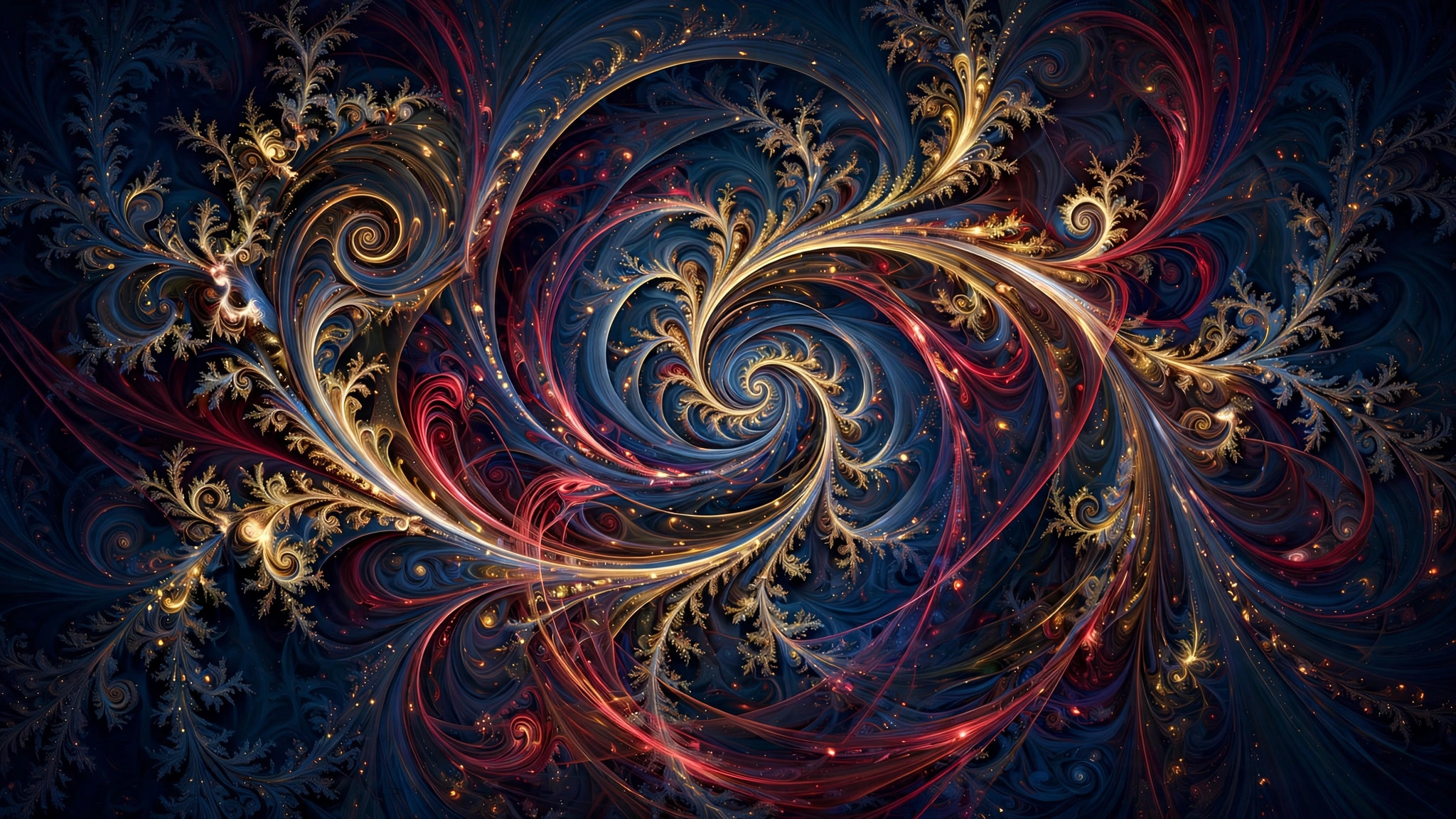
Follow a fractal orbit as it iterates — and trap it: color each point by how closely the orbit approaches a chosen shape, a point, a line. The result is an orbit trap fractal: swirling captured paths rendered as rich color fields, the mathematics’ journey made visible. A fractal orbit trap wallpaper turns iteration into art — the orbit’s adventure, painted — and this guide explains how the voyage is rendered.
Orbit traps captivate because they visualize motion, not just structure: you see where the orbit went, how it swirled, what it nearly touched. That sense of journey gives orbit trap wallpapers a dynamic quality rare in fractals: they feel like events, not objects. Where an ordinary fractal shows pattern, the orbit trap shows voyage — mathematics traveling.
Trapping the Journey
The orbit trap technique is simple: as the fractal iterates, track the orbit’s points; color each pixel by the orbit’s closest approach to the trap shape. Points whose orbits nearly touch the trap glow bright; those that stay distant fade. The trap — a point, a line, a circle — becomes a magnet for color, the orbit’s near-misses rendered as light. Wikipedia’s orbit trap article sets out the method behind these images.
As wallpaper, this creates the orbit trap’s signature look: swirling bands of color following the orbit’s ghost, the trap shape glowing at the composition’s heart. The gradient color flow art tradition pursues flowing color; the orbit trap achieves it through captured motion — the flow with a history. Readers drawn to spectrum color can explore a psychedelic rainbow abstract art guide to vibrant visuals.
Traps as Lenses
Different trap shapes reveal different aspects of the same fractal: a point trap highlights the orbit’s closest approaches, a line trap its crossings, a circle trap its orbits. Changing the trap is like changing the lens — same mathematics, new revelation. The best orbit trap wallpapers choose traps that flatter the fractal’s character: the trap and the orbit in dialogue.
Rendering the Voyage
Orbit trap wallpapers are defined by their trap palettes — the colors of the captured journey. Three palettes define the range:
- Crimson voyages: deep reds and golds, the orbit’s path rendered as fire.
- Ocean orbits: deep blues and teals, the orbit as deep-sea current.
- Prismatic traps: full-spectrum color, each near-miss a different hue.
Crimson Voyages
The classic: deep reds and golds, the orbit’s path rendered as fire. These wallpapers have energy — the trapped paths seeming to burn, the mathematics at full sail. They suit dramatic setups and pair beautifully with the geometric mint background design tradition’s love of structured dynamism: different mathematics, same vigor.
Ocean Orbits
Deep blues and teals — the orbit as deep-sea current, the journey as dive. These feel profound and mysterious: the trapped paths flowing like water, the mathematics submerged. They suit contemplative setups, the blue giving the dynamism a dreamlike quality.
Prismatic Traps
Full-spectrum traps — the orbit’s journey rendered as rainbow, each near-miss a different hue. These are the most spectacular orbit traps: the voyage as celebration, the mathematics in full color. They suit statement roles and users who want their fractals joyful.
Composing the Capture
Orbit trap wallpapers are composed around the trap’s placement — each arrangement a different voyage.
Central Traps
The trap at the composition’s heart — the orbit’s journeys radiating outward, the color fields blooming from the center. These wallpapers have natural focal points: the trap becoming a stage for centered content, the swirls organizing the screen like a galaxy. They suit lock screens, the trap holding the interface like a sun.
Drifting Traps
The trap off-center — the orbit’s paths sweeping across the frame, the composition dynamic and asymmetric. These feel like the voyage itself: the trap pulling the color fields in its wake, the mathematics in motion. The wave grey pattern aesthetic’s flowing calm finds an electric cousin here.
Styling the Journey
On desktops, orbit trap wallpapers create workspaces with dynamic depth — the trapped paths giving the screen a sense of motion and history. They are superb for creative work: the wallpaper itself a visualization of exploration, the journey as ambiance. A fractal art wallpapers design guide shows how orbit traps sit within the wider fractal family.
On phones, an orbit trap lock screen is alive: the swirling paths framing the interface like a captured storm. And for the mathematically inclined, these wallpapers are daily delight — the orbit’s adventure, painted in light, in your pocket.
Traps and Near-Misses
The orbit trap technique — the method behind these wallpapers — was popularized by Clifford Pickover, the fractal evangelist who saw that the paths orbits almost take could be as beautiful as the sets they define. The method is simple: as each orbit iterates, measure how close it comes to a chosen shape — a point, a line, a circle — and color the pixel by that near-miss distance. The trap never catches anything; the beauty is in the almost.
Different traps give different souls to the same mathematics: a point trap yields delicate filaments, the orbits’ closest approaches drawn as fine lines; a line trap gives sweeping curves, the near-misses aligning into waves; a circle trap produces the characteristic rings, the orbits’ approaches rendered as halos. The fractal is the constant; the trap is the interpretation — the same iteration, seen through different almosts. It’s a metaphor for attention: what you nearly notice shapes what you see.
The technique’s charm is its democracy: orbit traps work on any iterative fractal, and the parameter space is vast — trap shapes, trap positions, coloring methods, each combination a new territory. The community shares trap configurations like recipes, each a discovery in the infinite kitchen of the complex plane. The wallpapers are the finished dishes: the near-misses, plated.
The Beauty of Almost
There’s philosophy in the trap: the orbits never arrive, and the image is made of their not-arriving. It’s the aesthetic of the near-miss elevated to method — the beauty not in the destination but in the approach, not in the capture but in the pursuit. The screen holds a thousand almosts, each rendered in color, each a path that came close and curved away.
Let the trapped paths remind you daily: the almosts count. The attempts, the approaches, the near-misses — these are the material the image is made of, and they’re beautiful in their own right, not merely as failed arrivals. The orbits never reach the trap. The picture is complete anyway; the paths we almost take, it turns out, were worth coloring all along.
The Paths We Almost Take
An orbit trap colors not where the orbit went, but where it almost went — the near-misses, the close approaches, the paths glimpsed but not taken. There is poetry in that: the beauty in the almost, the art in the near.
Keep an orbit trap for the adventurous days, and let its swirling paths remind you that the journey matters as much as the destination — that the orbits we nearly follow color our lives as surely as the ones we do. The trap is set, in crimson and gold, on your screen. See what it catches.
Related posts:
Pieces in fractal-patterns talk to each other across pages — follow the thread with Buddhabrot Fractal Wallpapers: Ghostly Density Renders.
Share this page with a fellow art lover looking for their next wallpaper.

