
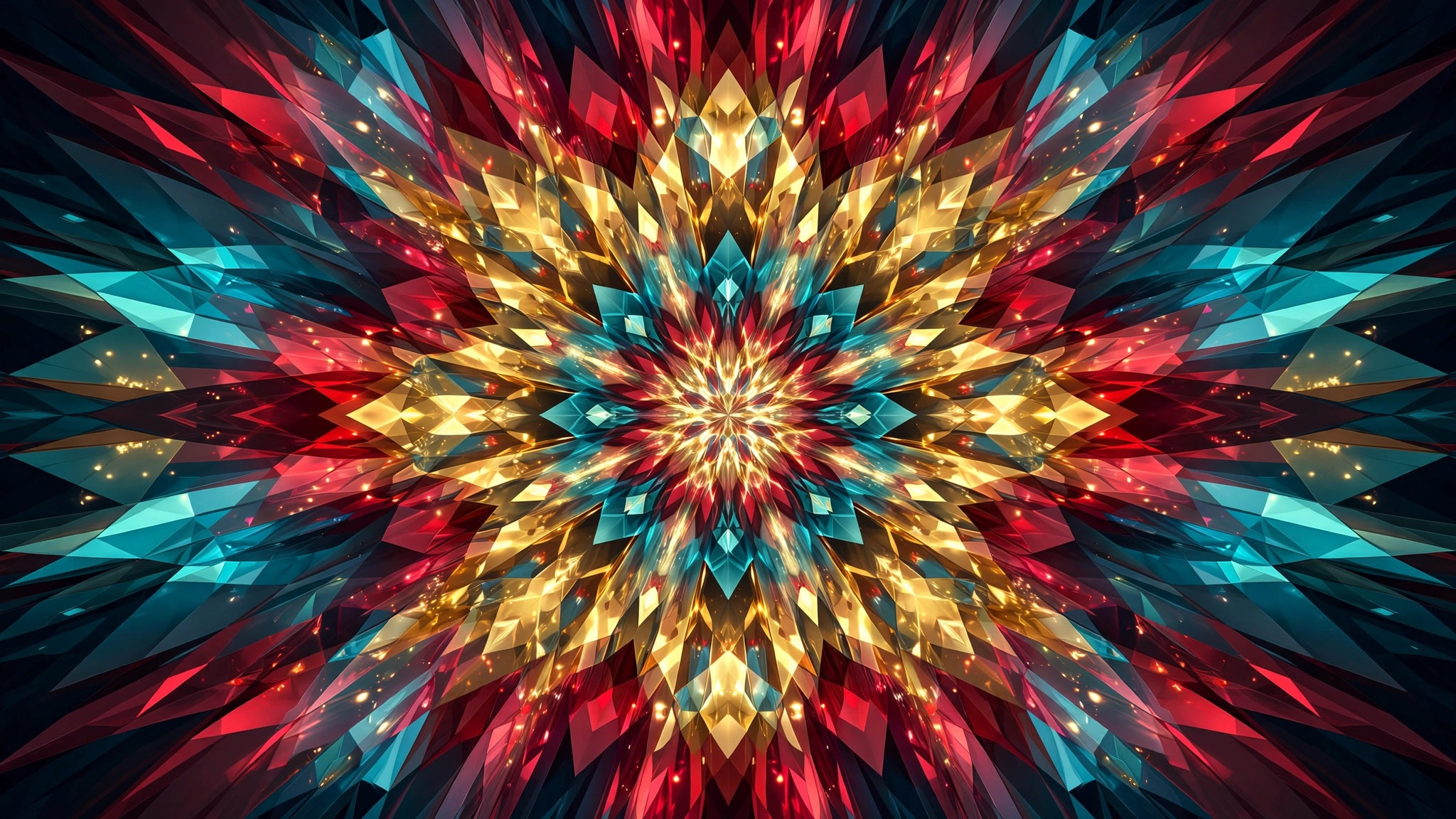
Place a polygon at the center, mirror it around the point, and watch the explosion: shapes radiating outward in perfect symmetry, the composition bursting like a firework frozen mid-bloom. A radial symmetry geometric wallpaper captures that explosive order — kaleidoscopic polygons in teal, gold, and crimson, energy disciplined into pattern. This guide follows what makes the center so powerful, where nature grows the form, why the eye loves it, and how the burst is composed.
Radial symmetry captivates because it is nature’s favorite organization: flowers, starfish, snowflakes — the living world loves the center-and-spokes. That biological resonance gives radial wallpapers an instinctive appeal: the pattern feels right in a way that grids sometimes do not. Where row-based geometry often marches in lines, radial symmetry blooms — geometry as flower, not as fence.
The Power of the Center
Radial compositions organize everything around a single point — and that point becomes the composition’s sun, its heart, its reason. The eye is drawn to centers instinctively (it is where the information is densest), and radial wallpapers exploit this: the burst’s heart becoming a natural stage for whatever matters most. Wikipedia’s article on radial symmetry explains the underlying organization in nature.
As wallpaper, that centrality does practical work: the burst’s heart frames centered content — clocks, widgets, focal windows — with geometric ceremony. The geometric red texture design tradition explores color’s energy; radial symmetry gives that energy a center to radiate from.
Symmetry as Celebration
Radial symmetry reads as celebratory across cultures: mandalas, rose windows, fireworks — the center-and-radiance as joy’s geometry. Radial wallpapers carry that celebratory charge: they feel like occasions, like the screen is marking something. It is the most festive of geometric styles.
Composing the Burst
Radial wallpapers are composed around the burst’s character — each arrangement a different explosion of order. The main arrangements are:
- Kaleidoscopic bursts: full radial symmetry, the pattern mirrored in many segments.
- Asymmetric radiance: radial structure with varied segments, some rays longer, some colors shifting.
- Layered mandalas: multiple radial layers, rings of pattern at different radii.
Kaleidoscopic Bursts
Full radial symmetry — the pattern mirrored in many segments, the kaleidoscope’s perfection. These wallpapers are hypnotic: the eye traveling around the center, finding the same beauty at every angle. They suit meditative moments and pair beautifully with the black geometric wallpaper aesthetic’s love of pattern: different organizations, same rigor.
Asymmetric Radiance
Radial structure with varied segments — the burst with personality, some rays longer, some colors shifting around the wheel. These feel more organic: the symmetry suggesting nature rather than mathematics, the flower rather than the crystal. They suit creative spaces, the controlled asymmetry keeping the pattern lively.
Layered Mandalas
Multiple radial layers — rings of pattern at different radii, the burst given depth. These are the richest radial wallpapers: the mandala’s complexity, each ring a new discovery. They suit large screens, where the layered radiance has room to achieve its glory. The neon abstract art in radial form shares this celebratory geometry.
Styling the Burst
On desktops, radial symmetry wallpapers create workspaces with ceremonial energy — the burst organizing the screen around its heart. They are superb for centered workflows: the composition naturally framing the primary window, the radiance suggesting importance. A geometric abstract poster 4K wallpaper design guide shows how poster-scale geometry uses the same centered logic.
On phones, a radial lock screen is centered: the burst’s heart holding the clock like a jewel, the symmetry making every unlock feel composed. And as a mood piece, radial wallpapers are unmatched — the celebratory geometry lifting the screen’s spirits, the pattern insisting that this moment matters.
The Radiant Palette
Radial wallpapers favor palettes that reward the center-out journey — colors that build toward the burst’s heart.
Teal and Gold Bursts
The definitive radial pairing: cool teal rays against warm gold centers, the contrast making the burst glow. These wallpapers feel like celebration rendered geometric — the screen as festival. They suit joyful contexts and energetic days.
Crimson Radiance
The bold radial: reds and oranges bursting outward, the pattern as firework. These are the most dramatic radial wallpapers — the symmetry containing the energy, the burst disciplined into beauty. They suit statement roles and users who want their geometry with passion.
Monochrome Mandalas
Single-hue radials — the purist’s burst, pattern as the entire subject. Without color variety, the symmetry’s precision takes center stage: every ray, every mirror, visible. These are the most elegant radial wallpapers — celebration distilled to form. A geometric abstract painting trends and styles guide traces how these palettes move through current geometric art.
Radial Symmetry in Nature and Culture
The radial burst is nature’s favorite party trick. Slice an orange and the segments radiate; look down at a daisy and the petals burst from the center; catch a snowflake and its six arms mirror each other. Radial symmetry is how living things organize when they grow outward from a point — the plan that needs no plan, the pattern that emerges from equal expansion. The geometric burst wallpaper is that natural exuberance, formalized: the daisy’s logic, drawn with a compass.
Cultures independently discovered the same form’s power. The Gothic rose window: stone tracery radiating from a central oculus, the cathedral’s wall becoming a frozen firework of light. The mandala: the cosmos diagrammed as concentric radiance, meditation given geometry.
The Islamic girih: star polygons bursting across domes and tiles, infinity suggested through radial repetition. Different faiths, different centuries, the same discovery — that the bursting center feels significant, feels ordered, feels like a truth.
The reason is partly neurological: the eye loves the center. Radial compositions give vision what it wants — a focal point, and organized paths outward from it. The gaze settles on the middle, then travels the spokes, then returns: the viewing experience as an orbit, the attention held in gentle circulation. It is the most restful of the dynamic compositions — all that bursting energy, and the eye never gets lost.
Celebration, Formalized
Which is why the radial burst reads as celebration: the firework, the applause diagram, the visual equivalent of a cheer. Cultures put radial patterns on their most festive objects — the carnival wheel, the celebration rangoli, the party’s paper fan — because the form itself says rejoicing. A radial wallpaper brings that festive geometry to the ordinary day: the screen, celebrating.
Let it celebrate with you, then — the bursting polygons as a daily festival, the geometry doing what geometry does best: finding the celebration hidden in form. The daisy knew. The rose window knew. The mandala knew; now the screen knows too: from the center, outward, beautifully — geometry, celebrating, and you, invited, every time you look.
Geometry, Celebrating
Radial symmetry is geometry at its most joyful: the pattern not marching or stacking but blooming, radiating, celebrating its own center. A radial wallpaper brings that celebration to your screen — the burst, frozen at its most beautiful.
Keep it for the days that deserve ceremony, and let its kaleidoscopic polygons remind you that order can be exuberant — that symmetry, radiating outward in teal and gold, is not constraint but joy. The center holds. The burst goes on. Celebrate.
Related posts:



If this set speaks to you, Moiré Pattern Wallpapers: Interference Geometry in Motion continues the geometric-abstract conversation in a new direction.
Bookmark this set for the next time your screen needs a new mood.

