
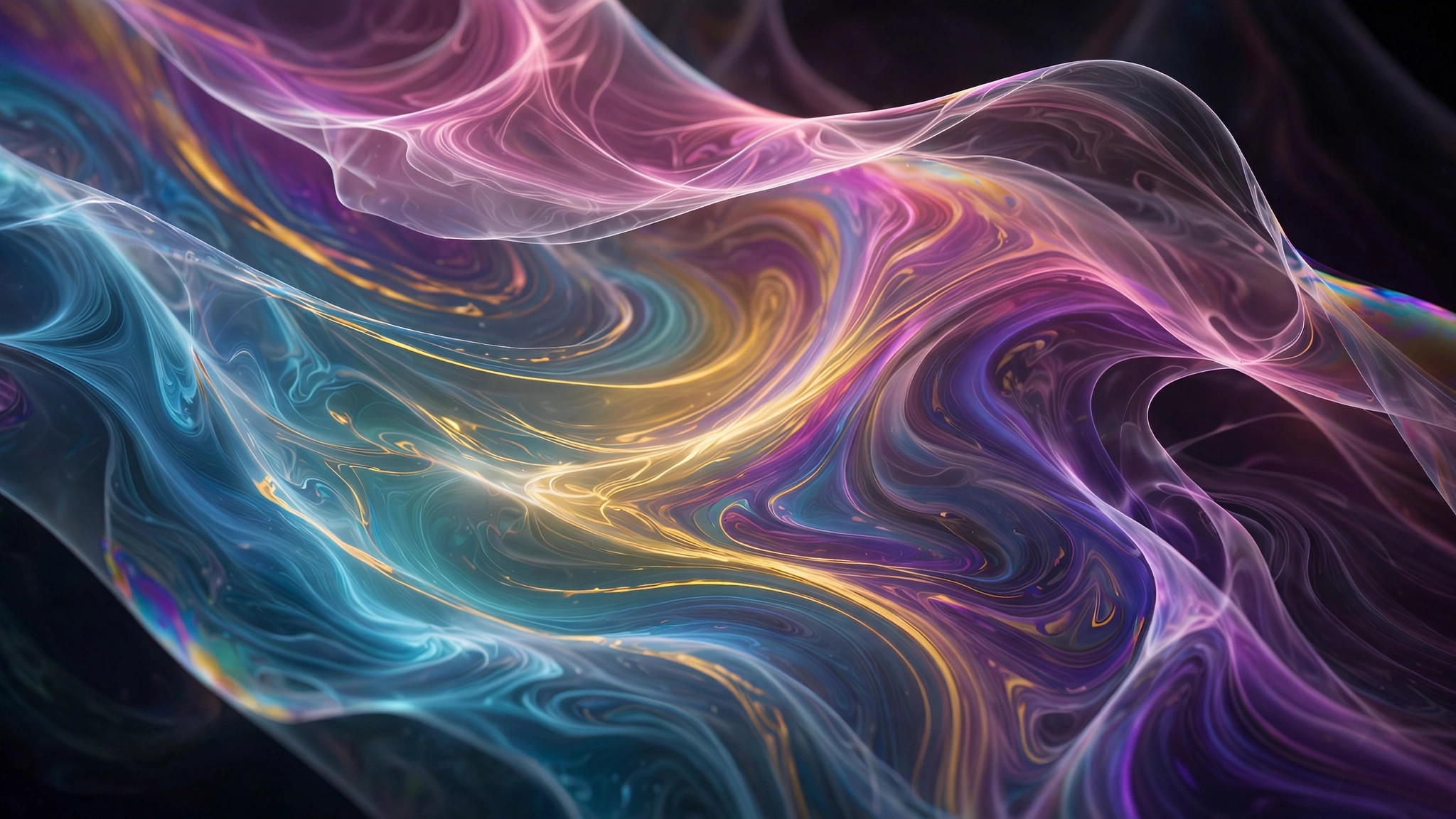
Blow a soap bubble and watch what happens on its surface: colors swirl and shift, magenta bleeding into cyan and gold dissolving into violet, the whole sphere wrapped in a rainbow that was never painted on. That rainbow is thin-film interference, and soap film wallpapers exist to answer a simple question — how can something so fragile become a lasting background for the screens people look at every day? Anyone who loves iridescent color, from casual phone users to abstract art collectors, finds the answer here, in photographs that preserve a phenomenon that lasts only seconds. The how matters as much as the beauty, because the colors are not decoration but physics made visible.
On screen, soap film has an unmistakable signature: oily, shifting rainbows on dark grounds, with colors that seem to float above the surface rather than sit on it. It is iridescence in its purest form, not the applied shimmer of holographic foils but a real optical phenomenon with all its fluid unpredictability. Where frozen, permanent subjects hold still for the camera, soap film does the opposite, offering beauty that exists briefly and survives only in the photograph.
Physics You Can See
The colors of a soap film encode its thickness with extraordinary precision. Where the film is thickest, you see silvers and whites, with all wavelengths reflecting together. As it thins, colors separate, yellows and reds first, then the full spectral play of greens, blues, and magentas. Just before the film pops, it goes black, thinner than a quarter wavelength of light, with the reflections canceling completely.
A single soap film photograph is therefore a topographic map of thinness, with every hue acting as a measurement. Readers who want the underlying optics explained in full can explore thin-film interference in more detail, but the wallpaper itself already tells the story at a glance. The transitions follow real gradients of thickness, which means they flow with a logic the eye unconsciously recognizes, even if the mind does not know the physics.
This physical honesty gives soap film images a quality that digital iridescence rarely matches. Digital artists can imitate the palette, but the authentic flow patterns, the way colors pool and stream across a real film, have a complexity that procedural generation struggles to fake.
Capturing the Uncapturable
Photographing soap films is an exercise in patience and speed. The films last seconds to minutes, evolving constantly, with colors flowing as the film drains and patterns shifting with air currents. Photographers work with wire frames dipped in solution, black backgrounds, and careful lighting, shooting rapidly to catch the film at its most expressive. The keeper rate is low, but the results, when they come, are unrepeatable, and no two soap film photographs have ever been alike.
Macro bubble photography stays close to the phenomenon, showing whole bubbles or film spans with the iridescence in full flow and backgrounds kept dark to let the colors sing. These images have a jewel-like quality, the film’s surface reading as precious, opalescent, and alive. They work beautifully as wallpapers because the dark grounds are naturally icon-friendly while the iridescent regions provide the visual interest.
Abstracted film art pushes further from documentation. Extreme close-ups turn the film’s surface into pure color fields, with the bubble’s curvature invisible and the interference patterns becoming landscapes of hue. Digital interpretations go further still, using the soap-film palette and flow logic as inspiration for fully synthetic compositions that lose physical authenticity but gain compositional control, so the artist can place the iridescence exactly where the design needs it. For a broader look at flowing color handled as design, see this Abstract Fluid Rainbow Texture: Design Guide.
The soap film family itself has three main branches, each with its own aesthetic:
- Free-floating bubbles offer the full sphere, with iridescence wrapped in three dimensions and highlights arcing across the curve.
- Flat films on wire frames provide the purest interference patterns, unperturbed by curvature, with colors flowing in two-dimensional rivers.
- Foam, in clusters of bubbles, creates cellular iridescence, each cell its own tiny rainbow and the whole reading as organic tessellation.
Wallpaper artists draw on all three branches, and the best collections mix them for variety, keeping the physics constant while the compositions stay fresh.
Color Logic of Interference
Understanding the color progression helps in choosing and appreciating these wallpapers. The classic sequence — silver-white through yellow, red, violet, blue, and green, then repeating in more saturated bands — appears in every authentic film image. Designs that honor this progression feel right, while ones that scramble it feel off, even to viewers who cannot articulate why. It is a subtle authenticity test that rewards a careful eye.
Background choice is critical. Black grounds make the interference colors luminous, the film glowing against the void. Dark colored grounds, such as deep blue and charcoal violet, add atmosphere while preserving luminosity. Light grounds, though rarer, create a completely different mood, the film as delicate watercolor, subtle and airy, a gentleness that also appears in softer fluid work like Abstract Fluid Beige Art: Trends & Styling Ideas.
The dark treatments dominate wallpaper use for good reason, since they maximize both the beauty of the physics and the practicality of the screen. A dark ground lets a relatively small area of iridescence carry the whole design without overwhelming the interface around it.
Pairing Iridescence With the Interface
Soap film’s dark grounds and concentrated color regions make it a cooperative wallpaper. The iridescence typically occupies only a portion of the frame — a bubble here, a film span there — leaving dark calm for icons and text. When choosing, look for this balance: enough film to fascinate, enough darkness to function. The most usable soap film wallpapers are really dark wallpapers with iridescent accents, the rainbow as jewelry on a black dress.
Photographers especially prize the moments just before the end, when every soap film thins to black and then vanishes. In that black film stage, the surface goes dark and mysterious, often ringed by the last brilliant bands of color. These images have a special poignancy, beauty at its most fragile, captured at the edge of nothing. As wallpapers, they carry a quiet philosophical weight, the screen holding a moment that was always going to end, and saying it without a single word.
There is irony in making permanent wallpapers from impermanent subjects, since the soap film lasted seconds while the photograph lasts indefinitely and the wallpaper may outlive the photographer. This chain of preservation, from fleeting physics to lasting art, is part of what makes these images moving, because they do not just show beauty but rescue it. A soap film is only a few hundred nanometers thick, thinner than the wavelength of the light that reveals it, and that something so insubstantial can produce such extravagant beauty remains one of nature’s better jokes. Soap film wallpapers preserve the punchline, reminding us that the most spectacular colors are not applied or mixed but revealed, hidden in white light all along and waiting for a film thin enough to set them free.
Related posts:
Drawn to these shapes and colours? Ferrofluid Spike Wallpapers: Magnetic Liquid Patterns explores a nearby corner of the same abstract world.
Bookmark this set for the next time your screen needs a new mood.

