
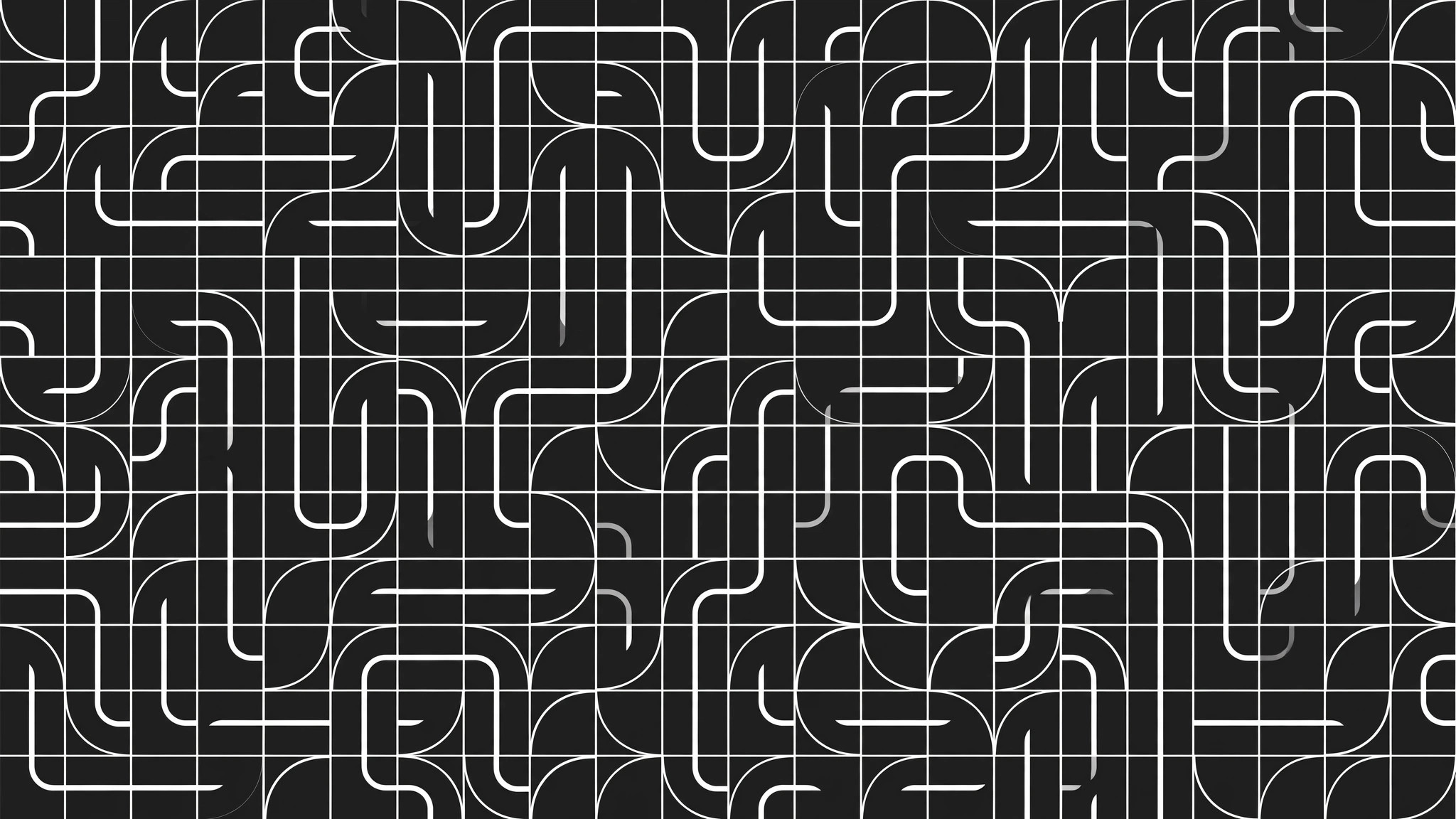
Truchet tile wallpapers answer a deceptively simple search: what can one square tile do when who rotates it, where it sits in a grid, when randomness or rules take over, why the connections emerge, and how artists scale and color the field are all allowed to vary. In 1704, French Dominican priest Sebastien Truchet published the modest observation behind the system, showing that a square divided diagonally into two contrasting triangles, rotated in a grid, produces mazes, loops, waves, and textures far richer than the humble origin suggests. Three centuries later, his tiles power generative art, game textures, and some of the most playfully intelligent wallpapers available, offering maximum beauty from minimum means as algorithmic pattern at its purest.
The magic is in the emergence, because no single tile is interesting on its own, yet hundreds placed together let the diagonals connect into flowing paths and the triangles merge into larger shapes. The grid dissolves into something that looks designed, even when the arrangement began with chance. That clever pleasure, watching simplicity outsmart itself, links these designs to the broader appeal traced in a geometric yellow abstract texture design guide, where repetition is used to build rhythm and surprise.
One Tile, Infinite Personalities
The classic tile is almost insultingly simple, a square that is half black and half white and split on the diagonal, with four rotations, one grid, and endless variation. The concept generalizes beautifully, however, and different tile families produce very different temperaments. Choosing the tile is therefore the foundational decision of the whole design.
Truchet’s own follow-up work used tiles with quarter-circles, producing the famous maze patterns where arcs connect into wandering paths. Modern generative artists use tiles with triangles, arcs, dots, and lines, so each tile type becomes a different instrument and the grid becomes a different orchestra. The account of Truchet tiles shows why such a small unit supports so many later variations.
What makes these tilings special among patterns is their relationship with randomness, since a purely random arrangement produces organic, maze-like textures that are different every time and never repeat. Rule-based arrangements produce structured designs instead, with all tiles aligned for bold diagonal stripes, alternating rotations for checkerboard rhythms, or wave functions for undulating fields. The same tile set spans the full spectrum from chaos to order, and the artist chooses where on that spectrum to land.
Several tile families recur because each one steers the finished wallpaper toward a distinct mood:
- Quarter-circle Smith tiles, with two arcs connecting edge-midpoints to create friendly labyrinth paths
- Classic diagonal triangle tiles, which produce bold and graphic diagonal energy
- Dot variants, which build pointillist fields across the grid
- Line variants, which create woven textures from repeated connections
The quarter-circle tile, often called the Smith tile after its popularizer, deserves special mention because its curves soften the grid and invite the eye to wander. Triangle-based tiles go more graphic, while dot and line variants feel more textile-like or woven.
Generative Soul, Handmade Feel
There is a paradox at the heart of Truchet wallpapers, because they are among the most algorithmic patterns in existence yet they feel handmade. The reason is local variation, since no two regions of a random field look alike, which reads as craft rather than computation. It is the same quality that makes hand-drawn crosshatching feel warm, as the eye detects non-uniformity and interprets it as human touch even when a random number generator produced it.
Contemporary artists enhance that feeling by layering, placing a Truchet field under a soft gradient so the pattern shows through like texture under paint. Other designs overlap multiple layers at different scales, creating interference effects, or color each tile by its rotation so the hidden logic becomes visible. These treatments keep the Truchet soul while giving each wallpaper its own personality, a balance that also suits the calmer geometry discussed in a cubism teal abstract background design guide.
Truchet patterns also have a double life in quilt designs, tile floors, and textile prints, crafts that discovered the same richness centuries apart. That cross-medium history gives the wallpapers a grounded quality unusual in generative art, because the patterns feel at home on a screen after proving themselves in thread and clay.
Composing the Grid
Scale is everything in Truchet design, because large tiles make each unit a visible actor, with bold, graphic pattern and readable individual rotations. That scale suits maze-like arc tiles beautifully, since you can follow the paths, trace the loops, and get lost in the best way. Small tiles dissolve into texture instead, and the pattern becomes fabric, still Truchet underneath but experienced as atmosphere rather than puzzle.
Color strategy follows scale, because bold, large-tile designs can handle strong palettes without fragmenting the composition. Fine, small-tile fields want restraint, such as monochrome, duotone, or subtle variations that let the texture speak.
Perhaps the deepest pleasure is the slow reveal, because at first glance the wallpaper is just a pleasant and textured pattern. Then you notice that it is all the same tile, and the entire complexity of mazes, waves, and textures comes from one square rotated four ways. That realization never quite gets old, since it is a small and repeatable wonder, and few wallpapers contain a built-in magic trick the way Truchet wallpapers do.
Truchet Beyond the Flat Grid
The concept refuses to stay two-dimensional, as artists have extruded the tiles into three dimensions to create blocky reliefs where the pattern gains physical depth. Others have animated the rotations, sending tiles flipping in waves across the grid like a mechanical ocean. Some have mapped Truchet logic onto spheres and toruses, wrapping the pattern around unusual topologies, and each extension proves the robustness of an idea still yielding discoveries three centuries after publication.
There is also a contemplative dimension that users report consistently, because tracing the paths with the eye, following a curve as it winds through the grid and finding where loops close, is genuinely calming. That visual meditation is not unlike following a labyrinth, and some wallpaper apps now offer interactive backgrounds where the pattern regenerates on each unlock. The phone becomes a small oracle dealing a new maze every time you look, turning pattern into a practice of attention rewarded.
In an era of maximalist design with more layers, more effects, and more everything, Truchet tiles are a reminder that complexity does not require complication. One tile, honestly deployed, can fill a screen with endless interest, so the system works as a design philosophy as much as a pattern. Start with almost nothing, arrange it with care, and let emergence do the heavy lifting, because the grid is humble while the result is anything but.
Related posts:

Abstract work rewards a second look — browse more of geometric-design when you are ready for a new backdrop.
Share this page with a fellow art lover looking for their next wallpaper.

