
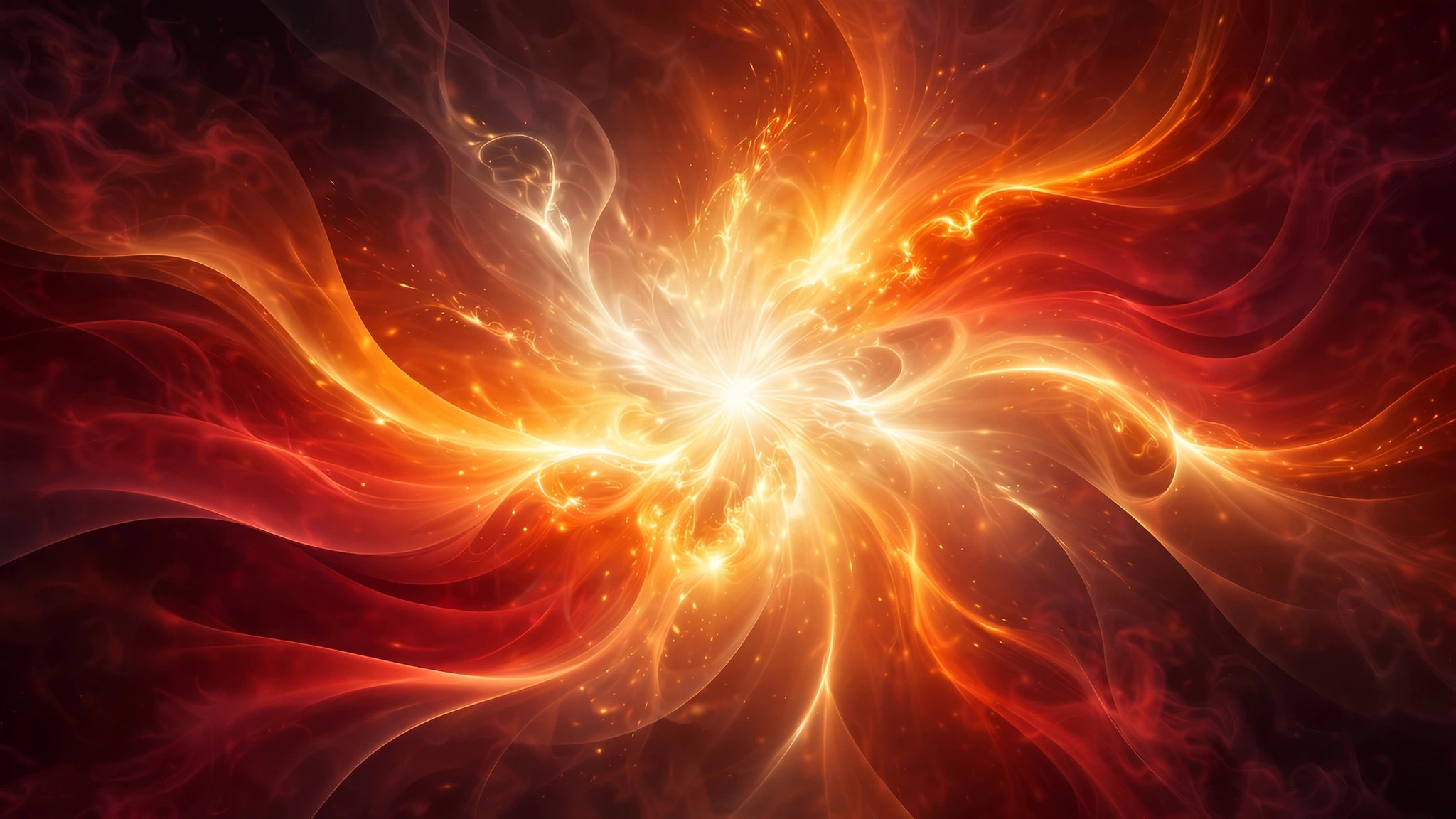
Every gradient has a direction, but a solar flare gradient has a source: a radiant core of near-white heat that pours outward through gold, orange, and crimson into deep maroon darkness. It is the visual equivalent of standing near a furnace with your eyes half closed — warmth you can see. As a wallpaper, it brings an almost physical energy to the screen, a background that seems to emit light rather than merely reflect it.
The solar flare style sits at the energetic extreme of the gradient family: where a gentle gradient might soothe with soft transitions, the solar flare ignites. The core demands attention; the falloff rewards it. It is a wallpaper for people who want their devices to feel alive — not calm, not neutral, but vividly, unapologetically awake.
Anatomy of Radiance
A convincing solar flare gradient is built in layers, and understanding them helps you choose well. At the center sits the core: the brightest point, often near-white with a golden cast, the source of all the energy. Around it spreads the corona — the active zone where color shifts rapidly from gold through orange to red, the most dynamic part of the composition. Beyond that lies the falloff, where crimson deepens into maroon and finally into near-black, giving the brightness somewhere to go.
The ratio between these zones defines the wallpaper’s personality. A large core with a short falloff is explosive — a flash, a burst, maximum drama. A small core with a long, gradual falloff is more like a sunrise: still warm, but contemplative. Neither is better; they are different times of day for your screen, and the best flare wallpapers are deliberate about theirs.
Real vs. Stylized Flares
Some solar flare wallpapers aim for realism — roiling plasma textures, filament details, the turbulent surface of an actual solar flare. These are spectacular and scientifically evocative, but they can be visually busy. Stylized flares, which smooth the plasma into pure color flow, are calmer and more versatile.
Realism impresses; stylization endures. For a daily driver, the smooth stylized flare usually wins.
The Energy Question
Let us be honest: a solar flare wallpaper is not relaxing. It is stimulating — warm colors advance toward the viewer, high contrast demands attention, and the radiant core is a perpetual focal point. This is a feature, not a bug, but it means placement matters.
When Flares Work
Morning routines, creative sprints, workout playlists, social devices — anywhere you want energy, a solar flare delivers it. The warmth is genuinely mood-lifting on grey days; there is a reason sun imagery appears in so much motivational design. A flare wallpaper on a phone you check first thing in the morning is like a visual espresso shot.
Taming the Heat
For work desktops, consider flares with the core positioned off-center — upper corner, say — so the brightest zone sits behind rarely-used screen real estate while your central workspace enjoys the calmer falloff. Alternatively, choose a “distant sun” composition: a smaller radiant disc in a larger dark field, all the warmth with a fraction of the intensity.
In short, the flare rewards a little strategy:
- Core off-center — brightness parked behind rarely used screen space.
- Distant sun — a smaller radiant disc in a larger dark field.
- Energy where it belongs — mornings, workouts, and creative sprints rather than deep-focus hours.
Color Variations on Fire
The classic flare runs gold-orange-crimson, but designers have explored the full thermal spectrum.
White-Gold Flares
The most luminous: cores of near-white radiating into champagne and pale gold, with minimal red. These feel like noon sun — clean, powerful, optimistic. They are the brightest flare wallpapers and the most demanding; use them where you want maximum light, like a dark room that needs visual warmth.
Ember Flares
Deeper and moodier: cores of orange-red sinking into burgundy and black. Ember flares feel like firelight — intimate, primal, evening-toned. They are the most wearable flare wallpapers, warm without being blinding, and they pair beautifully with dark-mode interfaces where the deep falloff can go truly black.
Unusual Flares
Adventurous designers have built flares in unexpected palettes: violet cores bleeding into magenta (a “nebula flare”), teal centers with gold coronas (an “aurora flare”). These are less about realism and more about the pure visual grammar of radiance — a bright source, a color journey, a dark destination. Teal-and-gold flares sit surprisingly close to the flows in aurora gradient wallpapers, while iridescent palettes drift toward holographic gradient designs.
Styling Radiance
On desktops, let the flare breathe: the composition needs dark space around the core to sell the glow. Crowded, edge-to-edge brightness reads as flat; brightness against darkness reads as light. On phones, a centered core behind the clock creates a stunning lock screen — time displayed over the face of a star.
For OLED screens, flare wallpapers are a showcase: the true blacks of the falloff make the core appear to float above the glass. And for shared or presentation screens, a subtle flare adds warmth to video calls without the distraction of busier abstract styles.
The Sun’s Moods
The sun has weather: the eleven-year cycle, the sunspots blooming and fading, the solar maximum’s restless flares and the minimum’s calm. The coronal mass ejections — billion-ton plasma clouds hurled into space — are the sun’s storms: when aimed at earth, they paint the auroras, disrupt the satellites, and remind us the star is alive. The solar-flare wallpaper holds one of those moods: the radiant core, the star’s temper, beautiful at safe distance.
The sunspots are the visible moods: cooler regions where magnetic fields tangle, the dark freckles on the brilliant face, each larger than the earth. Galileo’s sketches of them got him in trouble; modern telescopes watch them constantly. They’re the star’s expression — the face, changing, the moods written in magnetism.
Keep the solar gradient as that kept mood: the flare’s radiance, the core’s warmth, the star’s temper tamed to background. Your screen carries its little sun steadily — the moods implied, the warmth constant.
Carrying a Little Sun
There is something quietly profound about carrying a star in your pocket. A solar flare wallpaper is a reminder — abstract, beautiful, and always on — that energy is the default state of the universe. On the greyest day, in the dullest meeting, your screen holds a small, well-designed sun.
Use that power thoughtfully: let the flare energize your mornings and warm your evenings, and when you need true calm, keep a cooler wallpaper one swipe away. The sun is wonderful, but even the sun sets — your wallpaper rotation can honor that rhythm too.
Related posts:


If this set speaks to you, Rose Gold Foil Gradient Wallpapers: Metallic Pink Blends Explained continues the abstract-gradient conversation in a new direction.
Bookmark this set for the next time your screen needs a new mood.

